The secrets of the La Plata bar and of Pepe, the most loyal waiter in Barcelona
The historic bar of the Gothic celebrates 81 years in full form thanks in part to the charisma of who attends for more than half a century equally locals and tourists

-
CAT -
CAST
BarcelonaOn October 12, 1972, a 15-year-old kid with very bright eyes entered the La Plata bar to ask for a job. Half a century later, Pepe is still behind the bar of this place in the Gothic Quarter, where everyone knows him. "The more I give, the more I have," he lets slip. He learned the phrase from Pepito, the founder of the tavern. "Better to do four things well than to do many things poorly," he adds. The phrase isn't his either; it was always said by Quimeta, Pepito's wife. The couple who opened this bar on October 31, 1945.
Now that he is 70 years old, José Gómez Bernal, or Pepe, wakes up at six in the morning. By nine o'clock, he is already at La Plata working. "Retire? I don't know what you're talking about. I'm in shape. I've never drunk or smoked, which is rare for a waiter," he says with a laugh. The shutter has not yet been opened, and now the person who brings the wine arrives, now the one who brings the fish. Everyone jokes with Pepe. Born in Alhaurin de la Torre (Málaga), he arrived in Barcelona when he was a child aboard El Sevillano, that train which brought so many Andalusians to Catalonia. "We lived at 50 Ample Street. A friend told my mother that they were looking for a boy to wash dishes. At home, we had no money and we needed to work. So they put me to washing dishes. But I like people, and whenever I could, I would run out to serve the customers. And immediately, they put me to work as a waiter," he recalls.

After 54 years of working, Pepe can tell stories for hours about a bar that has just celebrated 81 years of life, having become a small miracle. In a city where many establishments have prioritized the tourist while mistreating the local client, at La Plata "everyone is looked after. But what moves us is the people who return. When someone arrives and shows us photos of when they used to come with their parents decades ago, it is very beautiful," he defends. "Wait, I'll make room for you," he says when he sees a familiar face enter. And he keeps his word. And he knows thousands of faces, with his photographic memory. "Not all of them," he justifies himself when you remind him of one of his funniest anecdotes. Once he had two gentlemen at the bar wearing sunglasses who were speaking English. They paid, satisfied, and left. "Pepe, didn't you see who that was? It was Bono!", a client told him. He had served fried fish to the singer of the Irish band U2. Pepe replied: "That wasn't Bono, he wasn't his age!". He thought they were referring to the former socialist minister José Bono.
The Barcelona bar
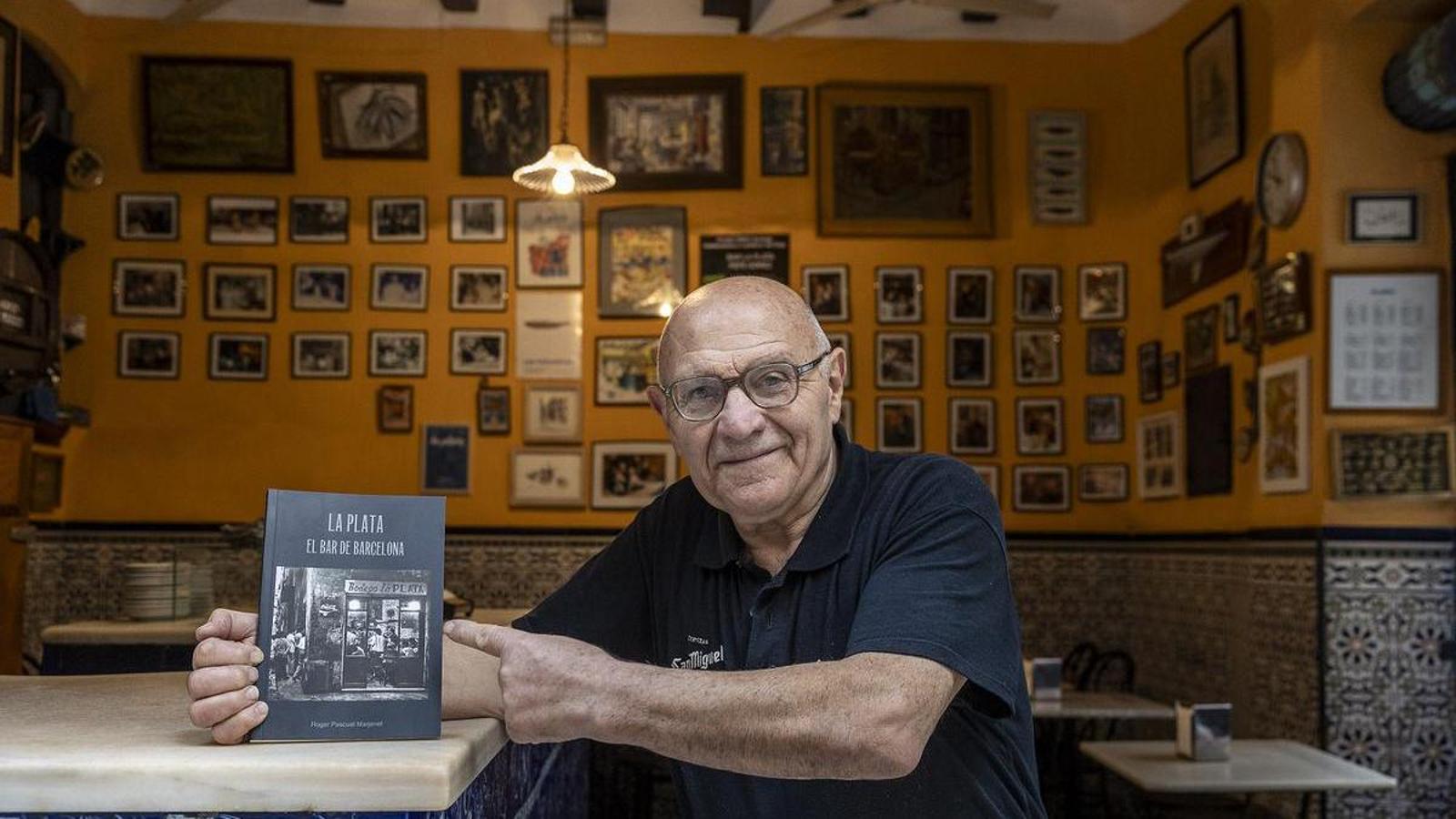
Anecdotes also told by Roger Pascual, a journalist and grandson of Pepito and Quimeta, who has just published a beautiful book about the history of the establishment, which he has titled El bar de Barcelona. And he is not wrong. You cannot understand the city without places like these that have spent "decades doing the same thing," as if it were an act of rebellion in a city invaded by tourist menus and Anglicisms. "We have gone through complicated moments, like the pandemic. As soon as I could leave the house, I came to sell small fish in paper cones. They would sell out. But I didn't experience the hard times. And that was the first one," he defends. When La Plata opened in 1945, Pepito and Quimeta slept in a tiny loft right above, where they couldn't even stand up because of how small it was. They were years of misery, ration cards and black market trading.

Pepito was a boy from Malla who, at 9 years old, herded cows in Osona and ended up looking for work as a waiter in Barcelona. He did his military service in 1934 in Calella de Mar and it was there that he met Quimeta. When Pepito left for the war to defend the Republic, she waited for him, even though she barely recognized him when they were reunited. After suffering from cold and hunger in a prisoner-of-war camp in Castromonte, a town in Valladolid, he had lost 15 kilos. Pepito never talked to his wife about everything he experienced there. He kept it all inside. They married in 1940 at the church of Sant Jaume on Carrer Ferran and celebrated it at Can Soteras, a popular restaurant on Passeig Sant Joan where Pepito had worked. A place that no longer exists. Later, he was a waiter at Can Tapies, right by Plaça Reial. Another place that no longer exists. It would be here that he would meet a Valencian couple, Pepe and Emilia, who went there every Sunday after dancing the tango. They were the ones who would lend them money to buy their own bar. They chose one that looked half-dead in one of the oldest buildings in the Gothic Quarter, at the corner of Carrer de la Mercè and Carrer La Plata. They paid 34,000 pesetas.
The first few years were very complicated. In 1947, Pepito was arrested because he had an illegal publication that was edited by listening to BBC news. He got out of the Model prison thanks to a military man who was a customer. Back then, they cooked whatever they could depending on what was found at the market. One day in 1952, Quimeta found small fish at La Boqueria and thought it would be a good idea. And it is still their signature dish today. "Some days we managed to fry 150 kilos of fish," says Pepe. Many Barcelona residents still know the bar as "the one with the small fish." Pepito and Quimeta did not rest until 1960, when they started closing on Sundays. They decided that every Sunday they would have lunch at the 7 Portes, where a waiter, Fortuny, had done his military service with Pepito.
And little by little, things improved. New places started opening up in a neighborhood full of life. "Do you know what this was like in the 70s? People were constantly carrying porrons up and down. You couldn't walk because of all the people on the street. I would take newspaper, put it on the hoods of parked cars, and serve fish there to those who couldn't get in," says Pepe, getting emotional. Nearby was Las Campanas, where the Navarrese owner had a parrot at the door. A place that has also closed, like so many others where young students did what was known as the "elephant route," since you could see many trunks there. "Back then, you had the Port here, the França station, the Tax Office, the Post Office... The neighborhood was full of people working or living. And everyone passed through here," says Pepe. These were years of changes and revolutions. One of the daughters, Anna, known as the Nineta, became a hippie and crossed paths with a very smart young man who used to buy churros for her at El Trebol, in Gràcia. It was Salvador Puig Antich. Nineta also remembers a young man who came from Turkey, where he had lived, with a suitcase full of bazaar shirts that he sold for pennies. His name was Isak Andic.

The Nineta would end up helping the parents behind the counter of a place where the legendary Bernardo used to come from La Barceloneta to play his guitar. The members of Los Manolos also passed through the bar, as Anna went out with a painter who had a brother in the group. A painter who made the sign that is still on the street today. "The sign stayed and the painter left," said the Nineta. Subsequently, many musicians have come to La Plata, such as Manolo García, the Australian Tame Impala or Pau Donés, who would change the lyrics of The Skinny One saying "For a little fish from La Plata, I would give anything".
"The more I give, the more I have"
With the arrival of democracy in La Plata, the neighbors who left mass would have a vermouth next to Ocaña, "the passion flower of the pansies”, as one of the city’s first LGTBIQ activists defined it. Comic book artists would come, such as the creator of Makoki, Miguel Gallardo, or the Portuguese painter Carlos Pinela, author of the portrait of Pepito that still presides over the bar. One of the most remembered days would be when, in 1975, a yellow Ferrari parked at the door and Hugo Sotil, the Peruvian Barça player, got out.
But Barcelona would change a lot after 1992. "The neighborhood went to hell," Pepe says ironically. Furthermore, in 1994 Pepito died. The man who had thrown coins out the window to celebrate the birth of his children and who always used to say that "the more I give, the more I have." His funeral brought together people of all kinds. They say that the person who cried the most was a beggar. "He was very generous. A customer would come who didn't have money to pay for wine or to go to Mataró... and Pepito would lend him 100 pesetas. He had a nail where he hung papers with the names of those who had debts that we christened as The Valley of the Fallen. I learned a lot from him and have tried to do the same. If someone doesn't pay, maybe you lose a client. But if they come back, they will always be grateful, you build loyalty, and when they return, they do a second round", argues Pepe.
Quimeta and Anna took charge of the bar, preventing its closure when the city council demanded renovations in the kitchen. They did it with the help of Pepe, who was already a grown man and had married a customer he had fallen in love with, naturally, in La Plata. Together, they managed to maintain the magic of a bar where the formula is the same as always: there is no menu. You have four options: the fried fish, a tomato salad, anchovies, and the sausage, which Quimeta added in the 90s because "there is nothing more Catalan." Some tourists leave disappointed when they discover there is no paella or patatas bravas. Those who know, stay. Brothers Ferran and Albert Adrià come here from time to time. And the famous American chef and food critic Anthony Bourdain hugged Pepe, moved by the quality of the product. La Plata remains in good shape, welcoming regular customers, tourists with good taste, and occasionally, celebrities. But what makes Pepe happiest is seeing familiar faces return. "Wait, I'll make space for you right away," he says. And in a few minutes, you have a plate of fried fish in front of you.

