Alba Riera: “I remember telling my parents: 'Stop taking me to demonstrations. I want to go to Disneyland!'”
Communicator

-
CAT -
CAST

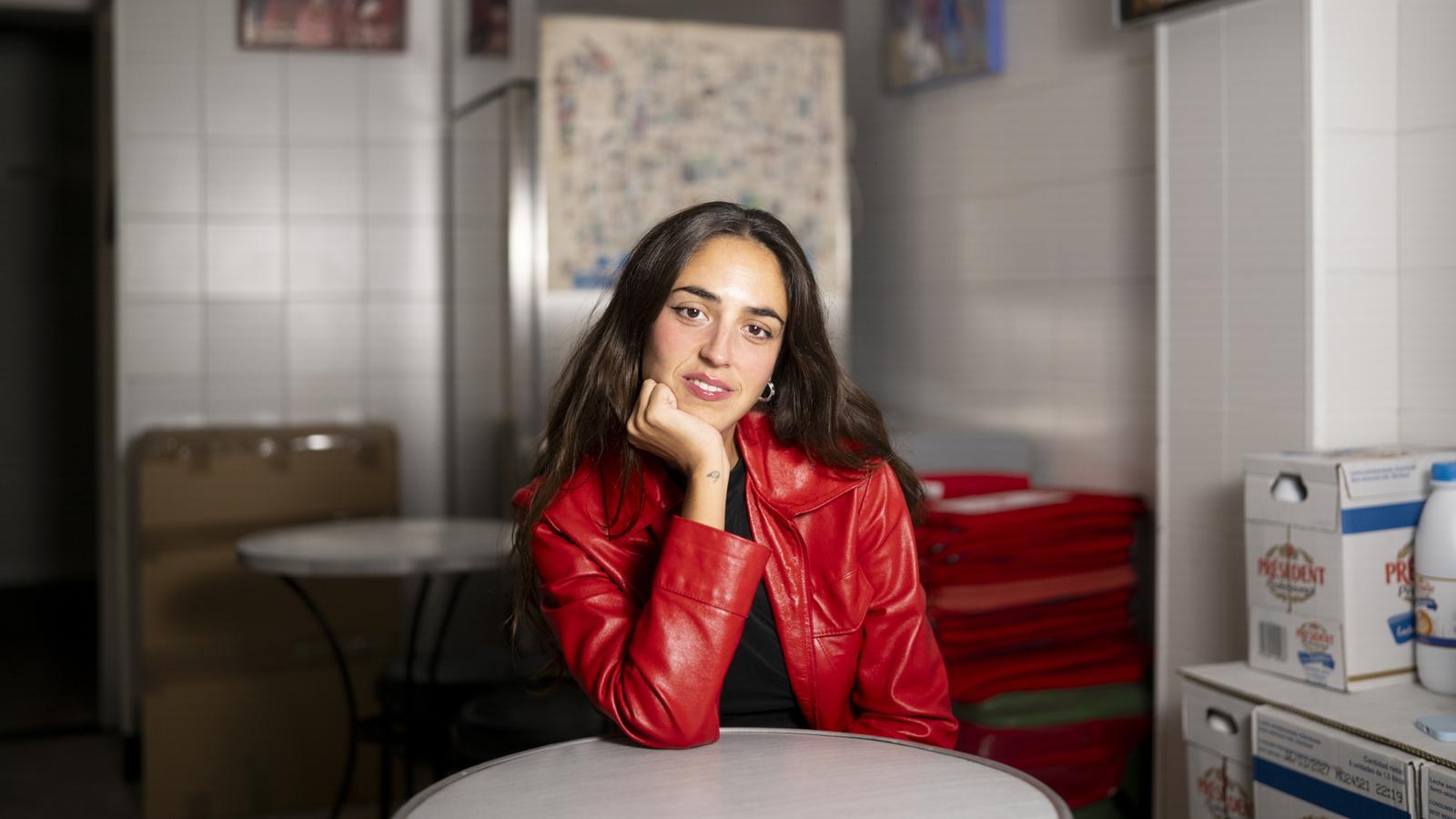
Indeed, it is not her in the WhatsApp photo, but Jennifer Aniston, the Rachel from Friends, with a characteristic gesture of hers, half princess, half grumpy. Alba Riera is such a fan of the series that, at Christmas, the family plays a Trivial game about the legendary sitcom that they handmade years ago. The former presenter of La turra set this image as her profile picture one day, a while ago; everyone told her it was literally her, and it has stayed that way ever since.
“It’s the show of my dreams.” You said that about La turra a year ago. What happened to make you leave it?
— Life has its cycles and this one had to come to an end. It is like love affairs: better to leave them at their peak, when not everything is worn out yet, because that way you can always romanticize them. And then there was the issue of age. EVA is a channel for young people and, in the end, every year I was a year older: it didn't wash anymore. I felt like a fraud of youth! But, in the end, La turra was about a perspective and a way of doing things that I will take with me wherever I go.
You are from 1991: young enough!
— The thing is I hate having birthdays, ever since I was a little girl: when I turned 30, I asked them not to put the candle with the number on the cake anymore.
Does it feel strange to think that someone else will present it?
— It feels as strange as it is beautiful.
Who has given you the most lectures?
— Myself! Oh, my internal dialogues... In general, I am very quiet. I have been learning that perhaps I don't have that many things to say either. But internally I am always fighting with myself and having great debates about any small topic.
What will your new dream program be like?
— It is still an unsigned project, but there are several things I would like to try. This phase is the most stimulating because, going back to the thing about crushes, you feel that everything is possible and it is a blank page. Of course, then reality arrives and you have to lower your expectations. But we need programs that stimulate critical thinking and that bring the conversations that are on the street to the table. With La turra I have learned that young people do want to talk about politics.
I don't know if this critical thinking has anything to do with being the daughter of former CUP deputy Carles Riera.
— It has influenced me, yes. Besides, I am the older sister and I very much had that father-daughter infatuation that people talk about. Keep in mind that my mother died when I was 14 and I was a nerdy girl and I liked to study; I had a great need for my father to recognize if I had done things well, and I didn't want to disappoint him. And, of course, since I was little I have gone to demonstrations, talks...
Indoctrination!
— I remember telling my parents: “Stop taking me to demonstrations. I want to go to Disneyland Paris and be a normal girl!”. Now I appreciate it, of course. And, in any case, I managed to get them to take me to Disneyland. (She smiles).
Did your mother have time to influence you as a communicator?
— Oh, definitely...! Besides being a speech therapist, she loved letters and was a literature teacher. She was emotionally gifted; she loved to listen. She would spend hours talking on the phone with her friends, and when I was little, I would secretly pick up the other phone in the house to listen in. Of course, I found out about things that, given my age, I shouldn't have known!
But you started by studying psychology...
— I was very clear that I wanted to be a presenter... until it was time to choose a degree. My mother had recently passed away and I know it is a cliché that people sign up for psychology because they need to fix their heads, but in my case it was true, I'm sorry! I was very sad and I lost my way. After four or five years of deep grief, I returned to find my center and to train in communication.
What have you learned, after so many interviews?
— That there are no incorrect questions, if they are honest. That you can conduct an interview with tense questions and, at the same time, have it be a comfortable conversation, if the other person opens up. What happens is that now, with reels on Instagram, I notice that people are more afraid to open up. Reels make that conversation reach more people, but people get tense. Before Instagram reels there were richer conversations.
The rant was broadcast on EVA. Is this space a good idea to reach young audiences or an Indian reservation to keep them distracted?
— It is true that at the beginning EVA perhaps took for granted that young people were only interested in a type of soft content. Well, everyone here knew what young people thought... without asking the young people themselves. And, on the other hand, it has been shown that they were also very eager for content that generates critical thinking, apart from entertainment. There has been a change of direction.
Do you feel like an influencer? In the end, for example, you have 28,000 followers on Instagram which is a visual network.
— It is different to be influential than an influencer, right? Perhaps I am a little influential, since the program has worked, to a certain extent. But I do not feel like an influencer because I do not base most of my work or my income on selling things. Now, if one day I did not have money to pay for my food, perhaps I would fall back on my image, which I understand must have some value on the network.
You spoke earlier about perspective: is it at odds with the neutrality expected of a public media outlet?
— You must be neutral, but the intention when doing things is inseparable from one's outlook and ideology. What do I do? Tear out my brain? My perspective is this, and it stays with me.
What red lines do you set for yourself?
— Listening only to people who reinforce your opinions makes us mentally lazier. Now, I admit that I am not so clear on what red lines should be drawn with the far right. I want to understand why these ideas seduce them and I would like them to have someone on the other side explaining to them why they are an atrocity. At the same time, I find that a debate can be dangerous if someone feels seduced by ideas like these. I still haven't figured it out, for the new project.
The other major issue for young people—and not so young people—is housing.
— It is the issue. It was quite foreseeable that we would end up where we are now. For some time, it had been difficult to get people to take to the streets, to rise up. We were coming from the post-Procés era, from a certain feeling of exhaustion and hopelessness. Housing, at least, is functioning as a struggle that is reigniting people. And it is normal: if you have nowhere to fall dead, you have no mental space to think about anything else. And that is depriving people of life.
You were talking about the post-Process. Why is the independence movement not taking advantage of this popular revival?
— I suppose the housing crisis has this emergency character, and the independence movement has been going on for so many years... that a bit more doesn't really matter. The independence cause is more battered, yes, but the fight for Catalan is at a heated moment. Of course, it's hard for me to talk about this and the blanket criticism of pro-independence parties seems somewhat unfair to me: there are those doing good grassroots work on the street. But it is true that there are many people for whom the parties that would best represent them would be the left-wing pro-independence ones, because of everything they defend... but they haven't found out about it. And that is a problem.
