The illusion of selling a painting to someone who has fallen in love with it
The Jordi Barnadas, next to passeig de Gràcia, is one of the art galleries that still resist on Consell de Cent

-
CAT -
CAST
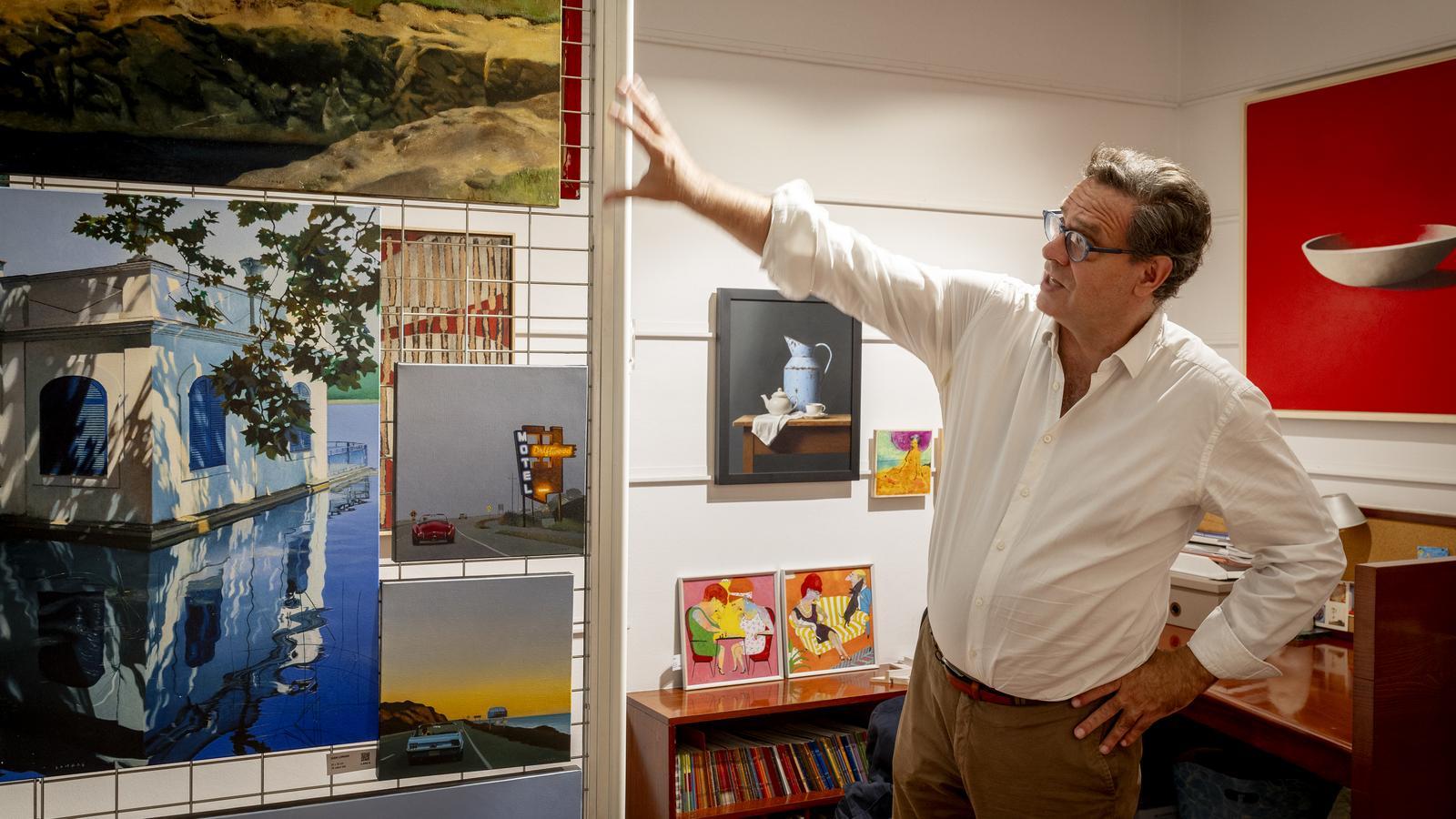
BarcelonaConsell de Cent street, especially in the section between Passeig de Gràcia and Balmes, has had a fabulous distinction for many years: art. It's no joke. And even today, this personality endures. A few art galleries still remain, Mayoral, Joan Gaspar, Toni Tàpies... Some historic ones closed, such as Prats, Dalmau, and René Metràs. We focus on Jordi Barnadas, right next to Passeig de Gràcia, a privileged location that has hosted it for forty years. Jordi speaks with enthusiasm about his profession, the trajectory of coherence he has always tried to maintain, and what the new times are like within the Barcelona gallery scene. He shows us paintings by some of the artists he keeps with affection in his permanent art collection.
Painters who have a relationship of trust and deep esteem with Barnadas: Olivares, Jordi Sàbat, Jaume Amigó, Pablo Maeso, Vall Karsunke, and the fabulous Sabala, with her unmistakable hallmark. "This is a very beautiful business, but you have to believe in it; you have to believe in the artists you exhibit, you have to connect with them. Otherwise, it is very difficult." From their extraordinary geographical location –the advantages of owning the premises– they have witnessed, like almost no one else has, the transformation of Barcelona over the last four decades, the post-Olympic city. For better or for worse.

The gallery was born in June 1992 as a poster and graphic work shop. Olympic Games posters were a good idea, already immersed in the tsunami of that summer. The engravings and lithographs—for two years—were the second step of the journey. Until reaching the third and definitive one, the original work. And where to look for the emerging artists that interested Jordi so much to bring them to his gallery? An unbeatable place has always been the Hipermercarts at Vinçon and American Prints. Young artists, with concerns, with their own world that matched Jordi's way of understanding art: “we have never been very fond of conceptual art, we prefer that to understand a painting you don't need an instruction manual”, he recounts. Art aimed at the middle classes, at affordable prices, for wide audiences and not necessarily art experts. And very important: that it would not be embarrassing to enter, walk around, show interest, and, if appropriate, buy.
The 2008 crisis was devastating, because since then it has not stopped crushing the middle classes. Even today, the general situation—with Trump's global command—affects how people are aware of art and approach it. “We are heading towards a business model where you need a lot of money to spend on art and I don't like that at all,” reflects Jordi. What makes him—and Silvia Vila, co-director of the gallery since almost the beginning—excited is that client who falls in love with a painting and whom you notice is making an effort to buy it.
At Barnadas they have managed to have many loyal clients, and also not depend on critics or subsidies: “They have always belittled us a little because we haven't liked conceptual art”. And he doesn't spare a critical gaze: “In Barcelona, the favor of tourism has been achieved, but not that tourism is an involved actor in the art and gallery circuit”. Only Gaudí exists. And the advantage they have, he admits, is that they have him two steps away. In fact, they are part of the Block of Discord —Casa Batlló, the Ametller and the Lleó Morera— and they have La Pedrera five minutes away. And this greatly favors a tourist public. He contemplates with regret that the relevant art market is in Madrid, with the important fairs and a higher level of the market. He shuns elitism and asks for more unity.
Now, the orientation that the market asks of them is, he reiterates, art understood as a luxury. But at Barnadas this does not convince them. They have a predilection for friendly art rather than combative, aggressive art, for that which too explicitly has connections with militancy —whatever it may be—: “Art that is too explicit in this sense tires me, I want people to search for and find their own ideas through figuration rather than abstraction”. The gallery, he admits, is Hopperesque, it connects a lot with the clear and transparent style of the wonderful Edward Hopper: the person, the city, the solitude, the everyday life, the colors... A warm, close, humanist gallery. Yes, humanist.
