A new wave of bomb threats affects around thirty planes in Europe
Barajas airport has received bomb threats on three planes but any risk has been ruled out

-
CAT -
CAST
BarcelonaReports about planes that have received bomb threats in Europe have been constant throughout this Thursday morning. According to the Reuters agency count, there have been at least 27 planes affected, in an episode that adds to the one already experienced on Tuesday. There have been alerts on planes that were flying and also on some that were on the runways of various airports. From low-cost carriers and also from flag airlines. All with different routes, but all within European territory. For now, there is no news that any of these warnings were a real threat. And no authority has dared to point out who may be behind it.
Bomb threats against planes are often communicated to airlines, airports, or authorities through anonymous emails or phone calls stating that there is an explosive device on board. The vast majority turn out to be false alarms, but all must be considered real until they are investigated, which forces the mobilization of resources to carry out the necessary inspections. Furthermore, they can force flights to be diverted and cause delays for passengers.
Most of the planes affected this Thursday have been able to land without problems at their destination, but some have had to make emergency landings at alternative airports. This is the case of an Aer Lingus plane that was on the route between Dublin and Rome that had to land at the Évreux airbase, about one hundred kilometers east of Paris, after receiving the warning while flying over French airspace. A WizzAir plane that was on the Milan-Warsaw route was also diverted and ended up making an emergency landing at Vienna airport.
At Madrid-Barajas airport, bomb warnings were received on three planes, but security forces have ruled out any risk, as reported by the police and Aena. The same happened at Copenhagen airport, where two planes that had landed there received threats that also turned out to be false.
On the other hand, three Ryanair planes heading to Bulgaria received warnings while they were flying, although the authorities have confirmed that no explosive devices were found. Two of them, which had departed from Madrid and Copenhagen, landed in Sofia at the scheduled time, but were diverted to remote areas, where passengers were evacuated and luggage and the plane were inspected. The other was a flight from London, which was diverted to Plovdiv airport, about 120 kilometers from the capital.
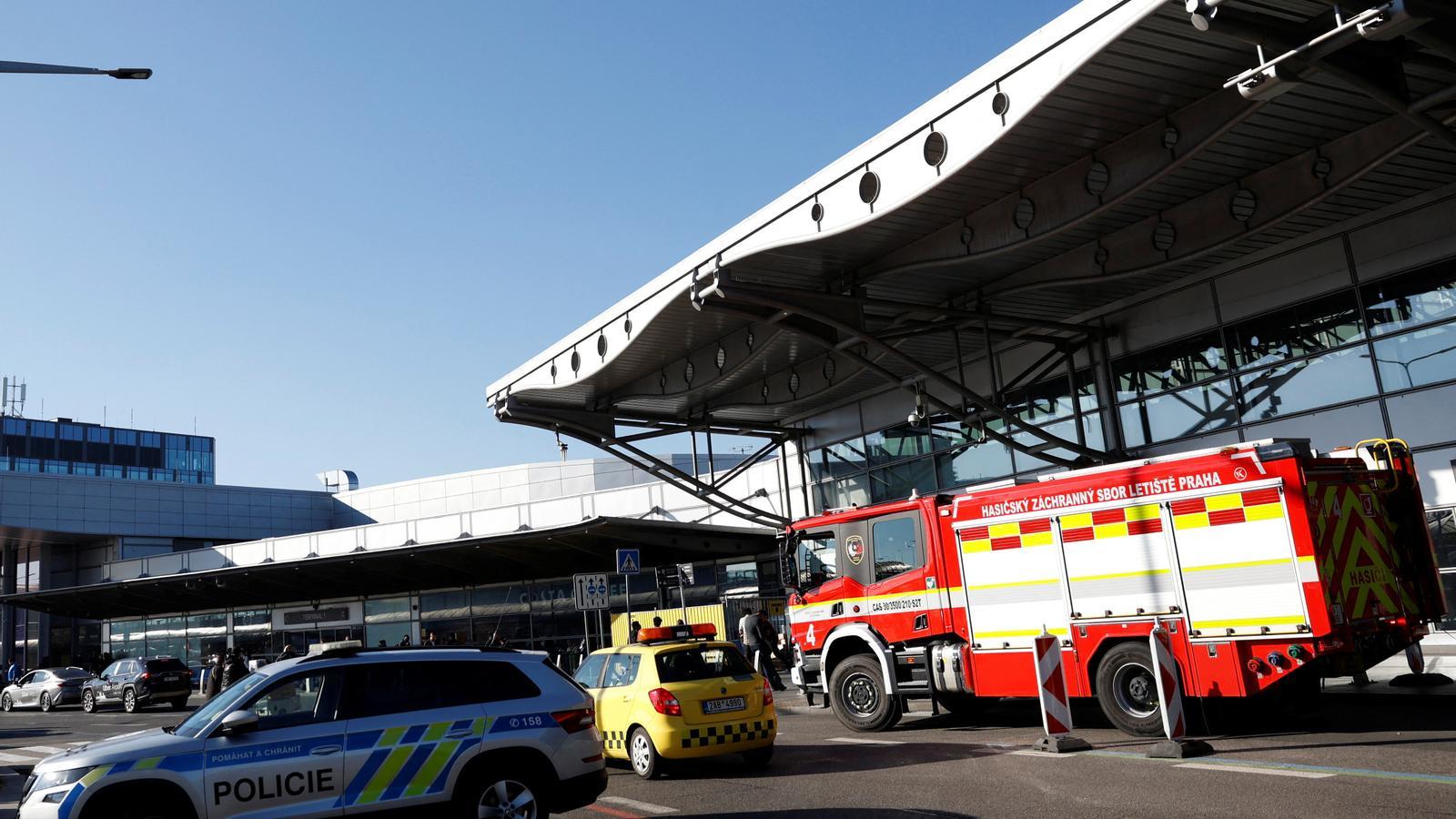
In the Czech Republic, four planes heading to Prague also received bomb threats, according to what the police reported on X, adding that the assessment of the threat level was low. Later they confirmed that, indeed, they were false alarms.
A warning on a Finnair plane flying the Helsinki-Rome route caused it to be escorted to Fiumicino airport, in the Italian capital, by Italian air force jets. An airline spokesperson confirmed that the plane had received a bomb threat, but that it had landed normally at its destination. Also in Italy, two planes bound for Milan received threats; one from Aegean Airlines from Thessaloniki and one from Ryanair that had departed from Porto.
Among the rest of the affected flights there is one from the Danish company Jettime, which was flying the Helsinki-Vienna route; one from the Polish airline LOT that was traveling between Warsaw and Brussels, and one from WizzAir that was going from Milan to Bucharest.
"Too early" to know who is behind it
All in all, a constant trickle of alerts throughout the morning that, despite ending up being false threats, manage to generate a sense of chaos in a multitude of different countries. These incidents take place after on Tuesday several flights in Europe also had to activate security protocols due to bomb alerts that ended up being false. The day before, an alert had also been activated on a flight traveling the route between Luton (in the south of England) and Sofia, which had to make an emergency landing in Budapest escorted by Hungarian fighter jets. What has happened today, however, is more concerning, due to the number of incidents and countries affected.
"Any threat against civilians is unacceptable," said the European Commissioner for Sustainable Transport and Tourism, Apostolos Tzitzikostas, in a post on X. He assured that the community institutions are closely following the situation and are in contact with the affected states and the European Union Aviation Safety Agency. He stated that "it is too early" to draw conclusions or determine if the incidents are linked. The commissioner said that state authorities are the ones with the responsibility to assess security threats, investigate the incidents, and implement appropriate measures, and he has asked them to cooperate with airport operators, airlines, and security forces.
For its part, the International Air Transport Association (IATA) has condemned these attempts to disrupt air transport and underscored that security measures "will continue to ensure the highest levels of public safety." "Safety is the industry's top priority and we take all threats seriously," said Nick Careen, vice president of security operations for the trade association for commercial aviation companies, who also urged authorities to "find the origins" of the false threats.
