Putin intensifies the hunt for Russian communists
The party leader, Gennady Zyuganov, maintains loyalty to the Kremlin, while his base revolts

-
CAT -
CAST
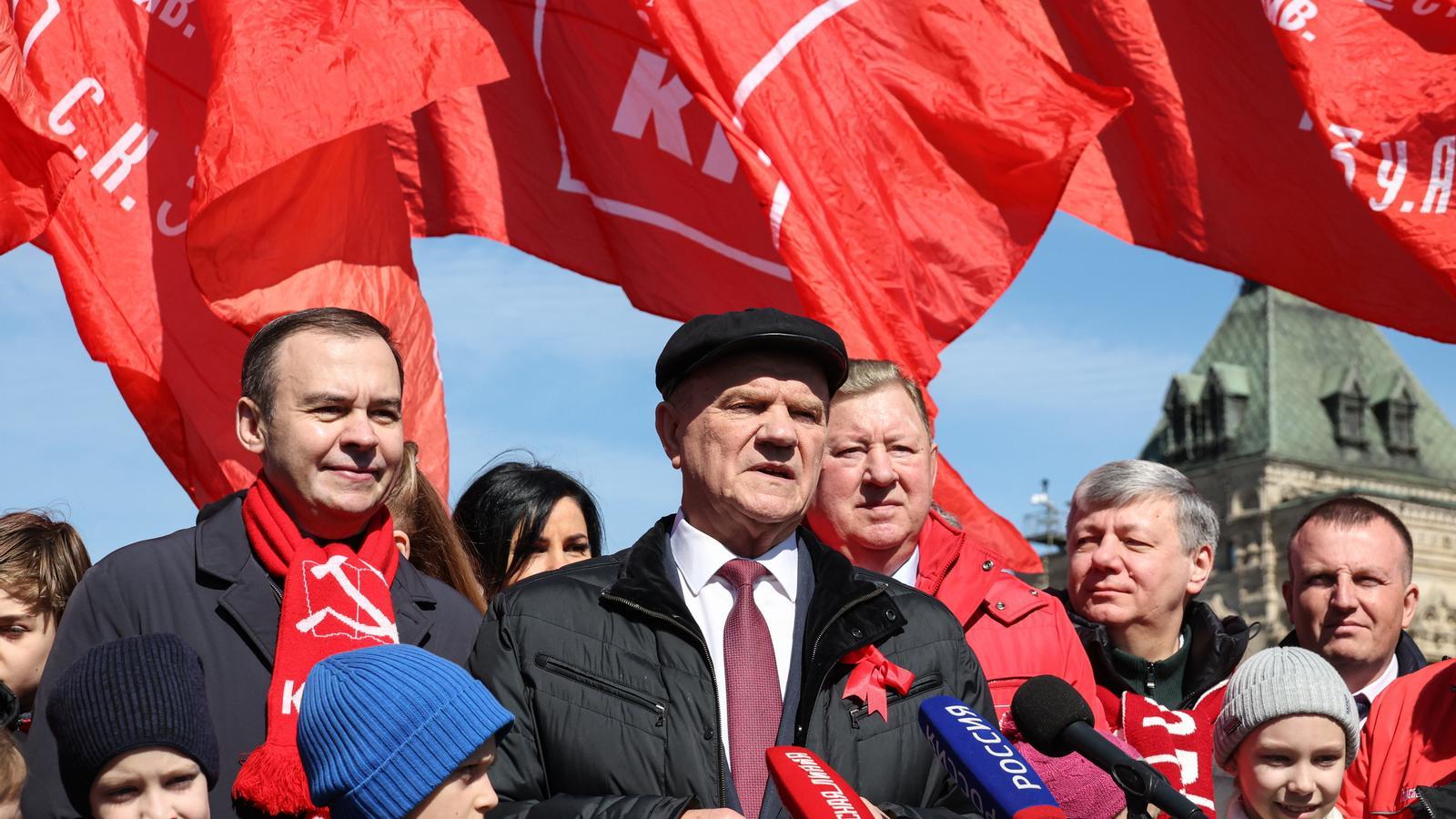
MoscowOn the 109th anniversary of the October Revolution, Russian communists are facing one of the most delicate moments in their history. The Kremlin has banned several of the party's commemorative events for this Saturday because they fear that the rallies will overflow and turn into protests against Vladimir Putin. This is what happened a month ago in Moscow, when a group of young activists took advantage of a demonstration by the old guard to shout “Down with the Tsar!” and there were about sixty arrests.
The Communist Party of the Russian Federation (CPRF), a group that since the fall of the Soviet Union has been the main opposition force in the country, has been fading into the background of Putin's political theater following the invasion of Ukraine, which its leadership welcomed with fervor. Despite this, the delicate economic situation and internet blocks have irritated its younger supporters, who link these problems to the war. The manipulation of the recent legislative elections and the persecution of some of its members has been the straw that broke the camel's back for many militants and regional leaders, who are eager for a change on an increasingly narrow playing field.
Its president, the historic Gennady Zyuganov, who has always navigated between loyalty to Putin and calculated protest, finds himself between a rock and a hard place: if he maintains complacency with the power and disavows the dissidents, he risks a divorce from his base. However, he also knows that if he is not able to control the militancy and it becomes a source of dissent within the system, he may lose the little room he still has to conduct politics and the survival of the party will be threatened.
“Historically, if you are a young person in a Russian provincial city and you want to engage in opposition politics, criticize United Russia and question the system, you have to join the Communist Party,” notes Ilya Budraitskis to ARA, a Russian historian and political analyst, expert on the post-Soviet left. From his point of view, in this context, Zyuganov's role has consisted of “playing by the rules of the system,” while trying to preserve the party as “a kind of safe space for these young people.” Now, however, he believes this balance “could be called into question.”
The police have arrested the heads of some regional branches who refused to recognize the “illegitimate” election results. In statements to this newspaper, former communist deputy Yevgeny Stupin does not see this trend as “a turning point,” but rather frames it within the “general tendency” of “systematically crushing the entire opposition space.” In contrast, Budraitskis does interpret it as a moment of rupture and predicts that we will see more imprisonments of young and popular figures in the party, such as Nikolai Bondarenko, who was already barred from the elections.
The historian believes that Zyuganov and his circle are “absolutely willing to betray their own militants” and that, therefore, they “will not offer any serious resistance” to this persecution. Going further, he points to the fact that, despite criticizing the fraud and the disqualifications of candidates, the CPRF has recognized the election results, “one of the necessary conditions for the party to be able to exist legally within the Russian political system.”
At risk of disappearing
The main obstacle facing Zyuganov when it comes to reconciling subordination to the regime and criticism of the government's policies is that the Communist Party maintains unwavering support for the invasion of Ukraine. “Issues like housing, education, and healthcare will become increasingly painful for the population and more linked to the ongoing war,” argues Budraitskis. Zyuganov fruitlessly attempts to pull Putin and the secret services toward less illiberal and more progressive positions and even warns the government of the danger of a wave of protests. “If you do not urgently take financial, economic, and other measures, we will face what happened in 1917. We have no right to repeat it!” he declared from the Russian parliament. In other words, a communist leader trying to warn Putin of a new communist revolution.
“I believe he perfectly understands that this is a very dangerous moment,” points out Budraitskis. “The regime is moving toward a real totalitarian dictatorship and he clearly realizes that even the party's legal existence could be compromised.” Budraitskis is convinced that Zyuganov is “a man with great self-confidence” and that he is “completely willing to play by the rules of the current political system.” However, he raises the question of what will happen when he steps down. The politician is 82 years old, has been at the head of the CPRF for 33 years, and, as the expert maintains, “there is no guarantee that the party will continue to exist after his resignation.”

