How to act in front of a 'commotio cordis', the probable cause of the death of Jesús de Miguel
The speed in the first minutes, with cardiopulmonary resuscitation and immediate defibrillation, is key to increasing the probability of surviving

-
CAT -
CAST
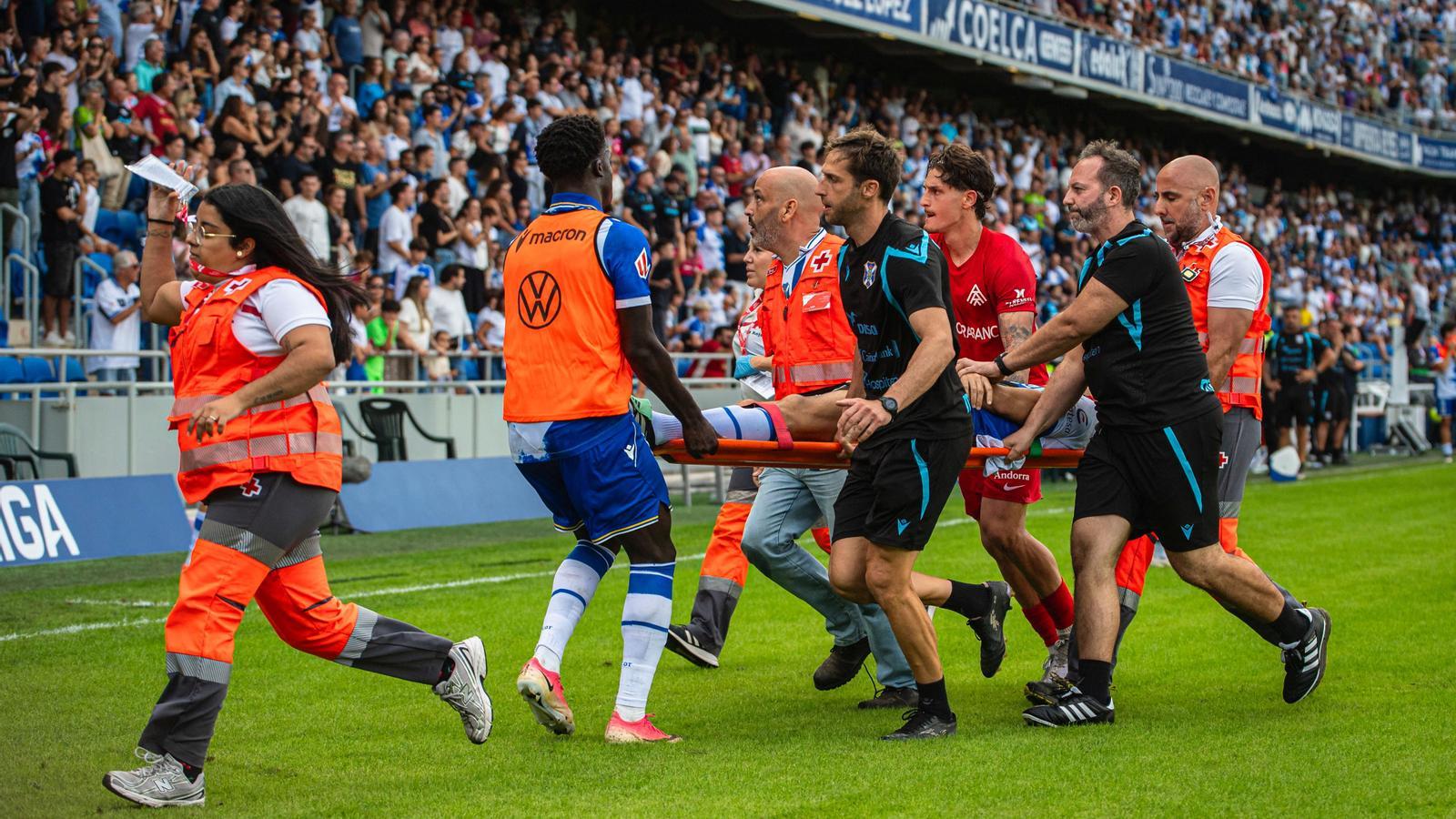
BarcelonaWhat should be done in the event of a cardiac arrest? Was the response at the Tenerife stadium correct? Why didn't the ambulance enter the pitch? The tragic consequences following the collision between Jesús de Miguel and Jesús Owono this Monday at the Heliodoro Rodríguez López stadium have brought to light various debates about how one should act on football pitches when facing an emergency situation.
“Medically, a defibrillator should be nearby to defibrillate the patient and start cardiopulmonary resuscitation (CPR) maneuvers immediately. Afterwards, the patient must be transferred to a center where they can receive the appropriate and necessary cardiovascular care,” explains Marta Sitges, director of the Cardiovascular Institute at the Hospital Clínic of Barcelona, to ARA. “The speed of implementing these measures is the most important predictor of recovery,” she adds.
In the absence of official confirmation, the first signs point to the fact that De Miguel may have suffered from commotio cordis, a condition consisting of an abnormal heart rhythm and cardiac arrest just after receiving a blow to the chest. “It is very strange and very infrequent,” confesses Dr. Sitges. In the last thirty years, the United States National commotio cordis Registry has only detected 220 cases of people who have died from this condition.

The Cleveland Clinic, a United States medical center, analyzes this rare disease suffered by some athletes, especially in baseball or hockey, where the ball or puck can impact at high speed against the player's chest. The chances of surviving a commotio cordis are 59%, but provided that there is immediate cardiopulmonary resuscitation and defibrillation, explains the medical center.
In the case of Jesús de Miguel, the speed with which Jesús Owono's knee impacted against the Madrid footballer's chest is what could have caused the commotio cordis. “A punch can cause this disease, but it must come at a 90-degree angle, at more than 60 kilometers per hour and it would have to happen just at a specific moment of your cardiac cycle”, exemplifies Cleveland Clinic, a fact that summarizes how unfortunate the action was.
Spanish regulations require that there be a basic life support ambulance at all football pitches where a match of the Spanish Football Federation (RFEF) is played. La Liga, furthermore, adds to its regulations that a room or infirmary must be enabled, in the changing room area, with a first aid kit and a stretcher. At the Heliodoro Rodríguez López, however, the ambulance did not access the pitch.
On the other hand, during the Albacete-Sabadell match last weekend, the vehicle did enter the grass to take away Quadri Liameed, an 'arlequinat' footballer, after he received a kick to the head. Judicial investigations will now have to determine whether or not there was medical negligence at the most critical moment to save De Miguel's life. "It will have to be assessed whether the intervention or the defect in the medical intervention could have had any kind of impact on the result," says Marta Masip, member of the criminal law section of the Barcelona Bar Association.
Other risks in football
Football is a contact sport in which knocks between footballers often occur, among others, traumatic brain injuries. “When there is a concussion, the first thing is to see that the neurological state evolves favorably, that there is no injury. Afterwards, one should try to avoid the person receiving a second blow in the short term because, although most traumas do not create any lesion in imaging tests (scanner or resonance), they do have an impact on a microscopic functional scale,” says Raúl Pelayo, a neurologist at the Guttmann, to ARA. In the most serious cases, where there is a loss of consciousness, the person should be under observation for between 24 and 72 hours.
On the other hand, there are the effects derived from having multiple concussions throughout life. “It is related to the risk of suffering neurological diseases or long-term neurological deterioration. There is even a specific degenerative disease, post-traumatic encephalopathy,” describes Pelayo. Precisely, this summer the Como banned children under ten who play for the Italian team from heading the ball during training sessions and matches to delay the time during which there is continuous contact of the head with the ball.
Violence in sport
The action, moreover, has also generated debates surrounding violence in the world of football. Although Owono did not think his action could lead to such serious consequences, the harshness of the tackle has sparked controversy. “You have to be aware that you can cause great harm with certain plays,” comments Raúl Sánchez, who became a quadriplegic after being kicked in the back on a football field. In his case, however, it was without the ball in play and the aggressor was sentenced to six years in prison. A ruling that created jurisprudence. “On a football field, not everything goes under the excuse of saying it is a game action,” he explains.
