Journey to the future: chronicle of a week in “challenging” China
Beijing takes advantage of the moment of global uncertainty to reclaim itself as a stable power of progress where technological innovation is vital

-
CAT -
CAST
Special envoy to ChinaThe Barcelona-Beijing flight begins with a geopolitical wink: on its way to Xi Jinping's skies, the Air China plane will cross all of Russia through Vladimir Putin's skies. This is not a common occurrence. Since the start of the invasion against Ukraine, Moscow has prohibited companies from some forty countries, mainly Western ones, from flying through its airspace. China, a friend, a very close friend, of Moscow and which has never condemned the aggression against the Ukrainians, remains exempt from this airline war. The result is pragmatic: the flight will be faster, more competitive, more effective. A good metaphor for the image that Beijing is trying to project to a world sick with unpredictability.
This is a trip to the future, but it is also an official trip. China's Ministry of Foreign Affairs has invited the ARA and three other Catalan media outlets to visit the country for a week. The tour has included a visit to Beijing, the political capital; Shanghai, the economic capital; and Chongqing, a trendy city. Reading between the lines, which is how such invitations should be read, the trip shows that China, having consolidated its economic super-miracle –nearly 800 million Chinese have emerged from poverty in 50 years–, is in a moment of vindication and a totally international vocation because, in a way, the country, the market, is becoming too small for them. Three ideas will fly over the messages, the propaganda, that we will receive these days. First, in Beijing they believe themselves to be the guarantors of stability and progress in a global landscape full of uncertainties; second, technological innovation –brutal, futuristic, strategic– is the Chinese's great card to aspire to be the main global power; and third, the world's geopolitical axis has finally landed in the Pacific and is moving away from the old West, just as Barack Obama's Pivot to Asia anticipated.
“China’s history spans more than 5,000 years. As the world's oldest civilization that has endured to the present day, China has offered the world many wonderful things throughout the millennia”. This is the beginning of a giant manifesto that occupies one of the most privileged walls of the Museum of the First National Congress of the Communist Party, in luminous Shanghai. People take photos there. Some visitors, Chinese from other provinces who have come to the city, take out the red flag and also have themselves immortalized.
The giant text is titled Preface, is written in English and is a summary of the history of the Chinese Communist Party. It is also, above all, a political interpretation of the history of China and, therefore, a good summary of how Xi Jinping understands his country: a nation punished and humiliated repeatedly by Western powers and Japan that, after many hardships and thanks to the arrival of communism, has “risen from the ashes of war” and “recovered its international prestige”. In essence, this wall speaks of one of the ideological mottos most repeated by Xi since he came to power: the Chinese dream. The doctrine has as its engine the rebirth of the Chinese nation, recovering centrality, prosperity, strength and international prestige. Mao Zedong, still omnipresent, said it in other words: making China stand tall again.

Without this constant link that the Beijing regime makes with the past, it is difficult to understand the lights of the present.
“No photos, no videos, ok?”. An employee covers our mobile phone cameras with a sticker before we enter Xiaomi’s monumental complex in Beijing.
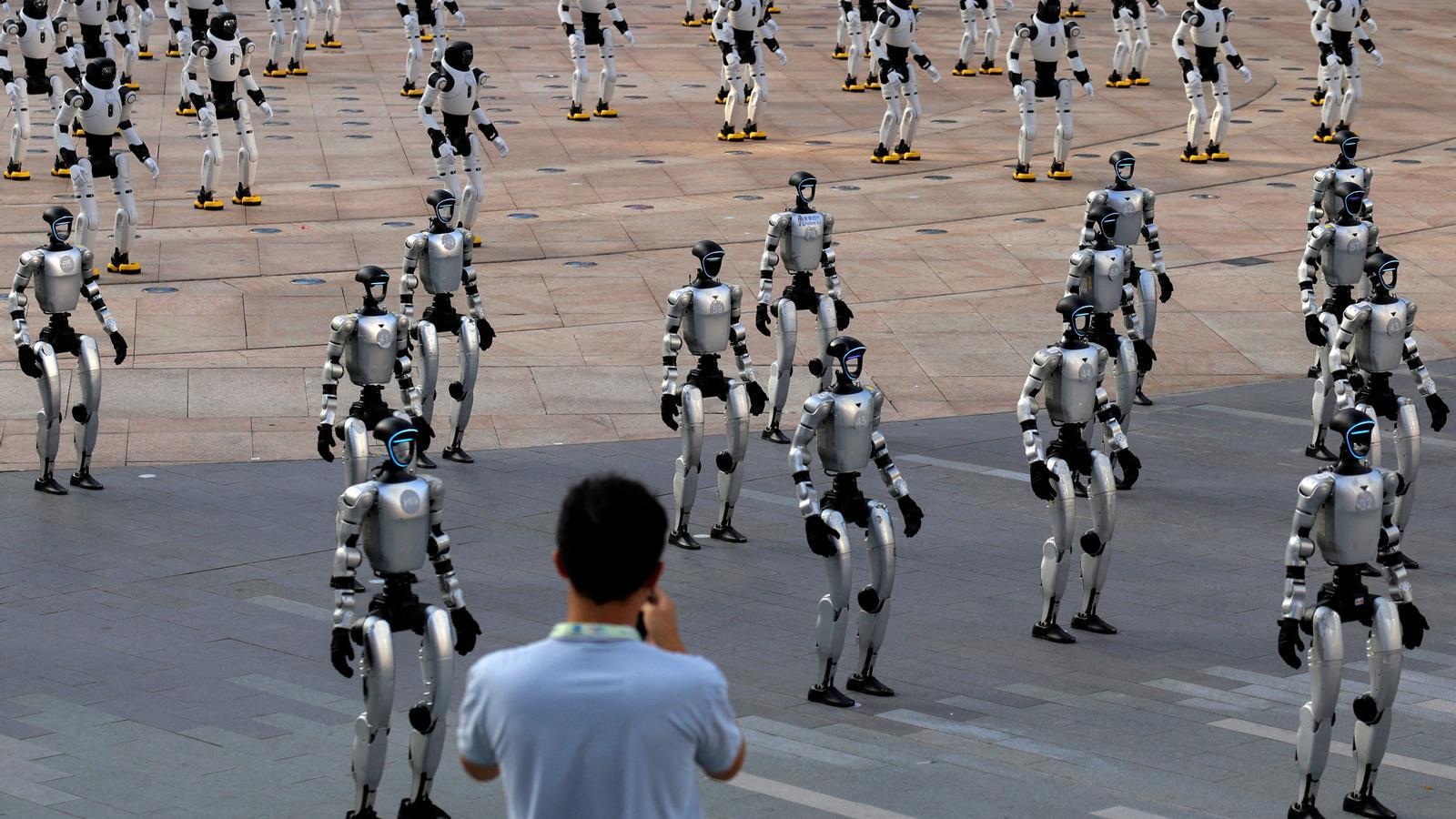
The brand is known in Europe above all for the smartphones, but the big bet now is on electric vehicles, the spearhead of the Chinese automotive industry to storm the rest of the global markets. Xiaomi's are cars with refined aesthetics –a Chinese take on Porsche–, with powerful engines and latest generation technological gadgets where, surprise, artificial intelligence is the protagonist. The factory is immense and a cart is needed to travel through it. The image is dystopian: there are practically no human workers, the cars are manufactured almost entirely by robots, which weld, assemble, press, and group parts. The robots that transport the materials, a kind of roombas giants, they play a little music that reminds one of the soundtrack to The Squid Game, and the print is so strident that it looks like a dark episode of Black Mirror.
A member of the delegation jokes about the robots. “The best thing is that they don’t get tired, nor do they sleep, nor do they have to take holidays”. The joke is not so much of a joke. Immense China –1.4 billion people– has been facing a growing demographic problem for years. The equation is known and shared by other countries: low birth rate, aging of the population, reduction of the working-age population, economic tremors. The express robotization of the country also seeks to face the demographic threat. Xi's regime could choose between making the entry of immigration into the country more flexible —which is very, very restrictive— or promoting robotization. It opted for the second path.

At the exit of the Xiaomi factory, an operator—a real, human one—awaits us with a sports car model. He will take us for a spin around a test track to show us how the vehicle goes, in just a few seconds, from being stopped to reaching 100 kilometers per hour: “Ready?”. The acceleration is intense, absorbing, and has certain geopolitical parallels. The acceleration is also silent, like the streets of large Chinese cities, where all vehicles are electric. The roar of combustion engines are echoes of another era. In a few years, the streets will be even quieter: various companies are already developing flying car models.
Pride and geopolitical factories
There is a lot of politics in all these factories. A clear pride is evident among the Chinese for their country's leadership in technological vanguard, for its change of model. Historically, China has been considered the factory of the world, the ideal place to cheaply produce products designed in other countries. The reputation of the mythical made in China did not please Xi Jinping. Now, Beijing showcases itself as one of the great laboratories of technological innovation: products are designed in the country and seek to be competitive not only on price, but also on quality.
In some Chinese supermarkets, you can already pay with the palm of your hand. It is one of the demonstrations they give us during a visit to the Tencent offices, another of China's technological giants. They also have drones that bring food to your home, an app that can detect a heart attack and send you an emergency service, or humanoid robots that make coffee or play chess. I read one of the slogans, also in English: The future is faster than you think (The future goes faster than you think). The company representatives enjoy the astonishment shown by us European journalists, in herd mode.

“When our science and technology flourish, our nation flourishes; when science and technology are strong, our nation is strong,” said Xi in 2024, during the National Science and Technology Conference in Beijing. The government's political recipe is clear: innovation is a central piece of China's geopolitical strategy, and the control of critical minerals is vital in the race to reinforce security, autonomy, and international influence.
In the facilities of Citic Group, a state-owned business conglomerate, they boast of financing, manufacturing, and developing almost everything a country might need to live. “The only thing we don’t make is graves,” jokes the employee who gives us the tour. They also boast of a world map. Aside from China, one can see they have projects spread everywhere: Brazil, Belarus, Angola, Peru, Kazakhstan, Venezuela, Australia, Saudi Arabia, or Spain. It is another type of Chinese diplomacy, master and mistress of the global south and with higher aspirations.
The Chinese paradigm shift has been worrying Western countries for years. Europe and, above all, the United States fear Beijing’s voracity, placing it as the great competitor, a threat, a challenge. For Washington, dealing with Beijing's growth is, directly, the great obsession of its foreign policy. The European Union's position is more ambiguous because, as usually happens in Brussels, sensitivities vary between capitals. The official definition that the EU makes of Beijing shows this strategic fog: “Partner, economic competitor, and systemic rival.” In China, they joke and say that the EU is like a traffic light: it has three colors, and each light means something. They ask for a single light, and for it to be green.
In a conversation with analysts from the Shanghai Institutes for International Studies (SIIS), one of China's great think tanks and with an impact on government decisions, the researchers ask us journalists what Beijing can do to be liked better in Europe. “China wants to be a great friend of the EU.” The official answer would be long: that the mistrust comes from an unequal trade relationship, from economic competition considered unfair, from a fear of excessive dependence on Beijing or from Xi’s implicit support for Putin in the European war in Ukraine. The short, graphic answer is the German car factories, one of Europe's historical engines, lowering their shutters because of the Chinese alternative.

But Long Jing, a researcher specializing in relations with Europe, pronounces a phrase that touches the pride of the Old Continent: “The EU is an extremely important partner for China, but it is also true that it is not at the top of Beijing's strategic priorities”. And she laments, paraphrasing Henry Kissinger: “Who should one call when one wants to speak to Europe?”. Certainly, the conversation can be very different if one speaks with Berlin, one of the most distrustful partners towards Beijing, than if one speaks with Madrid, which with Pedro Sánchez at the helm, has opted for a more conciliatory stance.
The analysts will ask us one last question: why are there so many demonstrations and riots in France, Spain, Italy? The right to demonstrate is a utopia in Xi Jinping's repressive country, but the researchers, like other Chinese people during the trip, ask it because of the perception of a lack of public safety in Europe.
Public safety in China, a country full of cameras and severe punishments, is non-negotiable. Also non-negotiable is the pact not to criticize the party, the leader. One of the translators we will have during the trip briefly breaks protocol and makes a sincere confession: “What I like least about China? The lack of some freedoms, the obsession with security. In Beijing, they act as if everyone wanted to kill the president”.
The reference NGO Freedom House classifies China as a “not free” country, with only 9 points out of 100 in political rights and civil liberties. In the Reporters Without Borders press freedom ranking, the Beijing autocracy occupies the 178th position out of 180 countries.
Trump, Chinese-style
In a hipster bookstore in Beijing, the number of covers about Elon Musk is surprising. The Chinese, says the guide accompanying us, admire profiles like that of the tech mogul: people with a voracity for making money by working long hours. Among the books, there is also the biography of Donald Trump, another character quite acclaimed in the country. It is quite funny to see it translated into Chinese. The title says something like: Never Give Up: How I Turned My Biggest Challenges into Success.
The competition with the White House is palpable in the country. In the visits the government has prepared for us, references to the race to surpass the Americans in various fields abound. In the meeting with SIIS analysts, Wu Chunsi, director of studies on the United States, admits that Washington is also the top priority for Beijing. And that Beijing does not trust Washington either. “There is a kind of transition in the world order, with a United States where the America First policy will continue to exist beyond Trump. It is clear that there is less and less interest in international concerns,” says Chunsi. The expert's radiograph continues and can be divided into three acts: first, we know that the US is very worried about our growth; second, Washington uses Japan to gain more influence in the Pacific; third, the key remains Taiwan: everything will be fine if there is no interference in Beijing's reunification plans for the island. The Uyghurs, by the way, no one remembers anymore.
Here comes another mantra about China: the principle of non-interference. The ideal world for the autocrat Xi is one in which sovereign leaders can do whatever they want within their own borders, without Western moralists pontificating about what is right and what is wrong. Beijing, which dreams of a China-centric world order, defends multilateralism and pragmatism, the search for stability that allows for the continuation of favorable conditions for trade, but the red lines are crystal clear: do not interfere in its path.

In 2021, the German journalists Stefan Aust and Adrian Geiges published a book with a monumental title: Xi Jinping, the most powerful man in the world. The slogan has resonated strongly this week in the futuristic Shenzhen, the scene of a meeting that was also monumental: friends Xi, Trump and Vladimir Putin sitting at a round table adorned with orchids.
The meeting, which many wanted to associate with the symbolism of the Yalta Conference, made me think about the vision that official Chinese academics conveyed to us regarding the most important geopolitical earthquake of recent decades, the Russian invasion of Ukraine.
“This is a European war, not a Chinese one. And Europe is often too emotional, too combative [with Russia], it should be more pragmatic,” declares Long Jing. In Beijing, they believe that we Europeans have a mistaken view of the influence that Xi can exert over Putin. They argue two reasons. One: it is not in Xi's geopolitical DNA to disrupt the policies of others. Two: China has a very long border with Russia and, in no case, is it convenient for it to have problems with Moscow. “We also have a complicated neighbor,” Long Jing tells us. The also is a Spanish reference to Morocco?
On the way back, the Shanghai-Barcelona flight will last about thirteen hours and will cross Russia again, now from east to west. Of the thirteen hours of the journey, about seven will be flying over Chinese and Russian territory. It is another way of understanding the geopolitical magnitude of the defiant Beijing and Moscow. At some point, the Air China plane will have crossed the long border that separates the two countries. In China, they also clearly remember “the unequal treaties” of the 19th century, signed humiliatingly by the Qing dynasty. The coerced black ink on that document meant that the Chinese ceded a million and a half square kilometers to the Russians. That is to say, the surface area of Spain, France, and Germany combined. That is to say, more than a third of Europe.
