Which party and which candidate are the kings of the networks?
The PSOE changes its strategy so as not to be left behind in the digital battle
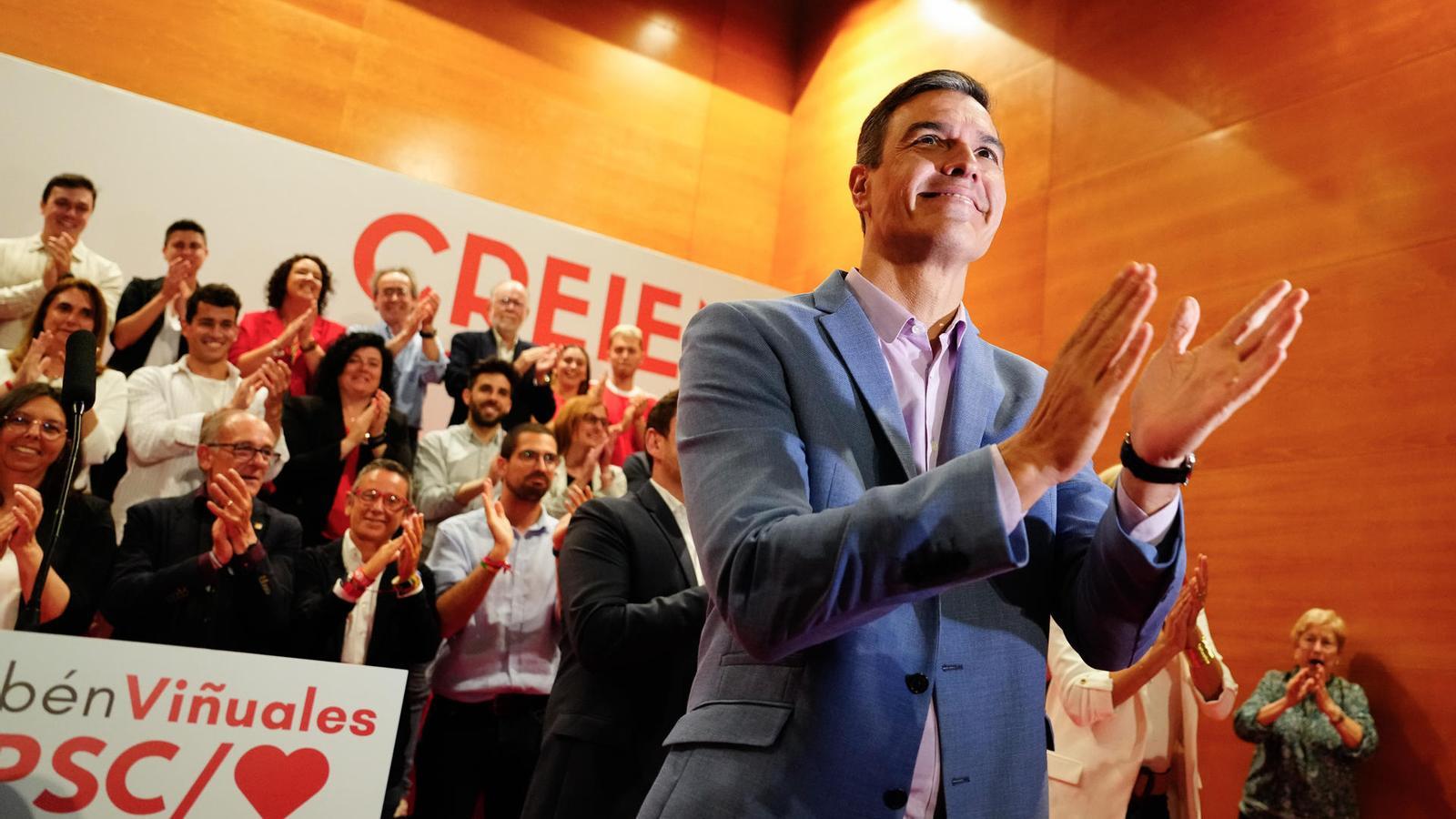
BarcelonaMost polls predict a victory for the PP, with the PSOE behind, and Vox in third place. However, Santiago Abascal's party does lead a ranking without discussion: that of social networks. The digital battle is theirs on X, the political network par excellence. And the electoral campaign of this November 29th is no exception. Conversely, if we analyze the candidates' profiles, Santiago Abascal has to settle for third position, behind Alberto Núñez Feijóo and Pedro Sánchez, who is the undisputed king of the networks. But what do the data from this campaign say?
Javier Ábrego, a professor at the UNED and a digital marketing analyst, has created a political observatory that he has named tweetelecciones.com, where he updates thirty-five party and candidate accounts on X every two hours. In this portal, he gathers who generates the most engagement or impact, that is to say, he does not only measure how many people see a publication or how many followers a profile has (which it also does), but how users react and participate actively. In other words, engagement represents any direct interaction or click on a post, whether they are likes, reposts, replies and quotes, clicks on images, hashtags on the author's profile and views.
Vox dominates this section with ease. Vox has more than two million interactions, 800,000 more than the PP and the PSOE, which are neck and neck. The head-to-head on Thursday between Sánchez and Feijóo has not caused the two major parties to narrow the gap with the far right either. Faced with polls that predict a victory for the right, the PSOE has changed its strategy to equalize the digital battle. And it has not done so with a simple touch-up.
Until less than a month ago, the socialists prevented users from replying to a tweet, that is, they had comments closed. But on October 22nd, the party decided to open the comments with the desire to be able to reach more people. “If you don’t let people reply to your posts, X penalizes you and you have less engagement and your tweets are seen less,” explains Ábrego. The results did not take long to arrive and it has tied in engagement with the PP, which a few weeks ago had a good margin of comfort. The socialists have also become the party that receives the most replies (mostly negative, like the rest of the parties) when before it was not even in the ranking, and from being the third party with the most mentions, it is now the first.
Apart from these two sections on replies and mentions, Vox also leads the ranking on X in number of views with a more than notable advantage in relation to the PP and the PSOE, with 76 million views, fourteen more than the PP and twenty-three more than the PSOE. This wide distance is also explained by the fact that on the day Abascal went on La revuelta they achieved eighteen million views, a record that Ábrego dares to venture will hardly ever be reached again. Vox is also first in likes and reposts and is, at the same time, the most active and the one that has posted the most tweets this campaign.
But if we talk about candidates, things change. Sánchez's profile sweeps with 4.6 million interactions on X, while Abascal, with 2.5 million, is third behind Óscar Puente, who sneaks into this ranking due to the railway tragedy in Toledo. Feijóo, despite being the favorite to win the elections, occupies the sixth position, with 1.2 million, behind the president of the Community of Madrid, Isabel Díaz Ayuso, who slightly surpasses him. The ERC candidate, Gabriel Rufián, is eighth, with 865,000 interactions. Sánchez is also the one with the most followers on X, with 3.2 million, far behind the rest. Abascal, who is the fifth most followed politician, has one million, one hundred thousand less than Rufián, who is fifth.
If we add Instagram and TikTok to the overall tally, Sánchez adds up to 6.7 million followers, far above Abascal (3.9), who is second, or Feijóo, fifth, with 600,000. “The candidate sells more than the party, only the PP and Podemos have more followers than Feijóo and Montero,” remarks Iván Blanco, ghostwriter for LinkedIn and personal branding specialist. Sánchez also clearly imposes himself over Abascal on Instagram and TikTok.
Viral clips from the parties
Political parties think of everything to reach the largest number of people. The inspiration from Lula da Silva after his victory in Brazil does not stop at the WhatsApp digital armies. On X, both the PP and the PSOE have replicated a video emulating Japanese anime that showed the Brazilian president as a superhero who fought against Bolsonaro. It was the work of André Rocha and it was a hit. Weeks later the PP replicated it with Feijóo to review his career and establish him as a fighter against Sánchez. And four days later, it was André Rocha himself who shared the version of the PSOE leader, when he recounted his beginnings playing basketball and his route through Spain with the Peugeot until reaching the battle against the PP and Vox.
The PSOE has also taken advantage of another viral clip. “No one will vote for you, Pedro Sánchez, no one,” exclaimed Ester Muñoz, spokesperson for the PP in Congress. And the socialists have turned those words around and, with a song made by an anonymous Valencian with the help of artificial intelligence, they have filled Instagram with videos of young people singing that they will take the socialist ballot. The song has even reached Spotify.
Junts has also managed to have its own viral clip: “Hello, good morning, I am Miriam Nogueras.” It is a greeting she gave on Antena 3's Espejo Público and it ended up going viral on X. It has had so much resonance that even the pro-independence candidate used the phrase to inaugurate a rally and it is the crutch with which she starts the videos in which she presents the Junts program. Esquerra, for its part, has had the attendees at the rallies participate, for example, by asking them what they have to defend themselves from or what they thought of the event with Rufián and Montero. The video that has triumphed the most from Podemos, for its part, was a TikTok by its leader, Ione Belarra, in which she criticized that La revuelta would have invited Abascal doing a handstand in the room.
