The Gramona winery creates the first classification of vineyards in Catalonia to face climate change
They are developing a tool that will allow them to make better decisions and anticipate a changing climate

-
CAT -
CAST
Saint Sadurní d'AnoiaThe future is uncertain. But not as much if you are informed. Let me explain. In this newspaper where I write, I read before 2020 on more than one occasion that in the course of our lives we would have to live through a pandemic and that it wouldn't be long before it arrived. There is no need to explain what the outcome was. Or that the climate crisis would bring about more violent climate phenomena than those we were accustomed to in our placid Mediterranean. The experts warned us, and this allowed us a key strategy, worthy of someone who has seen the future: anticipation. Another thing is whether we pay attention and are consistent. That is why what the Gramona winery, a great exponent of long-aged sparkling wines in our country, has done is very relevant.
They have decided to combat the climate crisis with the most powerful tool: knowledge. They have developed a system that will be the compass when it comes to making many decisions. A classification based on more than 40 parameters that have taken more than two years to develop. “Each generation has questioned and improved what it inherited,” says the oenologist and owner Jaume Gramona, and continues: “What is the use of what we do if no one picks up the baton? In this case, it has been picked up above all by Roc.” His son, Roc Gramona, explains to an expert audience the work they have done, a job that no one has ever done in Catalonia. And in Spain, neither.
At a time when the wine sector is licking its wounds because people aren't drinking as much and one can go from low production due to drought to having an excess and having grapes left over, they have bet on the future. Pessimism will hardly lead to a brighter scenario. It is in times of crisis that one must make a move. And that is what Roc Gramona has done, the sixth generation to be at the head of the winery. Which plots should be blended? Which varieties should be uprooted and which planted? With what layout should the vines be planted to avoid erosion? Which soils are most suitable for making great wines? In fact, with the soils, it all began.

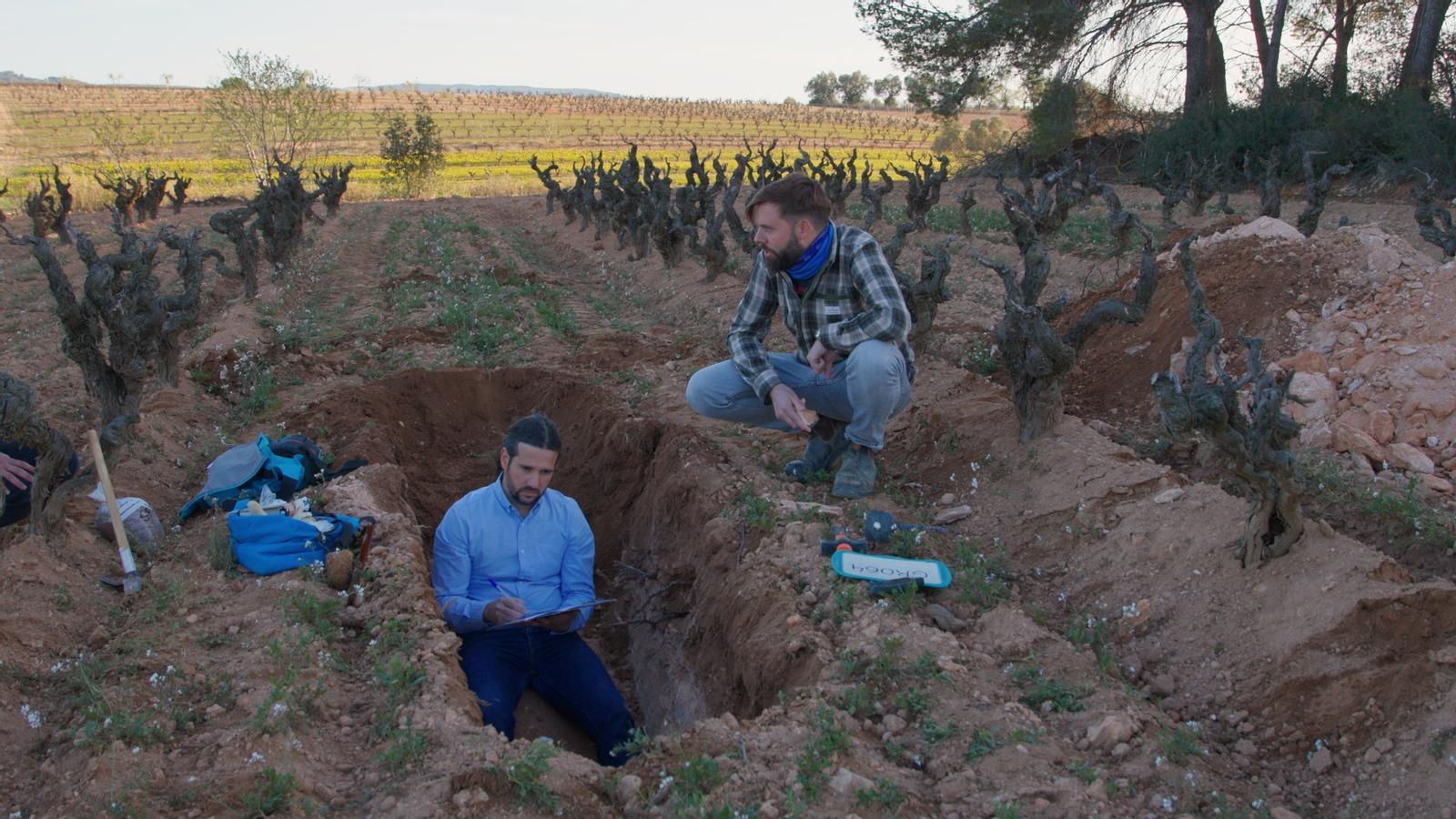
Two years ago, Gramona carried out a meticulous soil analysis project. In fact, in the vineyard you can see the pit, the deep hole where you can observe how it is stratified, what components are in each vineyard, and how far the roots reach. This is where it is also clear that they start with a distinct advantage. 20 years ago, the fifth generation decided to embrace biodynamic agriculture. This has meant that the plants grow in healthier, less compact, and richer soils. In these pits, this is seen empirically. “Biodynamics is the answer to climate change; I am a pragmatic man, and in 42 years of harvests, it has advanced by 42 days,” explains Jaume Gramona.
Against trends
They have analyzed, and made available to the public so it can be consulted on a website, all the vineyards with which they produce sparkling wine. This means 450 hectares, from the 15 producers that are part of the Aliances per la Terra group, all of whom are farmers who follow the precepts of biodynamics. And they have created a pyramid that they divide between unique vineyards (which they have at 18%), singular ones (60%), and classified ones (22%). Without going into the detail of the more than 40 criteria analyzed, and which they will update every year, it should be highlighted that, as the general director of Gramona, Jaume Vial, explained: “More and more parcel wines are being sold. With climate change, every harvest is different. How could we maintain the character and adapt to new times? Parcel wines must be made when it makes sense, when they are extraordinary,” he stated. This means that if a vintage is excellent in a unique vineyard, a wine from only that vineyard will be released, but the winery's bet is on blending. Finding the best combinations, to be more precise, and to continue making these quality sparkling wines.
The classification of vineyards they have made is inspired by that of Burgundy “but Catalanized,” says Roc Gramona. Here, for example, the age of the vine is not definitive, “the fact that the vine is old will not necessarily give better grapes to make sparkling wines. But the depth of the roots, the stoniness, the amount of active limestone... will,” explains Roc Gramona. “The soils are rich in limestone like in Champagne or Jerez. We are very lucky in the Penedès with our soils, and we don't say it enough,” affirms his father, Jaume Gramona. With this classification, Gramona paves the way, by having much more scientific knowledge of the vineyard, which will allow us to adapt to what we already know is coming. In a winery where one generation drinks the bottles made by the previous one, investing in the future is key.
