The unions will call a general strike for the housing crisis before 29-N
After a meeting this Monday afternoon, CCOO and the UGT support the demand of the Tenants' Union, which already had the support of the CGT

-
CAT -
CAST
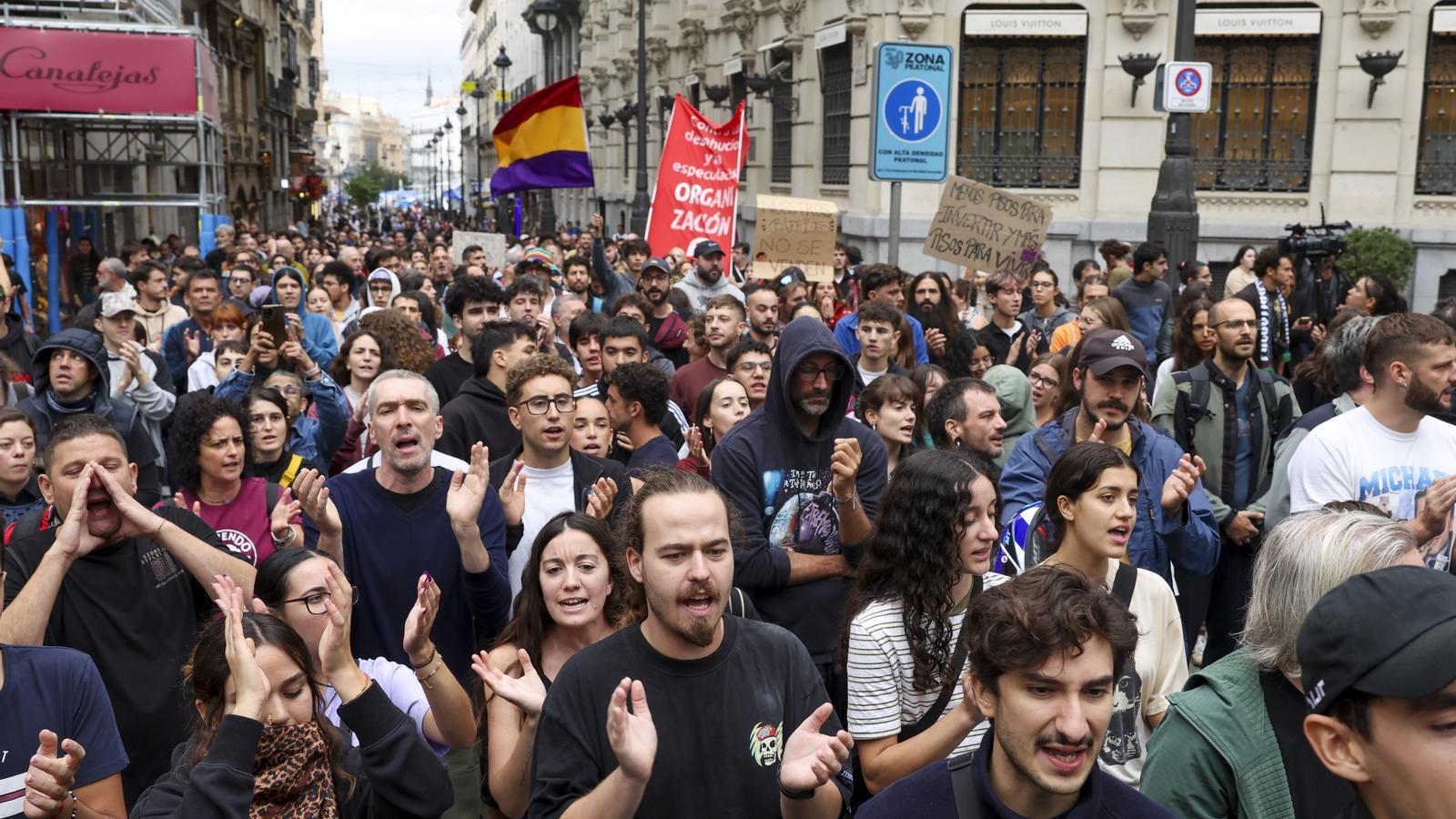
MadridThere will be a general strike over the housing crisis before the Spanish elections on November 29. The majority unions, CCOO and UGT, are supporting the stoppage demanded for days by the Tenants' Union, which this Sunday already had the support of the CGT union, as ARA has learned from sources familiar with the talks. CCOO and UGT, the two unions with the largest presence in companies, had until now been cautious and were waiting for the decision that Pedro Sánchez would make: whether or not to call early elections. However, the pressure on them has grown steadily, especially after this weekend's mobilizations throughout the State with thousands of people taking to the streets. After a final meeting this Monday afternoon, the majority unions have ended up deciding to support the proposal, as they reported in a joint statement.
"UGT and CCOO agree to call a general strike this autumn. The unions are incorporating the income conflict within the framework of the major mobilizations for housing. Wages are not enough to pay for housing and cope with inflation," the statement reads. Now the strike (planned for 24 hours) will have to be ratified by their highest governing bodies. The general secretary of CCOO, Unai Sordo, has argued that the demand "will not only be about housing," but will be "fundamentally" about the "need to promote" a wage increase: "Housing is eating up half of the salaries of many families, these are two things that are intimately linked," he maintained in an interview with RNE.
After the news broke, the spokesperson for the Madrid Tenants' Union, Alicia del Río, celebrated that UGT and CCOO "have stood by a movement that has been on the street for ten days fighting for decent housing" and committed to working towards achieving an "authentic popular unity of all workers." Their goal is for it to be a "massive strike that paralyzes the country" and that "succeeds in winning its demands." In the morning, from Puerta del Sol, she herself had argued that the general strike was "the only way" looking at the rest of the mobilized sectors, such as education, healthcare, or pensioners. The intention of the Madrid Tenants' Union is to announce the date and calendar of mobilizations at the end of this week.

CCOO and the UGT have been weighing up all these days how to respond to the demand to move towards a strike of this nature. Furthermore, in the middle of an electoral period like the one that is beginning, they feared that the final objective of the strike would not be clear and that it would add "confusion". "Who is the strike against? Against the [central] government, which has not done enough? Against the right to overturn the decrees? Against the PP autonomous communities that have been blocking the state housing law for some time?", union sources wondered to ARA. Finally, however, the two majority unions have picked up the gauntlet thrown by the Tenants' Union, which this Monday warned that they "would not wait for any electoral calendar".
A socio-labor motive
The general strike proposed by the Tenants' Union puts housing and rental prices in the spotlight, which is why CCOO and the UGT were weighing how it could fit with a socio-labor demand. The housing problem, however, affects the population's purchasing power –the upward pressure on prices takes up a large part of workers' wages–, and many companies even recognize that it is a difficulty when it comes to finding employees. This is the vein the two unions have finally latched onto.
For CCOO and the UGT, a general strike not only challenges the various public administrations that have jurisdiction over housing matters, but also business organizations that "must assume that wages must guarantee access to a basic good such as housing." For the unions, the employers' association must "prove" it with the renewal of the AENC –the framework agreement that serves as a guide when negotiating wages– and the unblocking of collective bargaining agreements. On the other hand, this weekend the Spanish business association CEOE deemed the possibility of going on strike for housing "illegal" because "it is not within the labor conflict."
The last general strike in the State was called by minority unions on October 15, 2025, for Palestine, while the last major shutdown for socio-labor reasons dates back to November 2012. In Catalonia, a general strike was also called in October 2017 against the police repression of 1-O. In the State, the call for a general strike corresponds to the workers, although it is common for their representatives or trade union organizations to be the ones calling it.
