Tens of thousands of people cry out for housing in the State and call for a general strike
The most massive protest in Madrid gathers 70,000 demonstrators according to the Spanish government delegation and 500,000 according to the Tenants' Union
-
CAT -
CAST
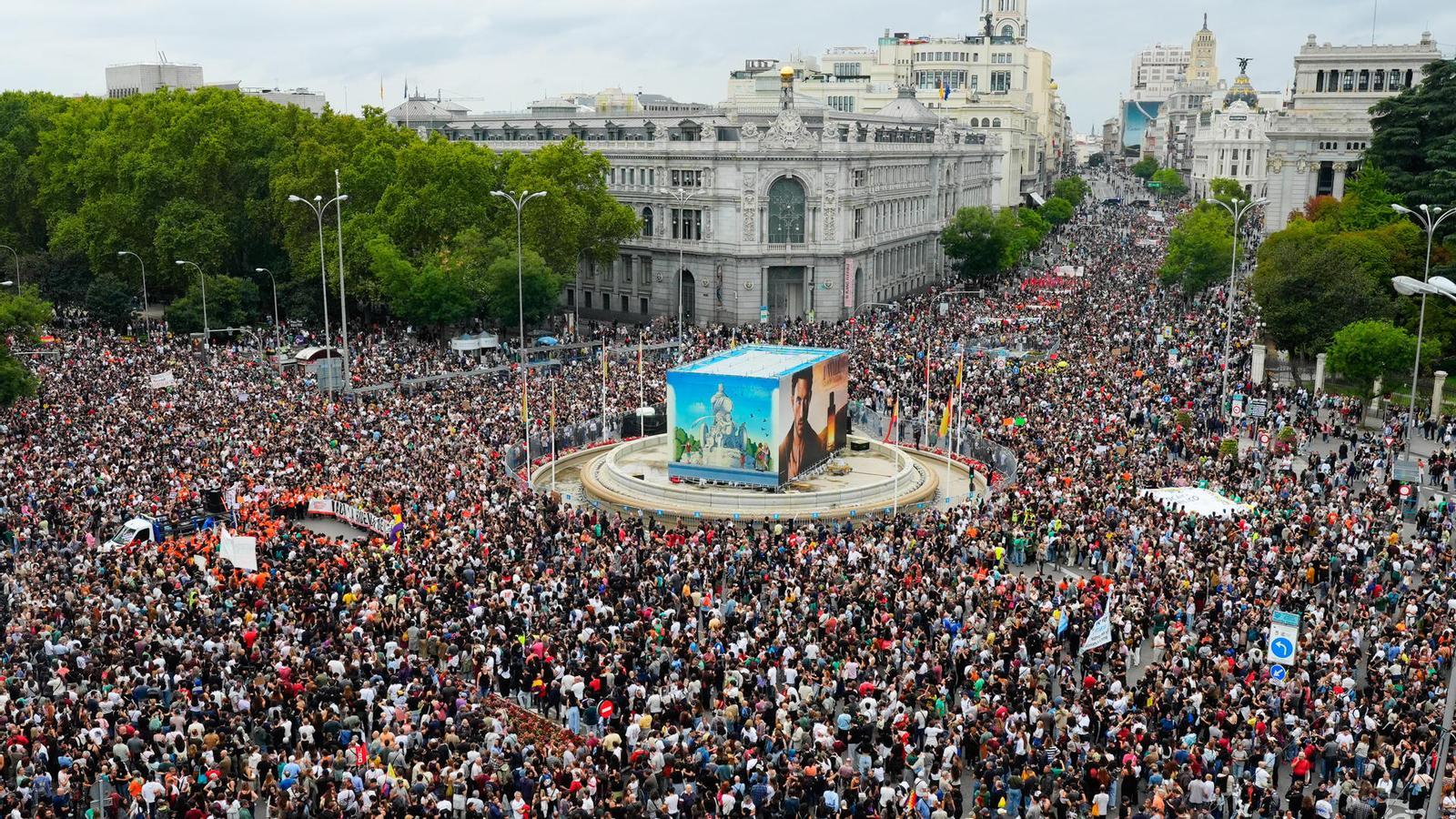
MadridWhile Pedro Sánchez considers whether to call early Spanish elections, tens of thousands of people have taken to the streets in the country's main cities to demand solutions to the housing problem. The most massive demonstration was in Madrid, where 70,000 people according to the Spanish government delegation and 500,000 according to the Madrid Tenants' Union launched slogans against political inaction and called for a general strike. "The time for politicians is over," proclaimed Valeria Racu, one of the spokespersons for the Madrid Tenants' Union, the organizing entity, in a media appearance. The inaction from Congress to the housing decrees has caused the horizon of struggle to be set on a general strike that Racu is confident will happen "soon".
From the Tenants' Union they warned that "power is now in the street," after having noted that "eight days in the street have done more than eight years" of progressive governments. The pressure will be exerted "whoever is in government," Racu remarked. The camping at Puerta del Sol, for which this organization is no longer responsible after it became overwhelmed, continues indefinitely, with the determination to bring about some change. In parallel, in Barcelona, the protest that was to take place in the afternoon had to be canceled due to the forecast of rain; it will finally be held on Monday, October 5th at 7 PM at Plaça Urquinaona.
In Valencia, the scheduled demonstration did take place and was one of the most notable, as it ended in disturbances. At least five people have been arrested, according to Efe, for attempting to force their way into a real estate investment congress being held at the Palau de les Arts, the point where the protest route ended. A group of people attempted to break through the police cordon after knocking down fences and throwing objects at the police, who charged at some protesters and responded with rubber bullets.

While these protests could be the driver of a change in strategy by the Spanish prime minister with a hypothetical announcement of elections before the end of 2026, proclamations against Sánchez's executive were heard at the Madrid demonstration. The criticisms, in fact, were directed generally against the political class and against a "Congress hijacked by rent-seeking". Despite the disappointment with the progressive government, the main targets were the Madrid president, Isabel Díaz Ayuso; the mayor of Madrid, José Luis Martínez-Almeida, and Junts and its spokesperson in the lower house, Miriam Nogueras.
"You no longer know who to trust"
Among the protesters were people of all ages with a shared concern about the difficulty of accessing affordable housing. "We have the keys to all of Madrid," the protesters warned, jangling their house keys in protest against housing prices while the threat of a rent strike also echoed. "How long will you be able to hold out if we all stop paying you?", they shouted in reference to the landlords. The demonstration lasted more than two hours, in four different columns that advanced at a slow and calm pace to the Cibeles square.
"Madrid for the gatos [the colloquial term for referring to people from Madrid], vultures out" is the slogan on the banner with which Ester and Carla, 23 and 25 years old, attended the demonstration. Neighbors of Vallecas and Vicálvaro, districts in the south of the city, explained to ARA that they still live with their parents because they cannot afford a rent. "We don't see any way out, it's unsustainable, and no party is worried about it. You no longer know who to trust," they complain, although they assure that, in the event of snap elections, they would go to vote with a very clear idea of "who not to vote for," in reference to the right. Another young woman, Andrea, 23, from the San Blas district, chose a banner against Ayuso to attend the protest. She has also been unable to move out and has been camping in Sol for days. All three agree in celebrating that the streets have finally ignited.
Also celebrating this mobilization, especially that of the young people, is Mireia, a 70-year-old Catalan woman who has been living in Madrid for decades. She owns an apartment and explains that she is worried about the general situation. "And what if I wanted to separate? You don't have access to any house," she says. It is a scenario that is also brought to the table by Virtu, a secondary school teacher in San Sebastián de los Reyes, a municipality north of Madrid, who explains that families from her daughters' school, aged 8 and 11, have to uproot themselves in cases of divorce and rent increases. "They go to live in other autonomous communities. They are kicking us out of the neighborhoods," she laments. She is wearing a t-shirt in defense of public schools, at a protest that other groups in defense of public services have joined. "Everything is related. Housing is so important that it is the first thing we learn to draw," she reflects.
