Catalan batteries to have zero-kilometer electricity
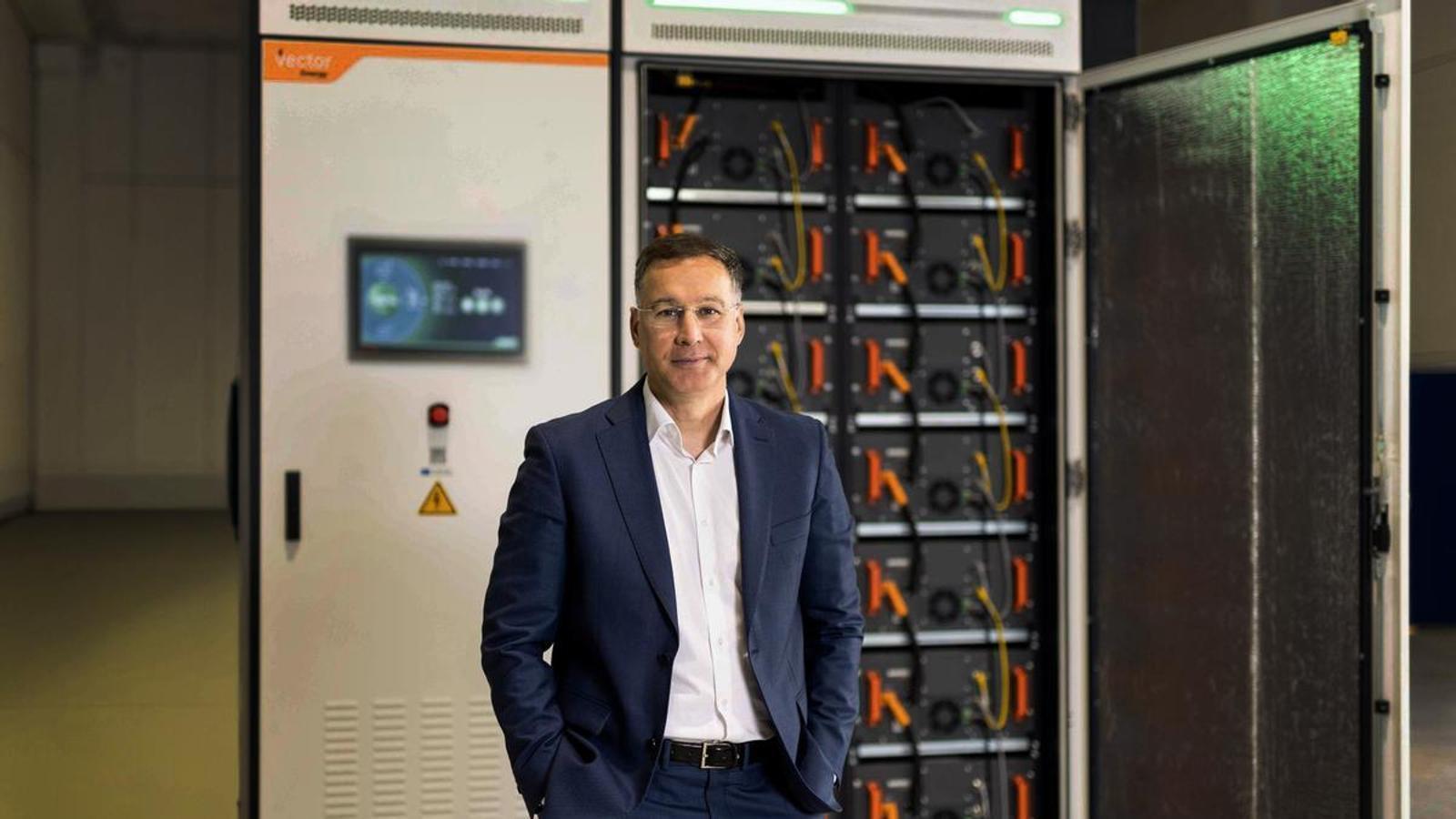
Vector Energy manufactures with its own technology in Santa Perpètua de Mogoda its storage systems

-
CAT -
CAST
Renewable energies have changed the energy paradigm in Spain and are doing so in almost the entire world. But the future, now, depends on storage. If renewables only generate energy when there is a resource –wind in the case of wind power, sun in the case of photovoltaics, or water in the case of hydropower– it is necessary to have systems to store the energy when these sources do not exist. Because one of the main requirements in the world of electricity is the security of supply.
Until a few years ago, electricity was conceived as a type of energy that was produced and consumed at the same time. That is, generation had to correspond at every moment with the existing demand, minute by minute. But renewables, self-consumption, the electric car, and the new systems of shared self-consumption and energy communities, that is, the shift from consumers to prosumers (producers and consumers at the same time) has changed the model, and batteries play a key role in being able to store the electricity generated that is not consumed at that moment.

While China has become the world's largest battery producer, there are those from here who want to carve out a niche in this business. This is the case of Vector Energy, a company from Santa Perpètua de Mogoda (Vallès Occidental) dedicated to battery manufacturing. "We buy the lithium from China," explains the company's CEO, Iván Olivares, "but we assemble the battery packs here and we have developed the cooling and the electronics. We have made the entire system," he explains.
These batteries have a power range from 125 kW to 5 MW, with a production capacity of 180 to 200 kWh. They are especially suitable for, for example, industrial facilities, infrastructure, or the agri-food sector. Olivares acknowledges that China is much more advanced in lithium technology. "Lithium is a very tested technology, but we are in the early stages of what is to come," he indicates.
This leadership of China in this electrical storage technology also has broader geopolitical repercussions. Energetically, in Europe "we are leaving one dependency, on Russia, to fall into another dependency, on China," says the CEO of Vector Energy.
The company currently has a staff of 70 people, of which 22 are engineers dedicated to research and development (R&D). "Those who work in R&D are highly specialized people," explains Olivares, who highlights that they have invested heavily in the laboratory and its equipment. "We can carry out tests of up to half a mega," he highlights.
Within the company, the electrical storage division is the one that has grown the most, and for next year a significant increase is expected, as they have projects for 40 MW. In fact, the CEO of Vector Energy acknowledges that the data center boom "helps us," because it is a type of equipment that requires high supply security and, therefore, needs batteries to avoid interruptions in the electrical fluid.
Chinese competition
Iván Olivares believes that the company can carve out a niche in the market, where there is little local competition in this type of equipment. “89% of what is sold in Europe is Chinese,” explains Olivares. The company's ambition is great: “By 2030 we want to reach 50 million in turnover,” explains the CEO. In this sense, to grow, he acknowledges that “the challenge is not the technology, but also the internationalization of the company,” with his eyes set on the markets of Europe, Latin America, and the Middle East.
Vector Energy has been part of The Yellow Nest Group since 2021. The company was born from the merger of Vector Motor Control, specialized in power electronics, and the automation division of the Circutor Group. From this merger, Vector Motor Control Ibérica was born, which subsequently became Vector Energy, based in Santa Perpètua. This merger allowed the development of proprietary technology and to stop depending on third-party technologies. The company invested nearly 4.8 million euros in facilities, laboratories, and industrial capacities. Currently, it has an approximate annual turnover of 12.5 million euros.
In addition to battery energy storage systems (BESS), the company has other products such as power electronic converters, active filters to improve grid quality, or energy management software. Furthermore, the company provides technological sovereignty and has, as its main future challenges, the consolidation of its internationalization and growth in industrial capacity.
In fact, it expects significant growth because energy storage opens up opportunities: currently the global battery fleet reaches 250 GW installed, and it is expected that by 2026 another 130 GW will have been incorporated. To get an idea of the growth, in Europe installations grew by 45% in 2025 compared to 2024.
