Josep Pedró: "How can the Dakar be held in Saudi Arabia if bombs are falling there?"
Motorcycle racer
-
CAT -
CAST
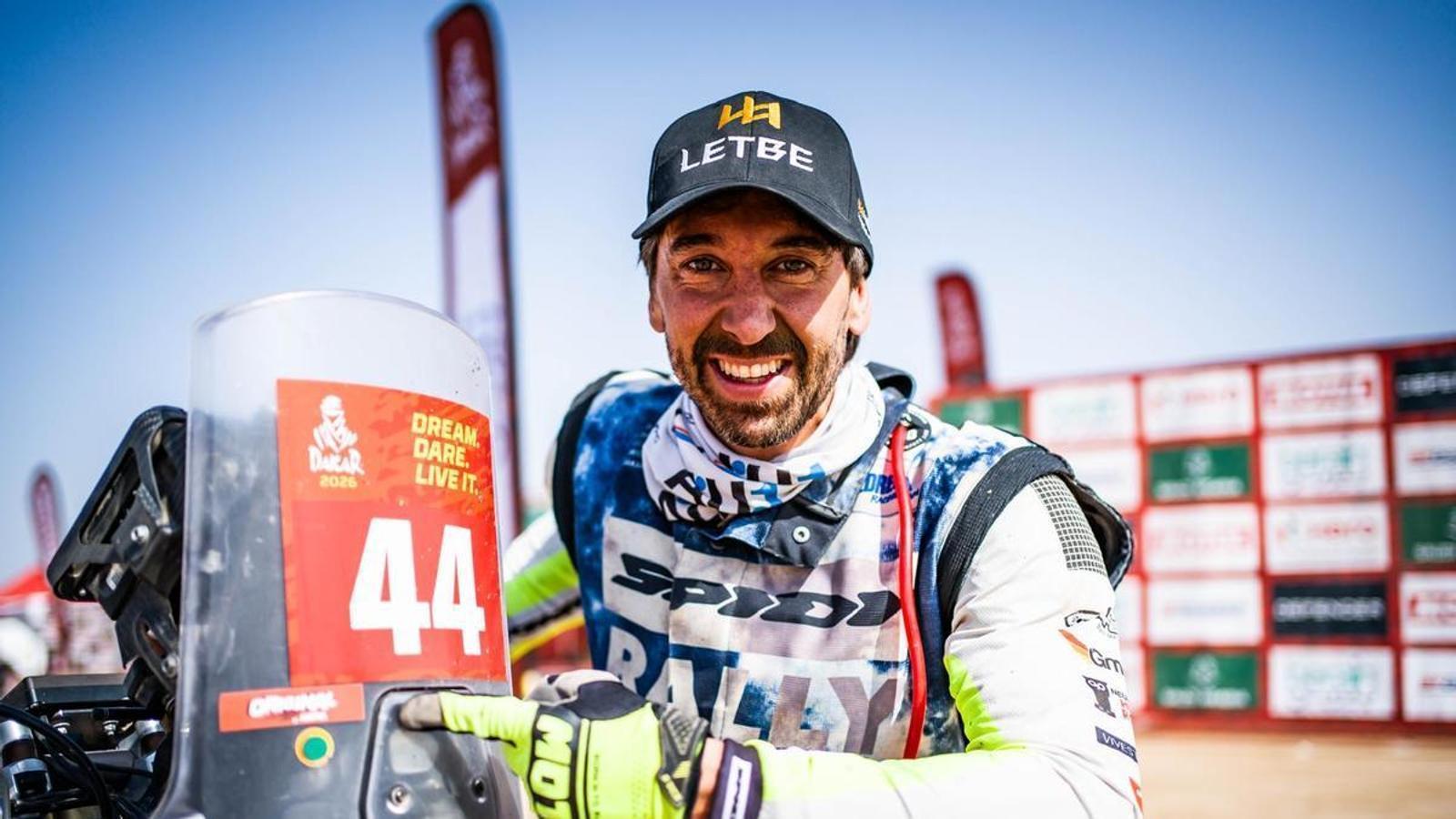
BarcelonaBeing able to participate in the Dakar Rally is the dream of many motor sports fans. In the Pedró household, father and son have achieved it. If Josep the father did the longest Dakar of all time crossing Africa from end to end in 1992, Josep the son (Barcelona, 1987) has already completed three editions in Saudi Arabia. In the last one, he was second in the toughest motorcycle category, the original by Motul', in which one participates without assistance. Now he is preparing for the next edition, but he does so with anxiety, denouncing that it seems impossible to hold the race in Saudi Arabia, since the conflict in Yemen and the Persian Gulf do not allow for guaranteed safety, with drones attacking Saudi territory on a regular basis.
There are three months left until the Dakar and you still don't know where it will be held. How do you handle this uncertainty?
— Well, it's complicated, to tell the truth. We've been like this for a whole year. In March, the route presentation was held and most of the participants were convinced that they would tell us they were working on an alternative. And to our surprise, we were met with a very firm speech that told us everything was under control, that we wouldn't have any problems in Arabia and not to worry, that everything would go well. But as the months went by, we've seen that things don't look good; the port of Yanbu, where we are theoretically supposed to unload all the equipment, has been attacked. How can the Dakar be held in Saudi Arabia if bombs are falling there?
Since then, what are the ways of contact you have with the Dakar? Has the discourse changed?
— The official discourse had been that everything was under control... until now. But everything changed in the last Rally of Morocco. I believe it has been key that the official brands have spoken with the organizers and told them that they do not want to send their workers to a country that is at war. In Morocco, David Castera, the director of the Dakar, came and spoke with many riders. It moved me that he came to speak with me personally, as it means that I am already part of the riders with some weight. And the discourse has changed radically. They accept that the situation is really serious and that right now the planned route is not viable. They have presented us with a proposal, which would still be inside Saudi Arabia, but in a different area, closer to Jordan. A safer area. They have few days to finish deciding it, because the material has to be sent by sea and it takes a month to arrive. The second alternative, then, is for the Dakar to be held in Morocco. And here everything is yet to be decided. Knowing if it would be 10 or 20 stages, in which area of Morocco...
The Dakar already abandoned its initial stages –crossing the Sahara– to flee from political instability. Now the same could happen with the Saudi stages.
— Certainly. And it is an ideal place for practicing our sport, as the landscapes are beautiful, demanding... Huge areas to compete in where there is no one, which makes it very safe for us. In Morocco, for example, many people live there, and therefore you find people on and off the road areas. And it creates a risk. In Morocco there is a lot of tourism and a lot of traffic, in Saudi Arabia that does not happen. I felt very comfortable driving in Arabia, but what we pilots want is to have a guarantee of safety. If it is not safe, then we go to Morocco. But the sooner it is decided, the better for everyone.

How do you imagine a Dakar in Morocco? It would be a return to Africa...
— Well, it will depend on what they have in mind: it could be a good option or it could end up being underwhelming. For me, the negative point is the danger of this terrain for us, for the motorcyclists. Morocco has many traps, it is a country where it rains quite a lot, and that makes the terrain a challenge for us. Right now, I do not rule out that it ends up being held between Morocco, Spain, and Portugal. If it is held in Europe, for the commercial brands that help us, it could be a good solution.
Does this possible route change alter your preparation?
— My preparation is 100% as if we were going to Arabia. If a change occurs, the work will be more about adapting the equipment than physical. At a brand level, as long as we have a rally, they will accompany us, I do not think it will have a negative impact, but the sponsors also want to have the assurance that there will be no added risk.
Your idea is to repeat in this more adventurous mode, without support. If the motorcycle breaks down, you repair it yourself. How does the idea come about?
— It was a last-minute decision. In principle, I had a two-year contract with a local brand, and three months before the Dakar they told us they were quitting. I was forced to invent a project in two months with the minimum budget, because until that moment that brand paid for everything. I had experience as a mechanic, so I decided to go in that category... and it was incredible. I enjoyed it and learned a lot. I discovered a part of myself that I didn't know well enough and that it turns out I'm better at! The best part of me comes out in long-distance races, I am psychologically strong. People who are very organized have an advantage. Now, the luck factor is always there.
When you are doing these marathon stages, are there moments when you can enjoy them, or are you so focused on not hitting a rock that you see nothing else?
— In these stages you go through every mental state you can imagine. We have our tricks. You experience moments of great concentration and others in which you can indeed lift your eyes a little and enjoy the beauty of the landscape. I have etched in my retina images of places so beautiful that they will always live with me.
Your father was also at the Dakar, but when it was still in Africa.
— Yes, it was a different story. He participated in the longest edition of all time, between Paris and Cape Town, in 1992. He told me that they passed through places where there was war and the organizers managed to get a truce. Once the last vehicle passed, the shots would return. He and other veterans have told me about what the race was like back then: now it is very different. Nowadays we have a level of safety that did not exist at that time. Before, people died on the route and were left there; the organization was not professional at all.
You are not a professional, you combine it with the family business.
— We have a small family business, a delicatessen. We have one location in Barcelona and one in Madrid, an idea of my grandfather's. I am in charge of coordinating the Madrid store, where we have quality Catalan products. As I compete, it is becoming increasingly difficult to balance everything, but luckily a brother is helping me. This way I can compete better.

