The formulas of four former ministers to revive the educational system
Pimec celebrates a dialogue with Rigau, Simó, Ruiz and Maragall that addresses teacher training and complexity in the classrooms
-
CAT -
CAST
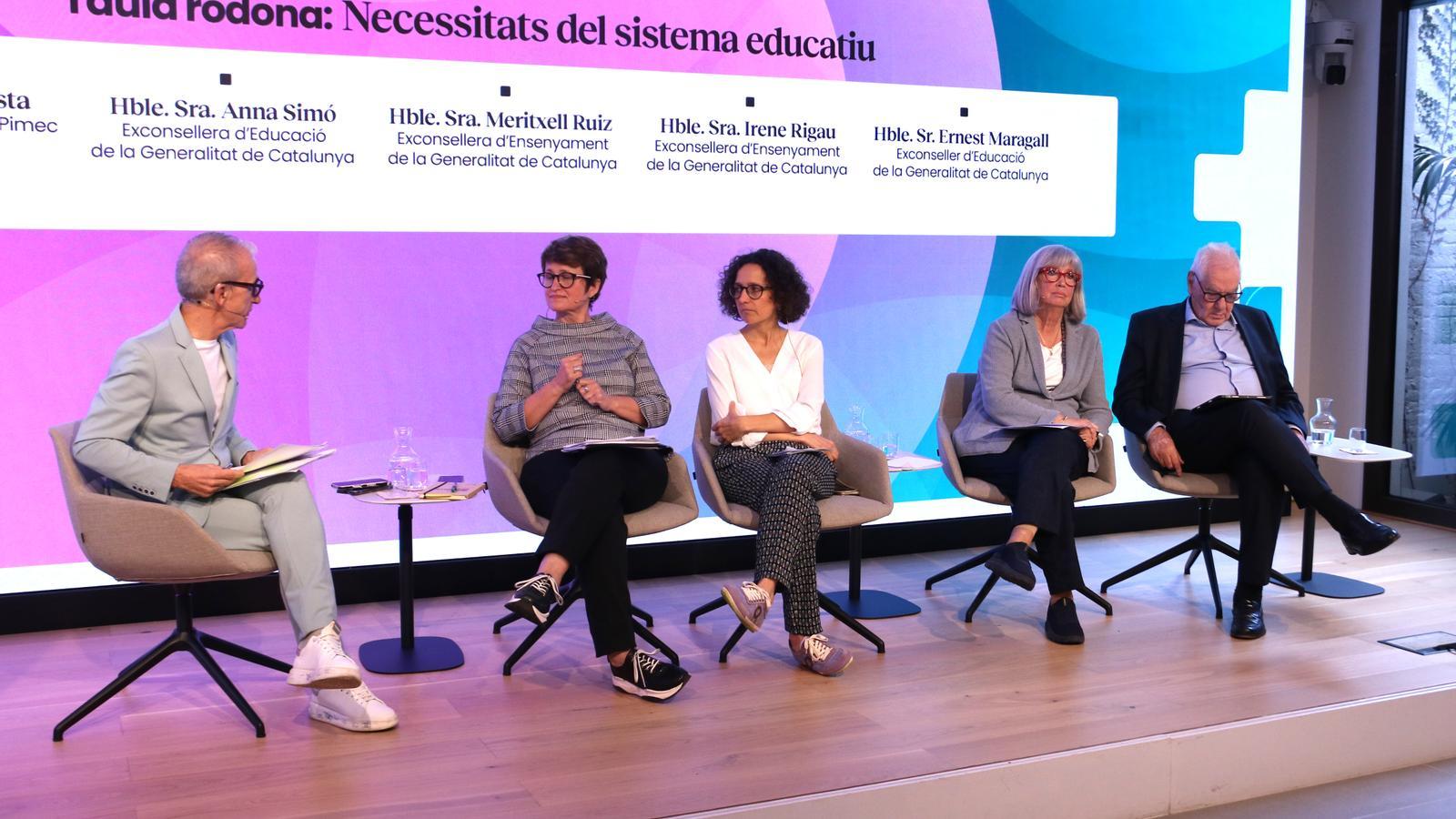
BarcelonaThe need to review teacher training and the way child poverty and rising complexity in classrooms are addressed have been the focus of the debate in the first of the meetings promoted by Pimec on education, which has featured the voices of four former ministers of the sector: Irene Rigau, Anna Simó, Meritxell Ruiz, and Ernest Maragall. In the midst of social debate and with a national debate underway to redefine the Catalan educational model –dynamited by the error in the PISA tests, but fueled by the protests by teachers and families over the last year–, all four agreed that it is necessary to "shield education" from different political cycles to ensure the country's future, since the educational system is a cradle for new generations and, therefore, for facing future economic and social transformations. That said, always "guided by the evaluation" of results.
Rigau, who was minister between 2010 and 2016, argued that the quality of the system "is measured by the quality of the teaching staff" and considered that the "great pending task" is to address the university training of future teachers. In this sense, she asserted that one of the main problems is the university's "commitment" to this training and has urged the administration to "dare" to develop the teaching career. In this regard, she referred to the current controversy over the pressure measure of not holding school camps and field trips by teachers and the responses the administration is giving. Thus, she argued that the solution does not imply paying for overnight stays but rather that going on school camps should count towards the teaching career. According to Rigau, this is a topic "that cannot be dealt with the unions" but must be addressed with the school boards.
In a similar vein, Ruiz –minister between January 2016 and July 2017– has argued that everything else is articulated based on teaching quality and has stated that both initial and continuing teacher training should be "reviewed from top to bottom." In the same sense, she has defended school autonomy, pedagogical leadership, and evaluation as key elements to improve educational quality. An opinion also expressed by Simó, who was minister between June 2023 and August 2024, who agreed to point out the importance of initial training and modeling, and valued the promotion of a teacher mentoring program, like an educational MIR, during her time at the head of the ministry. For his part, Maragall has stated that a "deep review" is needed in this area and has assured that it was one of the "battles" they undertook during his tenure, between 2006 and 2010.
Beyond training, the former ministers have also reflected on the fact that school is a reflection of society and the effects that current child poverty and the increase in complexity in the classrooms have. In this sense, Simó has assured that for her, child poverty is "the main structural problem" of the educational system, accompanied by the lack of equity, school segregation, and inequalities. She added that the PISA results also go along these lines, since she has suggested that countries with better results are more homogeneous countries, without so many inequalities. Furthermore, she has stressed that basic skills must be reinforced, as well as adapting vocational training planning to territorial needs.
Maragall wondered whether the problem lies with education or society, and whether it is society that sends problems to schools without providing them with the appropriate tools to address them correctly. "The underlying issue is complexity," he stated. Rigau acknowledged the current difficulties and recalled the limited scope for decision-making in Catalonia regarding education, but she argued that "to educate is to sow" and opted to add a touch of optimism, believing that the efforts made every day in classrooms will bear fruit in the future. Regarding the educational debate, the four former ministers also agreed on calling for stability in policies and defended the implementation of the Education Law of Catalonia (LEC). In fact, Simó pointed out the need to develop national pacts "based on work already done" and rejected the idea of taking reports previously completed and leaving them "in a drawer".
Niubó defends stability
At the closing of the conference, the current Minister of Education, Esther Niubó, defended precisely the importance of "stability" and the debate promoted by the Government to reach a country agreement. Thus, she highlighted the will of the Education Council of Catalonia to promote concrete actions based on listening and the needs of the system. However, she admitted that solid learning must be guaranteed for the entire student body and this is also related to the training of teachers.
For his part, the president of Pimec, Antoni Cañete, vindicated education as the best investment for a country's future, arguing that the societies that progress are those that train people with knowledge and critical capacity. "This is not about payrolls, it is about providing centers with resources and being able to make an offer that is what the system needs," he stated. In this sense, he warned that digitalization, industry 4.0 and artificial intelligence are transforming production models and the relationship between employment, productivity and salaries, and he assured that only countries that decisively bet on knowledge will be able to lead these changes. Therefore, he called for prestige to be given to the teaching profession and for educational centers to be equipped with the necessary resources to offer training adapted to the needs of the labor market.
