Illa commits to promoting a national pact to overcome the educational crisis
The president of the Generalitat wants to allocate 6% of public investment to Education

-
CAT -
CAST
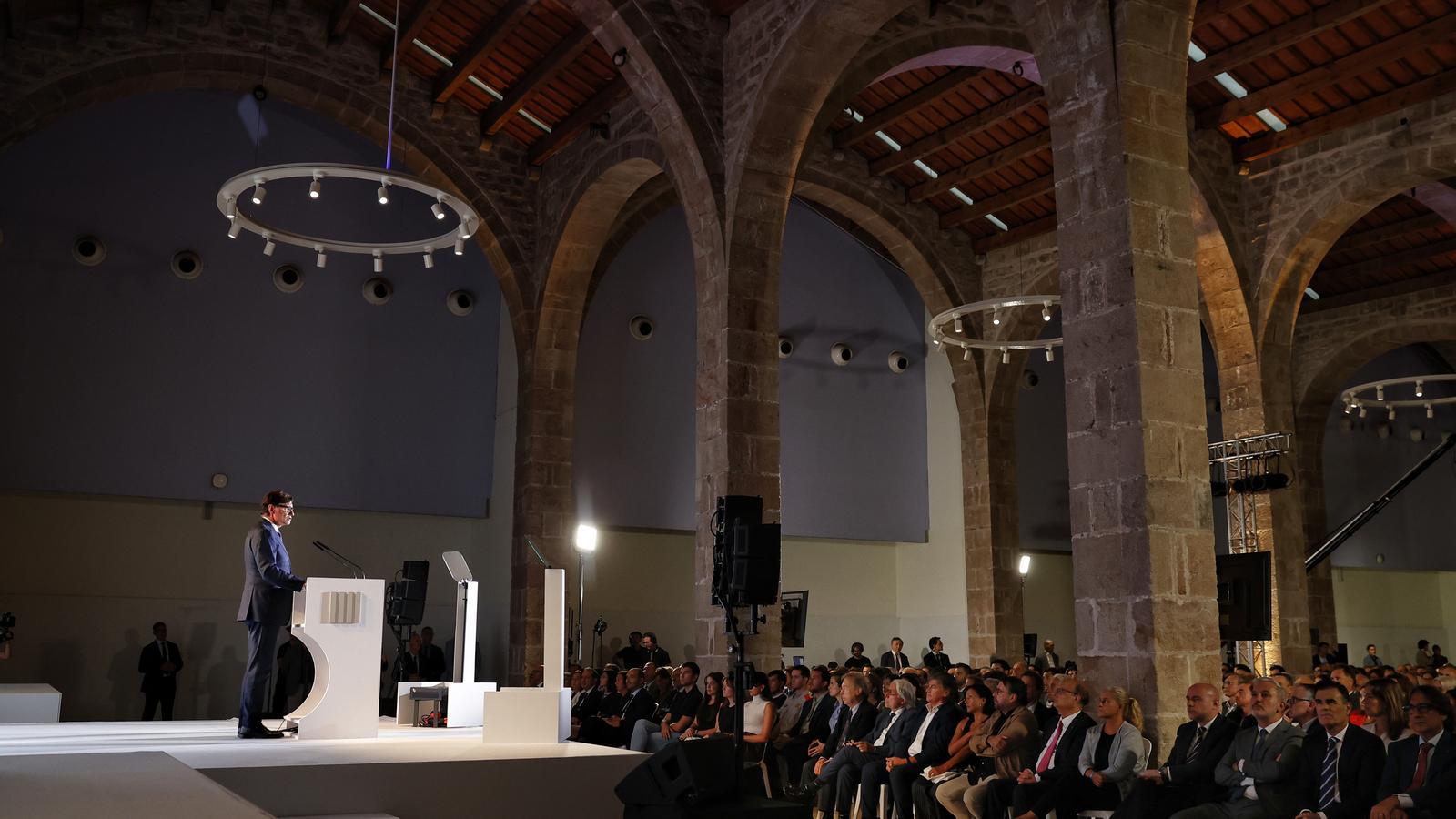
BarcelonaTwo years after arriving at the Generalitat, Salvador Illa has returned to appear at the Maritime Museum in an act of great pomp. More than 800 attendees were counted, and the entire Government was there, as well as the main union and business leaders, political representatives of various colors, and prominent members of the country's civil and economic society. The mid-term speech lasted about forty-five minutes – 28 pages of text – and from the Palace, it has been defined as a turning point in the legislature. The head of the executive took the opportunity to repeat some of his political messages, such as "unity" against the "division" of the Procés and opposition to the far-right; and he addressed various current issues, such as housing, infrastructure, immigration, and artificial intelligence. However, Illa is clear about what the target is: ending the educational crisis.
The head of the Government has committed to carrying out a round of contacts with the political parties represented in Parliament and launching a debate that seeks a national pact on education. In fact, this is a request that, as Illa himself has admitted, various political forces had already asked of him. In these discussions, the Education Council of Catalonia (CEC) will play a key role, which is the superior body for consultation and participation of the social sectors affected by the Generalitat's educational policies, and Illa has promised that he will start from the basis of wanting to reach the goal of allocating 6% of public investments to Education, as established by the education law approved in 2009.
The president, who appeared without taking questions from the press, avoided making self-criticism regarding the management of the conflict with the teaching staff, but assured that they share "the will to improve the country's educational system." He called for "sitting down and talking" and building "trust" between the Department of Education, led by the minister Esther Niubó, and the teaching world. And, therefore, to overcome the stage of stagnation of the conflict between the two parties. Also regarding education, the president of the Generalitat has announced an investment of up to 2,500 million euros – about one million per school or institute – to air-condition all public educational centers in Catalonia over the next five years.
Illa has made these announcements after months of conflict and teacher strikes, and after Niubó dismissed his right-hand woman at the Department of Education, Teresa Sambola. Her portfolio has also been in the spotlight due to the PISA failure, but it is not the only one. Senior officials in the Interior and Justice departments have also resigned, and the Minister of Social Rights, Mònica Martínez Bravo, left the executive branch. There are voices predicting more movements at the Palau.

AI control
Illa has also announced that Catalonia will have an observatory to try to mitigate the negative consequences that artificial intelligence may have, especially against workers. In the midst of the debate on the dangers and regulation of this technology at an international level, the president has announced that the Government will approve the creation of a Catalan Observatory for AI and the Labor Market to "safeguard labor rights" and so that "no algorithmic decision acts without human supervision". To control this, the executive will carry forward "a registry of algorithmic systems to know where, how and why this technology is used" with the goal of "analyzing, anticipating and governing" the impact of AI. "We must act with ambition and with values. We want Catalonia to lead an ethical and responsible AI", said the president of the Generalitat.
The socialist leader has assured that small and medium-sized enterprises will have financial support and the AINA project, which is an initiative that aims to incorporate and promote the Catalan language in the field of AI. In addition, the Generalitat will allocate new resources to the training of workers who may see themselves replaced by the development of this new technology. All these measures, the president of the Generalitat explained, are part of the plan that the executive will approve regarding AI and will be carried out with the participation and coordination of the unions and employers' associations of the country.
The post-Procés "unity"
Illa has once again contrasted himself with the years of pro-independence executives and has assured that in his two years of government, "unity" and "coexistence" have reigned. Just as he did two years ago, this Monday he has once again committed to "opening a new stage of hope" in Catalonia and, in confrontation with the discourse of the extreme right, he has remarked that his goal is to "improve the lives" of Catalans, wherever they live, wherever they come from, whatever they think, whatever language they speak, and whatever they feel."
The PSC leader, who quoted the latest message of "optimism and hope" from former president Jordi Pujol, has assured that with his Government, Catalonia "is once again a collective project for all Catalan men and women," and he has claimed that "stability" now reigns in the country. "We have a Government that governs," insisted Illa in a context of constant crises and resignations.
