The change of strategy of the Mossos to control the new riots
The police recover large groups of plainclothes officers, just as they did with the riots fifteen years ago

-
CAT -
CAST
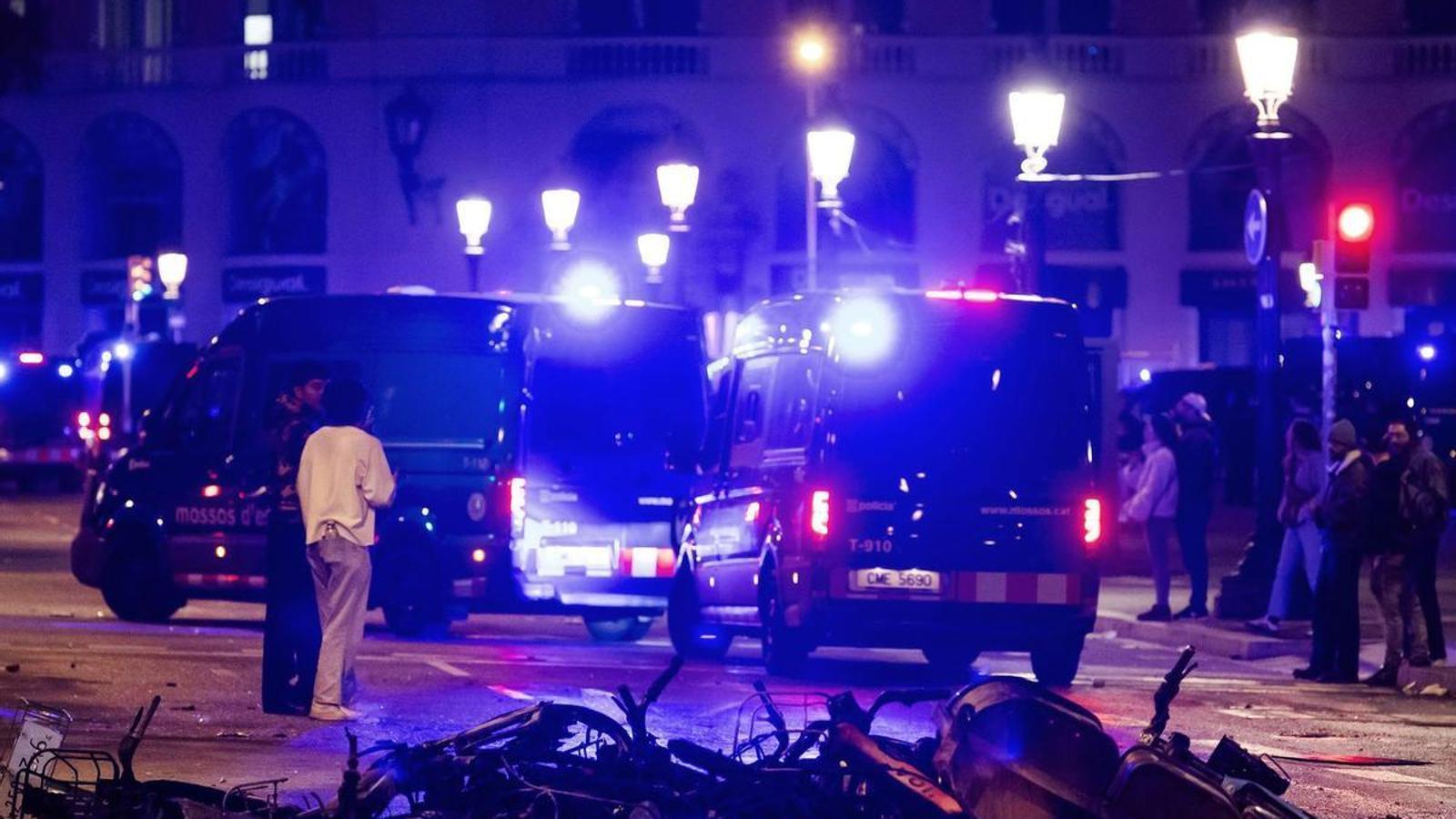
BarcelonaThe figure of 52 people arrested –three of whom are in preventive detention– during the riots of the November 11th general strike is a high figure. Especially, considering that the disturbances did not last many hours: they started before 9 p.m. and by 11 p.m. they had already been considered practically over. The majority of these arrests were carried out by groups of plainclothes officers, joint teams of the Mossos d’Esquadra and the Barcelona Urban Guard, who had already begun to make their presence felt in the city center by the evening. It is an image that was repeated during the Blocus riots on October 24th and in the failed call the following Saturday. This police technique, however, is not very common. At one point, over the police radio, they even got confused and said that a group of rioters was coming when it was actually these plainclothes officers.
The presence of groups of plainclothes officers, in large part, explains the 52 detainees from the general strike and the 130 arrested in the Blocus riots. These figures are even more relevant if we compare them with those of the strongest and most recent riots that have taken place in the country, such as the protests over the imprisonment of Pablo Hasél or the post-verdict demonstrations of the Procés. And this is despite police sources admitting that those were more belligerent and longer than the current ones.
For example, none of the nights of the riots over the imprisonment of Hasél ended with more than ten arrests, except for one where they exceeded thirty. The same applies to the post-verdict protests, which recorded similar figures. In other riots that have taken place, such as the pro-Palestinian protests, the disturbances against covid restrictions, evictions like that of La Ruïna and El Kubo in Barcelona, or the incidents this year on September 11th, the arrest figures of November 11th or the Blocus concentrations are not reached, not by a long shot.
Police sources reflect that back then these groups of plainclothes officers, so numerous and so destined for making arrests, were not created. But they are not new. To find them again, one must travel back to the general strikes of 2010 and 2012 and the riots that occurred at that time after the celebrations of the titles won by Barça. At that time, the detainees did, in many cases, exceed one hundred. Furthermore, many of them were arrested by these large groups of 'ferrets' (this is how the figure of the plainclothes officer is known in police jargon).
The 'contres'
These groups, according to police sources, stopped being used over time because they also had drawbacks. The main one is that you place a group of police officers, all dressed in black, very close to a demonstration, and this can create a certain level of intimidation and can influence the right to protest. In fact, on November 11th, when a group of anarchists started painting and trying to smash the first shop windows, a group of plainclothes officers was activated and was intimidated and attacked by these anarchists and other participants in the protest. In a way, this was the starting point of the riots.
However, there are also various elements that make them valuable in certain specific contexts. The most paradigmatic cases are those of Blocus and the riots following Barça's titles fifteen years ago. These were situations of looting of businesses carried out by small, non-specialized groups without a clear ideology or a mass of people defending an ideological stance. This context, police sources reflect, is ideal for these large groups of plainclothes agents to be effective.
On the other hand, if we look at the post-sentence protests or those supporting Pablo Hasél, here we are indeed talking about masses of people, united by a common cause and with groups specialized in causing disturbances: they know how to hide among the protesters and act together to avoid being arrested. In this case, one of the problems with intervening in groups of plainclothes officers with large masses of people is precisely that the protesters might revolt or denounce the police action, since the fact that there are many officers makes it difficult for them to go unnoticed. Furthermore, they are not agents specialized in demonstrations and social movements, but in most cases, they are police officers who work in plainclothes on the street, dedicated to arresting thieves and people dealing drugs.
Wait for the end
In recent times, the public order strategy of the Mossos has traditionally been based more on containing disturbances in a more direct way, with many Brimo agents deployed, and waiting until the end of the riots, when the main agitators are already clear and identified, to begin making arrests. However, on the day of the general strike, this was not entirely the case, as the first arrests occurred just as the disturbances were beginning and the Mossos public order agents (Brimo) opted for a role of less intervention and with fewer police charges.
Police sources also link the fact that the public order intervention was less direct to the loss of tools to be able to manage these situations. Now, apart from baton strikes in hand-to-hand combat cases, the Mossos use foam projectiles, but only for short range – along the way, rubber bullets and long-range foam have been lost –. It is true that in the pro-Palestinian protests the use of pepper spray was authorized, although it caused much controversy and a specific protocol has now been drawn up for this tool.
On the other hand, the current public order model of the Mossos is one of distance. That is to say, they usually do not enter much into hand-to-hand combat with protesters nor do they try to match the number of police with the number of people gathered, as does happen in other countries further north in Europe.
Hitting the table
In any case, police sources reflect that, especially with the Blocus movement—with the general strike, the shadow of this movement was still present—it was necessary to send a forceful message to the sympathizers of this phenomenon because there was a risk that it would become entrenched as the months passed. In fact, until recently, the Mossos have had a few quiet years on the streets. Now, after the last few months and with elections just around the corner, they foresee a new scenario of greater polarization.
