Reconstruction of the November 11th riots: this is how a group of anarchists started them
The Mossos followed about fifty people from the air, but they acted jointly and quickly
-
CAT -
CAST
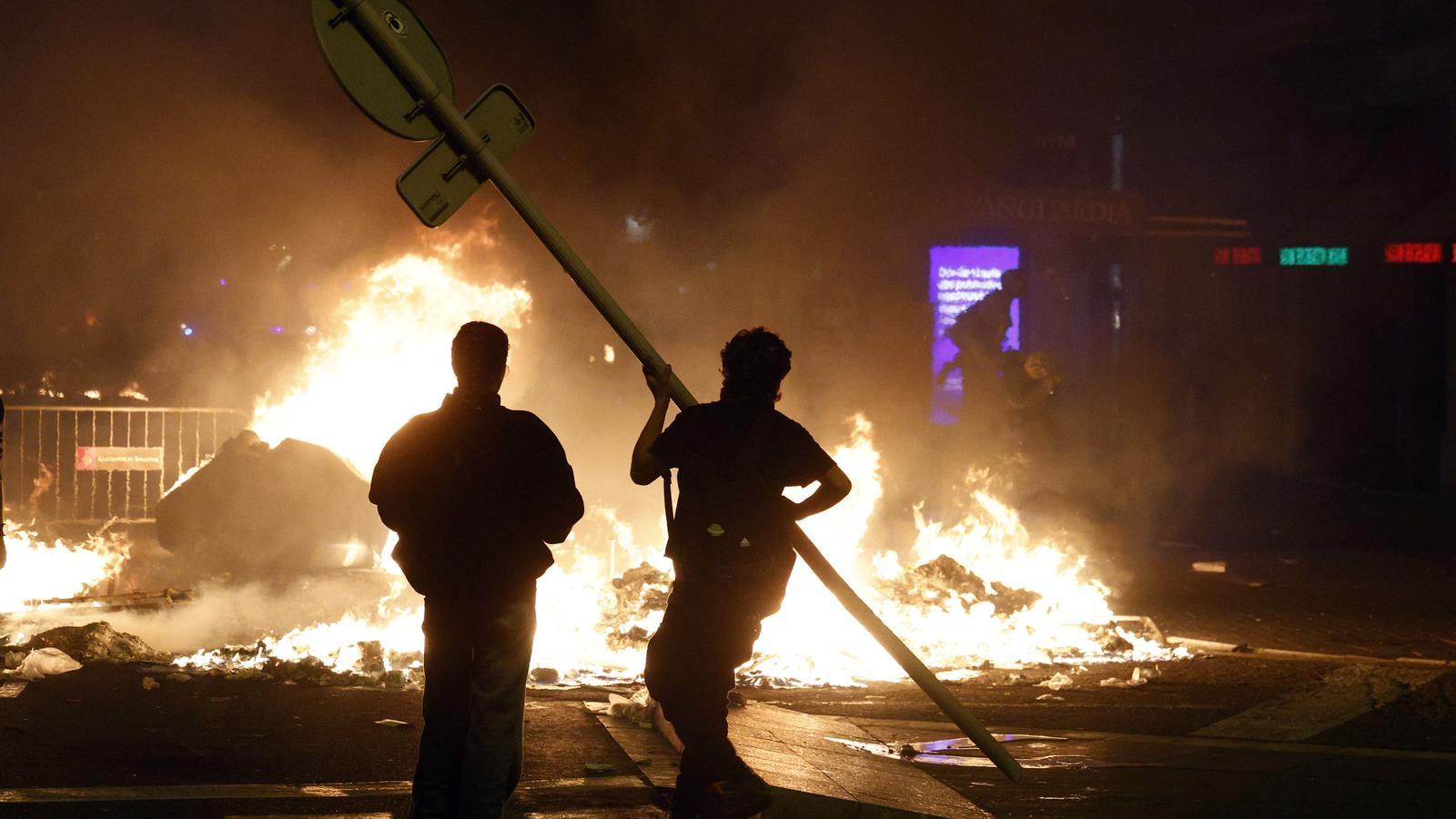
BarcelonaFrom the air, with drones and helicopters, they could already be clearly distinguished. On Passeig de Gràcia in Barcelona there were a great many people. The general strike unions had called a joint demonstration, but it ended up fragmenting. To gain visibility and keep their people more grouped together, some unions chose to concentrate a few streets down, resulting in three separate but close demonstrations. Despite the crowd, the Mossos d'Esquadra detected from the air a group of about fifty people, all dressed in black, near Casa Seat, at the Jardinets de Gràcia. In jargon it is known as a Black Block and it was they who initiated the intense riots on Wednesday. But how did they manage to walk along Passeig de Gràcia without being identified? How did they camouflage themselves among the mass of people?
The group of anarchists carried a banner with a symbol in favor of squatting and the Mossos tried to follow their movements constantly, especially with the help of drones. They all went in black from head to toe, with backpacks, technical glasses and even umbrellas to protect themselves. The police were able to trace their route: when the Jardinets demonstration began to go down Passeig de Gràcia, they did so much faster, moving ahead of the rest of the protesters. Always in a group, without losing sight of each other. Just before reaching the intersection with Gran Via de les Corts Catalanes, they began to make graffiti and kick some establishments, such as the Nike store. From this moment on, the police went from watching to responding: a group of 'fures' (the plainclothes agents of the Mossos) approached them in the middle of the crowd.
At the height of the Monumental fountain, the members of this Black Block detected the group of 'Fures' and went towards them, with the intention of coming to blows. This was the trigger for the riots. The plainclothes agents were forced to retreat and the Catalan police activated the public order agents of the Mossos. The anarchists responded to the Brimo by launching pyrotechnics horizontally, directly against the agents, and at that point the first clashes occurred.
The police decision was complicated: there were many protesters, including families with children and elderly people, who were demonstrating peacefully. Any intervention had to be surgical, very precise to avoid affecting the rest of those gathered. “There could have been many injured people,” warn the Mossos. In fact, the police had followed this group from the beginning, but it was difficult to intervene.
Vandalism acts
At this moment, it was seen how this group of anarchists had a high degree of organization and experience in street mobilizations. Linked to squatted social centers rooted in Barcelona for decades, it is accustomed to acting among the mass of people and camouflaging itself within it. After clashing with the police, they ran and began to smash various shops on Gran Via and Passeig de Gràcia. But unlike what the young people of the Blocus did, the anarchists did not loot any establishment; it was other protesters who were in the area who took advantage of the situation. This movement's struggle against capital does not involve committing robberies, nor does it for the pro-independence left, the other traditionally combative sector on the street.
When any journalist tried to record the actions, some member of the group quickly approached them to warn them to stop recording. The goal was to prevent the members from being identified later from media footage. There was one detail, however, that surprised the police: traditionally, anarchists have vandalized banking entities, which are closely linked to capital. This time, however, they chose shops of all kinds, some seemingly at random like the Lego store. The Mossos fear that this will become a new dynamic within the movement.
Once they incited the riots, they tried to disappear with the same speed with which they had broken in. And this is, according to the police reconstruction, where a diversionary maneuver begins: they lit a fuse that served other youths from other groups, such as those most linked to the independentist left or the Socialist Youth Organization (OJS), the Marxist split of Arran —with whom the anarchists do not act in a coordinated manner— to stage new riots and build barricades. Practically everyone, whoever the group was, wore black. Police sources state that they managed to arrest some members of this anarchist group, although they admit that the fact that there were many people in the same clothing made identification difficult. In fact, anarchists tend to leave as a block, when the riots are already underway, to avoid being arrested.
Rooted in the defense of housing
Anarchism has always been characterized as a fragmented network of unions, athenaeums, social centers, anti-fascist collectives, and autonomous groups. This plurality explains why, during the Process, anarchism took part in it, albeit in a more minority way, in the general strike of October 3rd or in the protests against the sentencing of the pro-independence leaders. The imprisonment of the rapper Pablo Hasél in February 2021 sparked a new wave of protests in which libertarian sectors had a strong presence in what (until now) had been the last major nights of riots in Barcelona and other cities in the country.
One must go back to the year 1996 to find one of the foundational episodes of the contemporary Barcelona squatting movement: the eviction of the Princesa cinema. Occupied as a self-managed social center at number 14 Via Laietana, the cinema was evicted 30 years ago on October 28th in a very forceful police operation, which provoked a subsequent demonstration that ended with serious riots in the center of Barcelona. That episode gave great visibility to the libertarian and squatting movement.
In the following years, the squatting movement consolidated with such emblematic spaces as Can Vies and articulated mobilizations against evictions, real estate speculation, and the criminalization of squatting, long before entities in defense of housing such as V de Vivienda or the Platform for People Affected by Mortgages (PAH) emerged. A task in defense of the right to housing that they maintain to this day. Libertarian sectors participate in mutual aid networks, neighborhood assemblies, and actions against evictions. It is a struggle that connects with the historical experience of self-managed social centers.
But returning to the 90s, anarchism began in that era, alongside the pro-independence left, the major anti-fascist mobilizations against Hispanic Day. Carrer de Sants was the epicenter in 1999 of a pitched battle against the police that ended with the windows of banks and real estate agencies smashed. A year later, both collectives also clashed with the police during the military parade in Montjuïc promoted by the government of José María Aznar.
During the 2000s, the anarchist movement participated in the protests against the World Bank meeting, which ended up being suspended in the face of social opposition, or against the European summit in Barcelona, in which the city was armored to prevent the recurrence of incidents from previous years. It would not be until 2014 that Barcelona would once again become the rose of fire. The eviction of Can Vies, occupied since 1997, triggered several nights of protests and riots with mobilizations that spread through Sants and other neighborhoods. The social response managed to stop the demolition and the center ended up being rebuilt.
