Iolanda Batallé: Iolanda Batallé: “There is a price I do not want to pay, when I go to sleep”
Writer and director of the Ona bookstore
-
CAT -
CAST
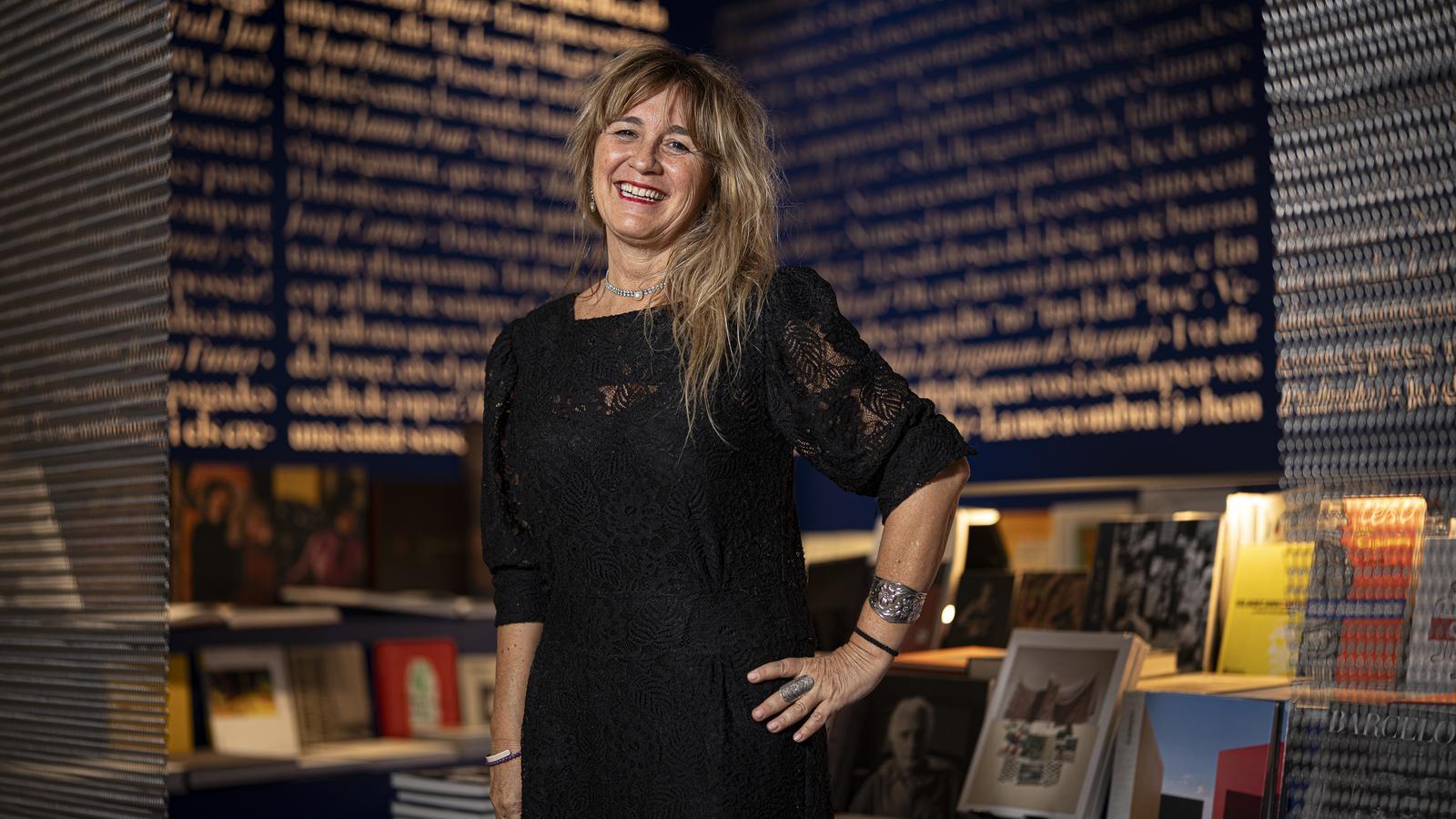
BarcelonaA few days ago, Iolanda Batallé (Barcelona, 1971) received the eighth Proa prize, endowed with 40,000 euros, for Far from California. The novel reconstructs a passionate and difficult youth romance of a writer inspired by the author herself, who has also drawn on her own professional experiences to build the book's second main character, a demanding and lonely editor. In Far from California, Batallé –who has been directing the Ona bookstore for almost five years– has her say on loving, creating, living, and suffering in two different times and places: the California, missed and at the same time feared, of the 90s and current Catalonia, based on a satirical x-ray of the book industry.
The first time you spoke to me about the years you spent in California was during a trip to Sweden in 2016, for the launch of Jonas Jonasson's new novel at Catedral, an Enciclopèdia Catalana imprint you were running at the time.
— And what did I tell you?
You explained to me that it had been very important, for you, and that at that time English was one of your passions. Not until you published the novel did I know that you also found love there.
— I returned from California in 1998, and that world has accompanied me all this time. Sometimes I had proposed to write about all that, but I resisted it, because I knew that returning there implied facing it. I still haven't dared to take a plane and go there.
Finally, you have traveled there in writing by becoming a 23-year-old young woman, Maria Viladoms, who, despite having been married for not long to Joe, a South African Englishman, goes to Berkeley thanks to a scholarship while he works in India, and that stay changes her life.
— The last thing Maria expects is to arrive there and fall in love with Max, a 19-year-old Californian who turns everything upside down.
Maria makes brave and rash decisions, and that sometimes helps her, but on other occasions it takes its toll on her, doesn't it?
— I think I describe her very well when I say she is a disaster full of love. With the perspective of time, we are all a bit of a disaster, because there are decisions we make during our youth that mark us more as the years go by than at the moment of making them. I don't believe much in guilt, but the novel explains that Maria, despite being married to Joe, who is like a gentle giant, and whom she loves very much, lives a very different love story with Max.
Although they live in “a film about two young bodies falling in love”, it does not take long for her to discover that Max is “cyclothymic depressive”. “Death became something that could happen any afternoon, upon arriving home”, we read in the novel.
— When we are 20 years old we lack many vital and emotional tools to face certain things. The love story with Max has some very good moments: Maria and he have such a good time together that they are capable of throwing bicycle wheels across the campus and marrying a bird and a tomato.
Behind the militant smile of the protagonist...
— Behind the militant smile there is a lot of suffering. That is why it is militant. So that the suffering does not defeat her.
There is the darkness of Max's depression and the suffering it causes in himself and in others. Is it a vital learning experience for Maria?
— Yes. After years of struggling with it, she makes a decision that surprises everyone. Whenever you opt for one choice or another, you pay a price. As time has gone by, I have come to the conclusion that there is a price I do not want to pay, when I go to sleep.
Who is it?
— I need to think that what I have done is what I had to do. Sometimes we talk about the pain that has been caused to us, but in Far from California the pain we cause to others is also faced, not with the intention of hurting, but out of love. At the same time, the character of Maria becomes aware of the harm that the people she loves do to themselves.
The novel combines the parts written by Maria, recalling the years she lived in California, with the diary of an unnamed editor who mirrors the girl's youth experience. The editor writes: “For some, love is sex; for others, it is tenderness; for me, it is respect”. What do you think?
— From my present as a fifty-year-old I would tell you that, beyond the initial passion, love is what happens beyond this first stage, it is enduring the day-to-day, when everything becomes complicated and, if there are illnesses on top of that, even worse. True love is being there, it is staying, it is gifting each other time.
Do tenderness and respect win the game over sex?
— With time, tenderness is key, and respect is always so. The characters in Far from California are all quite respectful. It is another matter that they mess up and do not always know how to get out of it in the best way.
The novel's editor is a mirror and at the same time a counterpoint to Maria. If the writer lives "in space", the editor does so "in time". The editor's voice is that of experience, and she is more critical of the world than the writer.
— The editor of Far from California speaks of what she describes as a "circus" from a point of malice, but also of humor and appreciation. I have been dedicated to the book trade for 35 years. I have played all the parts, the only thing left for me is to create a distributor.
We are now in your office at the Ona bookstore, which you have been directing since January 2022, but before that you directed the Ramon Llull Institute, founded the publishing house :Rata_ and were at the head of La Galera.
— My path began at Galàxia Gutenberg, when Hans Meinke was still there, and from there I went on to become part of Núria Cabutí's team at Mondadori, Rosa dels Vents and DeBolsillo, where I grew a lot. As an editor working on the text, the contact with Constantino Bértolo was fundamental. I learned management thanks to Núria Tey and Núria Cabutí. Both parts are important and a balance must be found.
In the novel, the editor criticizes the part of the “Management enthusiasts,” who show her “some charts” with the evolution “of the sales, placement, and restocking results of the books” that she has contracted and edited in recent years.
— The more management-related part can allow you to escape to the other worlds that open up with every book. One of the most important novels for me has been, since I was 8 or 9 years old, Alice in Wonderland, by Lewis Carroll. Since then, I have been collecting it in different languages. When I was little, when I read about Alice or saw her on TV, in the Disney adaptation, I would cry because it scared me. I feel a great fascination for her and, for that reason, she always appears in my books, just as mental illness is always present in them, in some way, because I think we all suffer from some, to different degrees.
In Too Many Debts to Flowers (Columna, 2023) it appeared.
— Exactly. There it served to show a family pain. The family in the book proposed to save an abandoned village in the Pyrenees, and the mother went to the extreme of committing suicide. In Far from California it appears as a more intimate pain, which has to do with the pain of facing our youth.
Maria wonders if she will ever hear again from that Californian love, Max, and also from her ex-husband, Joe.
— When you have loved someone you never stop loving them completely, even if you are no longer together or you perhaps never hear from them again. It also happens with our dead, who continue to accompany us. In recent years, a few friends of mine have died, some suddenly, and others not so much. The writer Xuan Bello, for example, who was like a brother. The day that another friend, Pep Lluís Aguiló, informed me of Xuan's death, I was about to call him because we wanted to go see him in Asturias, as we did almost every summer. Another great writer with whom I had a very good relationship, Begoña Huertas, also died. She was suffering from cancer, but she had improved... until she had a relapse. I often repeat that we are little people who one day die and that's it. That is why it is worth believing in what we do and not giving it great importance. To any writer who is starting out, I would recommend that they go to a bookstore to realize that it is an extraordinary fact that someone chooses our novel and reads it. If, on top of that, they connect with it and let us know, it is a miracle.
