Three hours and a half to vote at the London consulate
More than a thousand Spaniards queue to vote on the first working day for residents abroad

-
CAT -
CAST
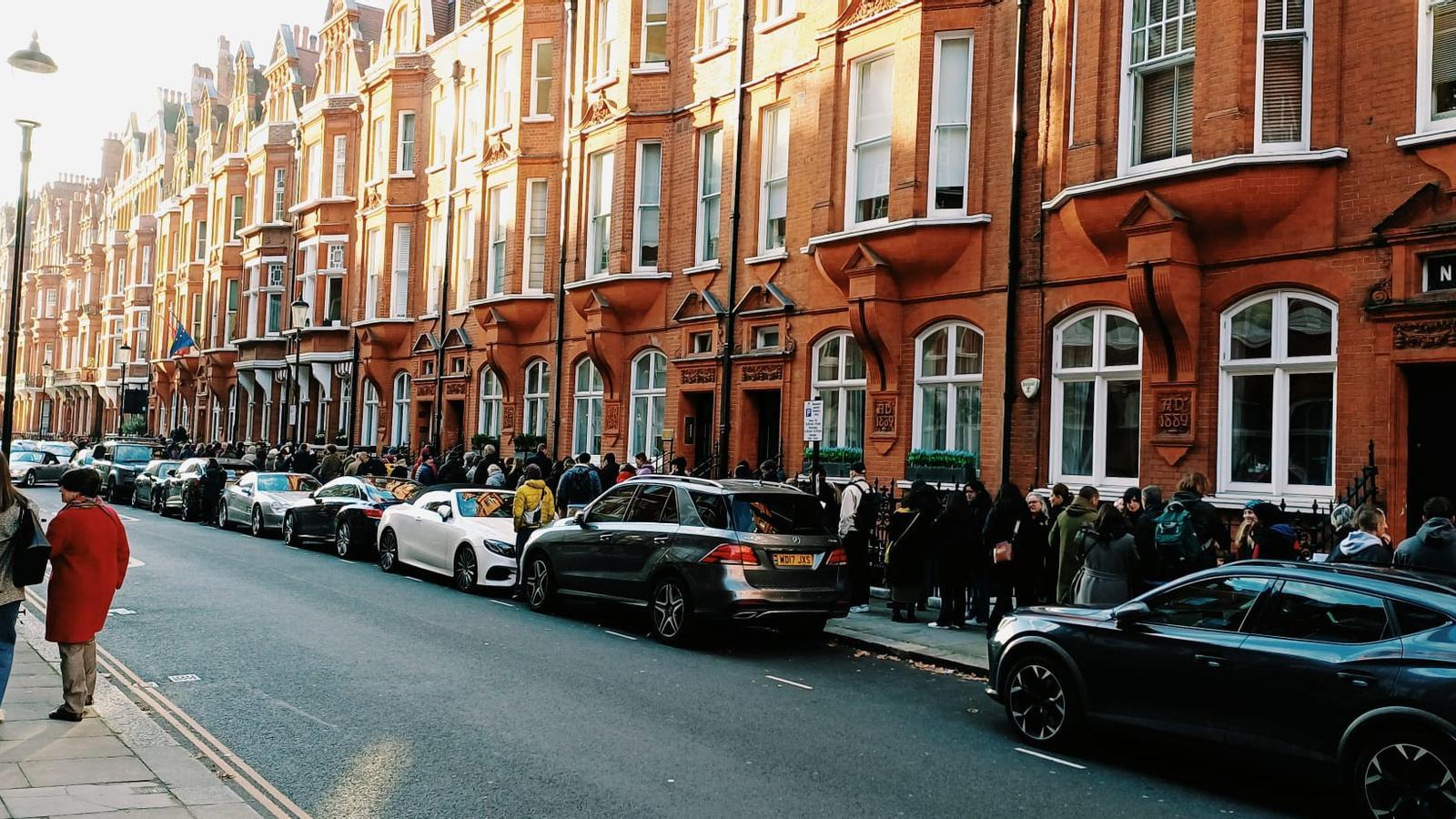
LondonIt was supposed to be a pleasant walk around Sloane Square, taking advantage of this Saturday's London sun, despite the cold of the day: between seven and eight degrees. A walk also to, among other matters, cast my vote for the 29-N elections at the ballot box set up at the consulate, on Draycott Place. In-person voting, not by mail, but not because I have ever believed the arguments of the Popular Party and Vox regarding hypothetical manipulation. I was going with my partner to, afterwards, be able to get ahead with some Christmas shopping at John Lewis and King’s Road. the arguments of the Popular Party and Vox regarding hypothetical manipulation. I went with my partner so that, afterwards, we could get a head start on some Christmas shopping at John Lewis and King’s Road.
But just turning from Cadogan Gardens to Draycott Place, the family plan went down the drain. The queue to vote in person was nothing like those of previous general elections, let alone regional ones: just over twenty meters, fifteen minutes of waiting at most. The queue we stood in today to vote is one I have neither seen nor joined ever in the 25 years I have lived in London. When we arrived, shortly before 11:15 a.m. local time, it was already more than 250-300 meters long. A couple of hours later it had grown even more: 400 or 450. We voted shortly before three in the afternoon. The consulate, on the first day of CERA voting (census of residents abroad), closed at five. But one of the officials assured me that they would let the people still in the queue at that time vote.For weeks, some polls in Spain have been announcing that the turnout for next Sunday's elections will be historic: well above 70% and, even, with the possibility of exceeding 75%. Does what I saw today in London, something none of the people I have spoken to had ever seen either, signal this extremely high turnout? It is hard to say. But, without a doubt, it is a clear symptom of the great interest there is in elections that are shaping up to be historic according to what most polls suggest: that the far-right Vox party could enter the government hand in hand with the PP.
Only 10%
In the July 2023 elections, the United Kingdom had 134,201 Spaniards registered in the electoral roll of residents abroad. Of these, 97,548 belonged to the consular district of London, where 17,662 people exercised their right to vote, which places participation at 18.1%, almost double the average for the overseas vote. The data, partial, may still be indicative. Although it is true that, among those of us who live abroad, very few participate in electoral processes. A disinterest favored even more by the requested vote law, promoted by Mariano Rajoy, which forced one to request the documentation to exercise a fundamental right. Now, after its suppression, in principle –although it is not so– one receives the documentation to vote or not. In July 2023, 233,688 citizens participated in the elections from abroad, only 10.04% of the 2.3 million registered.

In his rallies, the Spanish Prime Minister, Pedro Sánchez, speaks of 75% as the turnout figure that could give him the 176 seats to reach a plurinational left-wing majority. One of the common clichés of elections is that the higher the turnout, the more the left rises. But it is hard to say.
In the more than three hours of waiting in line, I walked up and down and respectfully asked people what they would vote for: a progressive option or a conservative option, without going into further detail. I asked people who were alone, and people who were in groups. There were those who, while queuing, were reading: La península de las casas vacías, by David Uclés; a novel by Eduardo Mendoza, or English authors like Graham Greene and Julian Barnes.
I assume, as it should be, that the sample has no statistical value. But what did they tell me? A group of Andalusians were clear that they would vote for Adelante Andalucía; other people, the Popular Party; others, a progressive vote; another group of naturalized Spaniards, all progressive, too. And the first person I asked, right on the consulate steps, a boy of about 25, from Malaga, told me: “Vox, which is what my family from Benalmádena told me to vote for”.
I have shared the queue on X in several posts and have been told everything: from congratulations and cries of hope, due to the topic of the left and high turnout, to claims that everyone in London votes for the PP, or that the images I posted were generated by artificial intelligence. I have not been spared some reminders of my mother or the Prime Minister's mother either. Even the Planeta prize-winning writer Lucía Etxebarria has responded by saying that a "fraud" is coming.
The turnout on November 29th, perhaps, has a first indicator in the London queue. The ballot box, I can attest, was very full when I arrived. In addition to the two mandatory officials who certified the authenticity of the process, a representative from the BNG and one from the PP were also watching over a process that was more than clean. Tired from the three hours of waiting, but clean.
