Rosalía triumphs at the great LOS40 Music Awards festival
The author of 'Lux' takes four awards at a gala at the Palau Sant Jordi where the public had the final say
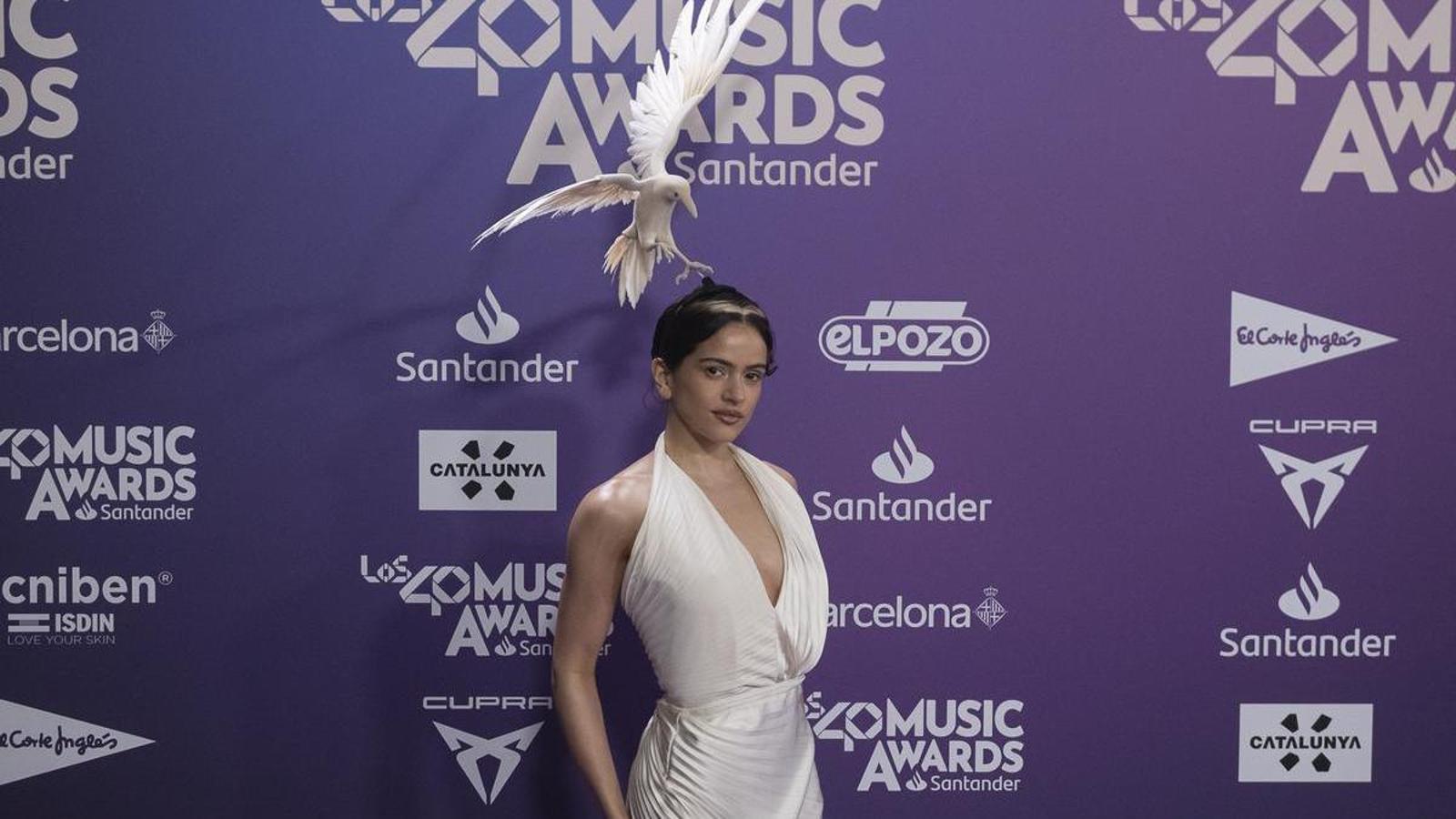

BarcelonaThe Palau Sant Jordi had dressed up for the gala on Friday evening. The floor, accustomed to beer splashes and the occasional cigarette butt, had been covered with tables set with white tablecloths and stars of national and international stature. As the last taxis arrived, just past eight o'clock, the sponsors' mascots were handing out gifts to the last teenagers looking for the entrance: an gloss from Essence, or ISDIN, with its anti-acne soap. With the first thumps of the speakers, however, the scurrying began: "It's starting, it's starting!". LOS40 Music Awards celebrated their prizes in an ambitious and especially Barcelonan edition with a good handful of artists playing at home in various categories: Aitana, Bad Gyal, Rosalía, and Estopa.
The awards culminated the celebration of LOS40's sixty years, and they did it in style: a week of surprise concerts and musical events and a gala with seventeen live performances. Before starting, a voice-over announced the chances of each nominee, in the style of Eurovision: Rosalía gathered seven nominations; Quevedo, five; Shakira, Eladio Carrión, Manuel Turizo, as well. With every name, the audience roared with euphoria for their artist and, if the awards were measured in decibels, it is clear that the winner of the night would have been Quevedo.
Rosalía was the great winner and took home four awards, among which were best album for Lux and a Golden Award as global artist of the year. Due to the show's format, this kind of pop all-stars macro-concert, the awards and speeches ended up seeming like appetizers to space out the performances, which followed the language of the mega-tours we have seen in recent years: dancers, lots of pyrotechnics, and a camera crew to follow the artist from all angles, often interposing themselves directly between the musician and the audience in this music video recording that modern stage settings have become. The gala comes at a time when the pop industry seems to have won the battle against the problem of streaming and social networks precisely through major live shows: tours, megatours, concepts, eras, and true theme parks surrounding the artist, from "Bad Bunny's little house" to Shakira's Macondo.

Aitana in English
Perhaps because of this festival format, however, the artists remained in the background when they were not performing. It was a night of brief speeches, dedicated to music and above all to the fans. The most memorable moments belonged to the brothers Estopa, with a newly released album, who upon winning a Golden Award ended up singing a cappella accompanied only by the audience, in a great triumph for their legacy. Their interventions were also the funniest: things like the “close-up glasses” (search glasses), or “you might wonder why we have gathered you all here,” making each other laugh to finally tell the artists that continuing to make songs in times of anger is also worthy of an award. Another endearing moment was the speech by Aitana, winner of the best song award with Superestrella and best tour in the national category, who gave her speech entirely in Catalan, the only one of the evening, and dedicated the recognition to her friends from Sant Climent de Llobregat, who had come to see her.
This was a gala that was held only ten days before some more than heated elections. Mentions of politics were rather discreet: thanks to the team and the fans, and little else. The most decidedly political moment was the presentation made by Rosalía for the award for the cultural phenomenon of the year to Guitarricadelafuente, who minutes before we had seen singing hanging from a log and surrounded by arrows like a Saint Sebastian. To present him with the award, the one from Sant Esteve Sesrovires had gone up on stage alone, all in black, to declare that it is through films such as La bola negra and the voice of Guitarricadelafuente that we remember that there are hard-won rights that must continue to be defended. The most emotional moment of the night, however, was the presentation of the Golden Award to Alaska, who was recognized as someone who had made space for diversity in a Spain very different from today's. While the singer accepted the trophy, the audience chanted “A quién le importa…” with such force that it forced the music in the room to stop to make room for the anthem.
In fact, the luck of a gala designed as a big concert was being able to see firsthand the reaction of an audience thirsty for music, and how it exploded with the artist when they managed to do something as simple as making them sing or dance, even though making music has now become something spectacularly complex. Carlos Vives, who, by the way, wanted to dedicate an award also to his “Catalan relatives”, since it had been explained to him that in Catalonia there were many Vives, managed to make the whole Palau Sant Jordi stand up with a mix of his cumbias. If you were going or returning from the bar during the performance by Romeo Santos and Prince Royce, you could find all sorts of couples scattered around the venue dancing bachata playfully, hidden between the columns. Towards the end of the night it seemed that the cheers had won, and the Sant Jordi finally lit up completely with the performance of Quevedo, awarded best Spanish artist. What a thing, so ancient and so revolutionary, the music that makes you move.
