The Mossos admit that the police presence did not manage to dissuade the disturbances
The police detected minors under twelve years old and still do not know who is behind the calls

-
CAT -
CAST
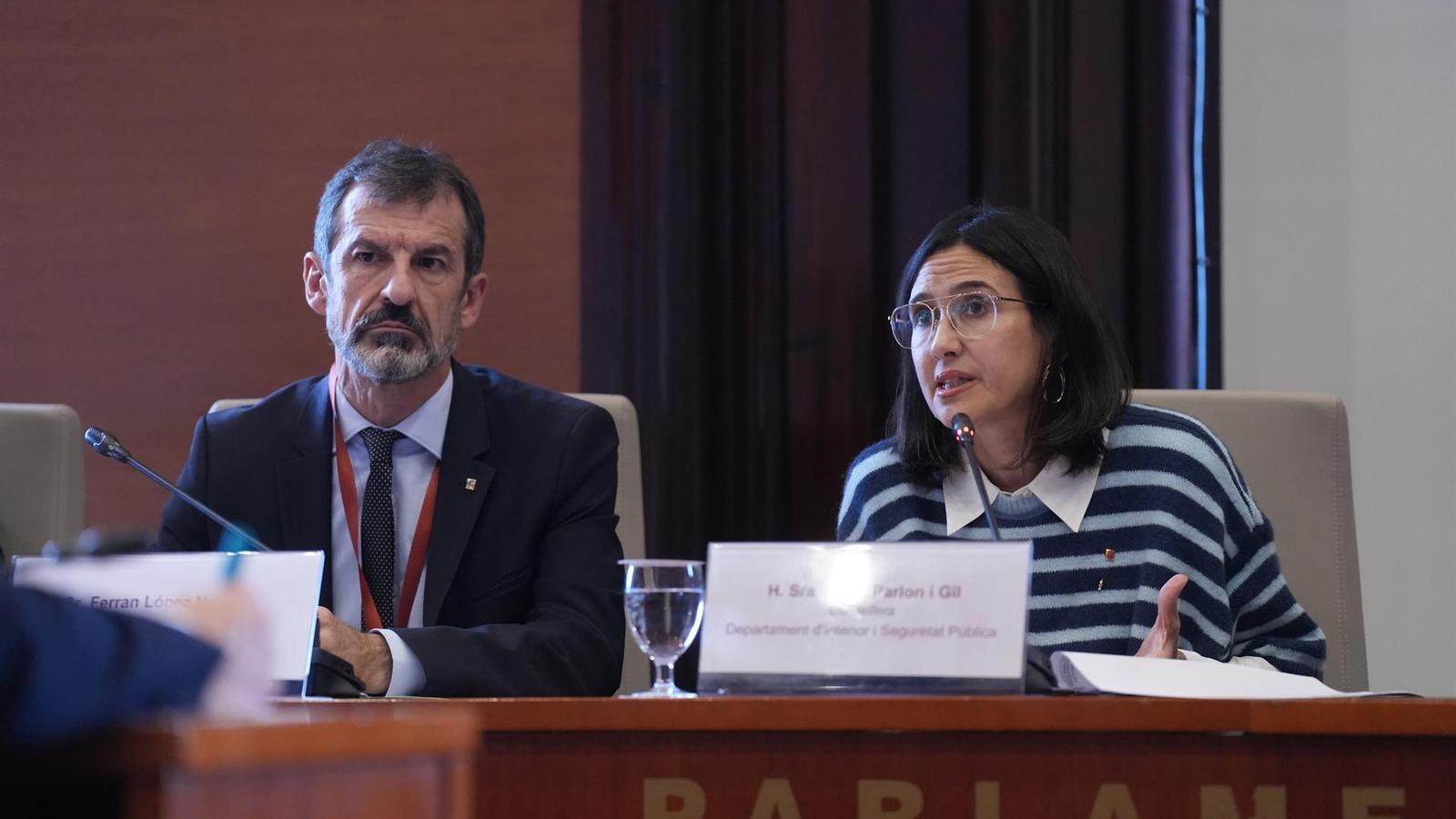
Barcelona"It didn't take us by surprise, the facts deny it." With these words, the Director General of Police, Ferran López, has denied that the Mossos d'Esquadra did not expect the riots on Saturday in Barcelona. The demonstration had a level 2 out of 3 rating and, as this newspaper has already been explaining, they carried out 300 checks on young people before the gathering and also confiscated hammers, pyrotechnics, sprays, stones, and balaclavas. There had already been some 'Blocus'-style demonstrations before, one in Manresa, for example, without incidents. But the police were indeed surprised by the violence of the young people. "We did not correctly gauge the level of violence, we had never seen it before," admitted López before an opposition that criticized the Mossos for not sufficiently anticipating this scenario, to the point that Junts has requested the resignation of Minister Parlon.
The young people acted this way after the police had stopped and identified them minutes earlier, even though there was a large operation in a Barcelona full of people. It was a Saturday afternoon at Portal de l'Àngel. And yet, the young people did not go elsewhere, nor did they return home. Minors and adults, including several twelve-year-old children, responded to the preventive police action by counterattacking with violence. The Mossos were not a deterrent, and this concerns the police. "It forces us to ask ourselves about the loss of respect for authority. The police presence was not effective at that moment in making them go home," stated the Chief Commissioner of the Mossos, Sílvia Catà.
López and Catà accompanied the Minister of the Interior, Núria Parlon, during an appearance at the Parliament to give explanations for the riots. They all spoke of a new dynamic, and Parlon quickly wanted to make it clear that they are not talking "about young people claiming their rights," but rather "about attitudes typical of criminals." "The police are prepared," she said. The minister appealed to families to take responsibility for the content their children watch and also warned that "they will not stop shutting down groups in which young people are recruited.

The threat, however, cannot be considered closed. Many new calls are circulating, anonymous posters speaking of Vic, Reus, Tarragona, and other cities. Catà, however, has said that they are especially concerned about the call for riots this Saturday in Barcelona. The police have already shut down two Telegram channels with more than 2,000 people where there was open talk of robberies and barricades. Parlon has guaranteed that she will put "all resources" at their disposal.
The chronology
The first groups began to be detected on October 20th, four days before the riots, according to Catà's chronology. The next day, the General Commissariat of Information (CGINF) began detecting TikTok profiles calling for protest. Initially, the activity, in general, "was low," although there were the first comments encouraging theft and some saying that everything would be peaceful. The threat, however, became real within a few hours.
Despite the prior work of identification, removal of furniture (such as dumpsters), or prior warning to merchants –López has admitted that they must improve in this area and, for this reason, they are intensifying contact with the sector–, the riots began at 7:00 PM and the incidents did not end until one in the morning. Almost 400 police officers were deployed, who arrested 133 youths, 85 of whom were minors. And López has warned that there will be more arrests. Of these, 64.8% are Spanish and 32% are foreigners. Furthermore, there is 3.1% for which there is no data. The majority (74%) had no prior record and only one was in a sheltered center. The Juvenile Prosecutor's Office has requested, for the moment, supervised release and a prohibition on attending demonstrations for a total of 46 minors. "Anyone's children can commit serious crimes, regardless of their origin," said Parlon in a harsh reply to Vox. The minister went on to add that there is "a serious problem, regardless of who governs, if a part of our youth" acts like this.
"We don't know who is behind it"
"We did what we had to do. After what we have seen, we must act differently," admitted Parlon, who advocated against asking the police for "miracles." In this sense, police commanders did not want to disclose anything about the investigation to determine who is behind the accounts, the groups, and, in the event that one exists, if there is a leader or an organization leading them. "We do not know who is behind it, at the moment. We do not want to speculate," concluded López.
Catà admitted that these processes are often costly and that is why they have asked for help from Citco, the Intelligence Center against Terrorism and Organized Crime, which depends on the Ministry of the Interior and where the Mossos are integrated, to shut down groups. This request is already being executed. The Chief Commissioner also said that they maintain regular contact with the platforms and that last year they sent 1,600 requests to these social networks. "Anonymity cannot be confused with impunity," warned Catà, adding the need to face the problem not only from a police point of view. Nevertheless, the Mossos admitted that the large number of detainees, practically unheard of in riots, pushed the system to its limit.
The explanations from the Interior leadership did not prevent the opposition from criticizing the planning of the police operation. Josep Rius (Junts) regretted that they did not act with more diligence, Laia Cañigueral (ERC) stated that something failed, and, from the PP, Alberto Villagrasa requested that, for Saturday, they count on the National Police if necessary. Xavier Pellicer (CUP) asked not to attack minors, who are "instrumentalized" by the far-right.
