The right to housing seen by children: these are the winners of the ARA and Unicef contest
These are the drawings and stories awarded from the contest convened by ARA and UNICEF in which ten centers from the Camp de Tarragona have participated
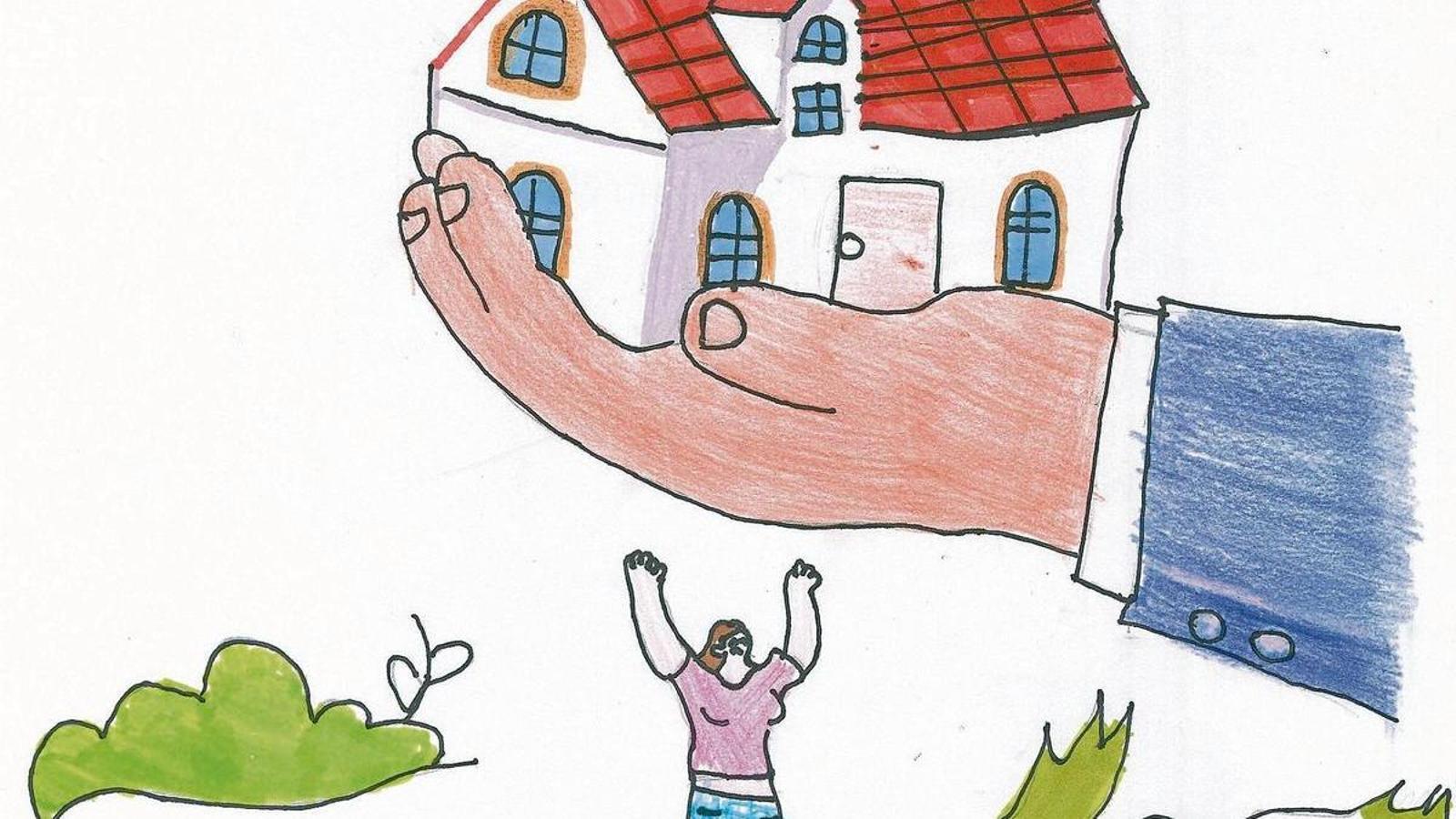
-
CAT -
CAST
TarragonaStudents from first to sixth grade of primary school and from first to fourth year of ESO from ten educational centers in the Camp de Tarragona region have participated in the short story and drawing contest about the right to housing organized by ARA and UNICEF with the collaboration of the Tarragona City Council and the Tarragona Provincial Council. These are the winning and finalist stories and drawings that have participated in the contest.
Category 5th and 6th grade of primary school
I like my house a lot
Hello, my name is Valentina, my house is very beautiful, it is large and cozy, it is located very close to Europa square. My home consists of a huge kitchen with three rooms, those of my parents, my brother and me, there is also a living room with a large television. My room has a closet to put my clothes in and a large bed where one rests very well. I would like my house to be a little bit bigger, but only a little, because I believe my home has everything we need. But I would like to have a house in the middle of nature. When I was little I lived in Peru and I always thought about living in a better place that had a pool, a garden or a very large room. Now that I am older I have thought about it better and I know perfectly well that back in Peru I did not have many comforts there, sometimes the electricity or the water would go out... but when I moved to Catalonia I realized that it was all different from my old house, my current home is much more comfortable.
I think very often that when I am older I would like to have a house in the woods, in the middle of a mountain, surrounded by nature, animals and the tranquility of the forest. I would also like it to be like a large cabin with a bonfire next to it and brown and green furniture, with a fireplace to be able to warm myself in the winter and spend the afternoons reading a book or watching the rain through the window. Also, I would like to have a cat because I like them a lot. I believe that living in a house like that would be very beautiful, since I could disconnect from the noise of the city, do outdoor activities and enjoy myself freely in the countryside.
I would spend time with my family and we would all enjoy nature together by hiking in the mountains, playing board games, or simply eating and contemplating the beautiful landscape through the window with a cup of coffee.
Although I like my current house a lot, I believe that in the future I will be able to achieve the house of my dreams, we still have plenty of time to imagine and desire the dream home. I hope it comes true.
- La Salle de Reus
- 1st prize

What is your home like and how would you like it to be?
Our home is a place where we feel good. It is where we spend most of our time with family, rest after a long day, and share special moments. In winter we are warm there and in summer it is cool. This makes us feel comfortable all year round.
Each room has what we need. There is a bed to rest, a desk to study, and a space to keep our things. We also have toys, books, and corners where we can play or do the activities we like. The dining room is one of the places where we spend the most time together. We talk, laugh, play, and also share meals there. In the kitchen, we prepare food, and in the bathroom, we take care of ourselves and maintain good hygiene. Furthermore, we have light, water, and heating when it is cold. When the heat arrives, we can cool off and be more comfortable. All of this seems normal, but in reality, it is very important to live well every day.
We are also lucky to have a school where we can learn many things. There we find friends to play with, and teachers who help us grow and discover new things. If we get sick, we can go to the doctor or the hospital to be cared for. These are things that are part of our lives and that sometimes we do not value enough.
When we think about all this, we realize that we are very lucky. Not all boys and girls live in the same conditions. Some do not have enough food or drinking water. Others live in very small houses or in dwellings that do not protect them from the cold and the heat. There are children who cannot go to school every day or who have to work from a young age to help their family.
There are also those who do not have medical assistance when they need it or who do not have safe spaces to play and interact with other children. There are even families who do not have a house to live in and go through very difficult situations.
That is why it is important to value what we have. A house is not just a building with walls and a roof. It is the place where we feel safe, where we grow, learn, and share moments with the people we love. Having adequate housing helps us live better and have opportunities for the future.
We must be grateful for everything we have and remember that there are people who need help. Being supportive and thinking about others is a way to build a fairer world for everyone. LET US REMEMBER THAT HAVING A HOME IS A RIGHT OF ALL CHILDREN
- Mare de Déu del Carme School in Tarragona
- 2nd prize

My home
My town is small, it has a lot of countryside and my house is big. It has heating and we are neither cold nor hot. It has two bathrooms, a kitchen and a living room.
I have a bunk bed, a desk and a study chair. I have three fans and air conditioning. I study well and I play a lot.
I moved once because it was a rental and we had to pay every month. My father lived in a very small apartment block. There were five siblings when my father met my mother. They went to live in Bràfim. My mother's home was small and she lived with my grandfather and grandmother. When they had my brother, they moved house. I would like to have a larger home because I want a dog and a cat. I believe that all children need a decent home because it is essential.
- Sant Jaume School of Bràfim
- Third prize


ESO Category
The right to housing
First prize
It was a cold autumn afternoon and the room light illuminated Joel's desk, full of Social Studies and Mathematics sheets and notebooks. The next day he had the deadline to hand in an essay for class. The teacher had asked them for a text about the right to housing, a topic that often appeared in the news, but which seemed a bit exaggerated to him. Then he sat staring at the blank sheet of paper without really knowing how to start, and dead tired because he had recently arrived from training.
Not knowing what to write, he turned toward the window of his room to look out at the street. On the building opposite, for a couple of weeks now, there had been a huge banner hanging from one balcony to the other where one could read: “Housing is a right, not a business”.
Herman lived there, a kind, elderly man who had been in the neighborhood his whole life and was the owner of the corner bookstore, where he had been going to buy notebooks since he was a child. But last week his mother had explained the situation to him: an investment fund had bought Herman's entire building and wanted to raise his rent by almost double to renew the contract. Since he could not pay that outrageous amount with the bookstore's meager income, they were threatening to kick him out. The neighbors in the area had organized quickly to help him, holding meetings in the square and hanging banners to raise awareness of the problem.
Suddenly, Joel saw it clearly. The work did not have to be a boring list of articles of the Constitution or complicated terms. It was about real life, about people like Herman and communities that help each other. Returning to the table, he picked up the pen and began to write his story and reflection: A roof to live under, a right to protect.
When we think about the most important things for living, almost everyone thinks about food, health, or family. But we often forget that without a home to take refuge in, none of this is possible. Having a place to sleep, cook, study, and feel safe is the foundation for any person, as housing is the gateway to all other human rights.
These days, in our own neighborhood, we see how many families and lifelong neighbors are facing the danger of losing their homes. This happens when the price of rent rises so much that a working person cannot pay it, they not only lose the house: they are separated from their friends, their environment, and part of their memories.
It is urgent that society and laws make a change; without a stable home, it is impossible for children to go to school with peace of mind or for adults to be able to keep a job. A town or a city is not just a collection of beautiful buildings, but the people who live there and are part of it. Therefore, governments and institutions have the duty to protect the right to housing and place limits on abuses, since the need to have a dignified roof over one's head must always be above the economic benefits of a few.
Once Joel finished writing he felt truly fulfilled, because that time doing homework was different, he had fun and felt proud of what he had written, from then on he decided to try not to leave things for the last moment. All because of a simple social studies assignment.
- La Salle Tarragona
- 1st prize
Start from scratch
Second prize
The worst part about leaving Barcelona, the city where I grew up, was not packing my suitcase or leaving my home and all the memories there. The worst part was giving the last stroke to Babi, my dog, who was going to stay with my grandparents. My father took my hand, as a sign that we had to leave, while my mother, still weak from her illness, only gave me a forced smile. I knew they were trying very hard, so I swallowed my tears and we got into the taxi to go to the train station.
For weeks, I had been hearing my parents from my room talking about our financial situation; my mother fell ill and my father had been fired from his job due to a misunderstanding, but luckily, a new opportunity arose for him in Berlin. My father's job would not make us rich, but it would give us a future.
Finally, we got on the train, sixteen hours of travel awaited us, sixteen hours of bad thoughts about what could happen in Berlin. As I had already imagined, I could not sleep, I kept being afraid of the language, not making friends, the fact of missing Babi and my grandparents or knowing if we would have a real house.
After this long journey, we arrived in Berlin, dad was on his mobile looking for the address of what would be our home and mom was a little sleepy from the effect of the pills.
At first glance, I liked the city a lot, but it was very cold and all I wanted was to get into the taxi, arrive at the house, and turn on the heating.
Father finally found the address and we quickly got into the taxi.
We had some complications communicating with the taxi driver, but we finally arrived at Gerichtstraße street, where our new home was. Everything was a bit dark and the buildings looked very old and in poor condition.
Clearly, I expected that there would be no one else in the apartment, to be able to have my own room, take a shower with hot water, turn on the heating, and above all, be comfortable. But when we opened the door, there were six people inside. They were two families who lived in that apartment. At first, I didn't understand anything, but I didn't complain either because I didn't know why my parents had chosen that apartment.
The three of us had to live in a room that was not very large, share a bathroom with those strangers, take showers with icy water and be very cold, especially at night.
With patience and love, my mother explained to me that for the time being we had to stay in that apartment because the rents of other apartments were very expensive; first, we had to wait until we were established with my father's salary. That same night, I heard my mother crying with my father because she did not want that life for me. My father was comforting her, and I could not help but start crying and give them both a hug.
The next day, my father got up very early to go to work. Since I was starting school the next day, my mother and I went to explore the city. When we returned to the apartment, I was still not used to seeing strangers in the place where I lived, so I said hello and went to our room. A short time later, my father arrived and told us how his first day had gone.
The next day, I also got up early, because school was already starting, I was very nervous and very afraid that I wouldn't be able to socialize. Surprisingly to me, many children approached me to talk and ask me curious things about Barcelona. At first, we communicated by using gestures and mixing words in English, but as time went on, I understood German better.
And so the months went by. Living with so many people at home wasn't easy either. We had to learn to take turns cooking and to respect others' silence, but those strangers from the first night ended up becoming our friends.
All of a sudden, today marks four months since we left my city to come here, and little by little, we are getting used to our new life.
We have decorated the room, we have bought a portable radiator for when it is cold, we get along very well with the other two families and we have a video call every night with the grandparents and Babi. Although I miss having my own room, I know that the most important thing is that we are healthy and together.
The most important thing about all of this is that I have learned that a home is not four luxurious walls, but rather that a home is built little by little every day.
- La Salle Tarragona
- 2nd prize
A decent home is a right, and not a privilege
Third prize
I was only 9 years old and I had a fairly simple and happy life. My father worked managing different documents and matters that I did not quite understand. In fact, I had never really been able to read them well. My mother, on the other hand, worked as a doctor in a private clinic. I had always had every facility that my parents could offer me and everything I desired: trips almost every month by private jet, a mansion on the outskirts of Madrid, a mountain house in the Pyrenees, two chalets at the beach (one in Benidorm and the other on the Costa Brava)... In short, everything you could imagine and more.
One day, suddenly, I asked my parents if they would let me install TikTok and Instagram. Of course, they let me, and I started browsing them.
First, a video of an influencer appeared to me showing how they were vacating one of their six houses. Then, a video by Raúl Becas y Ayudas appeared, explaining how to apply for aid to be able to pay the rent. Little by little, videos about the high costs of housing started to appear to me. Families who could not pay, people who had to leave their homes, and people who slept on the street while waiting for social housing.
Everything seemed very distant to me. I had never had any problem having a house to live in, on the contrary, more than one. How could it be that our family had so many, and other people none? One day, while I was looking at Instagram, a post from the newspaper ARA appeared saying that more and more people were being forced to share an apartment, because they could not afford to rent one.
One day, while scrolling through TikTok, a video of a session in the Congress of Deputies appeared to me. At first, I didn't think much of it, until I recognized someone. It was my father. I was surprised. He was a politician and was part of the people who made decisions about the country. Always, throughout my entire life, he had hidden it from me.
This discovery made me see the world in a different way. I began to think about everything I had and had had (trips, many houses...), and which for me had been normal. At the same time, I thought about the families who did not know if they would be able to pay the rent the following month.
Perhaps, since I was born, I had been isolated from everything that was happening outside, but now I was beginning to understand that while some people with power and money could have several houses, many families could not even afford one.
That night, I went to sleep with a question that was going around in my head: if politicians had the power to change that situation, why were there still so many people without a decent home?
- La Salle Tarragona
- 3rd prize

Special Education Category
What is your home like and how would you like it to be?
Awarded
I live in Villa Blanca, which is a center where there are many pavilions. I live in Àtria, I am 17 years old and I live with other people and I also live there with my girlfriend who is named Laia and I would like to move to a supervised apartment with her when we come of age.
- CEE Sant Rafael (Tarragona)

