The Mossos ask for help from the Intelligence Centre against Terrorism to close the groups that incite riots
The Catalan police requests to the Ministry of the Interior the suppression of contents of Blocus with explicit references to violence

-
CAT -
CAST
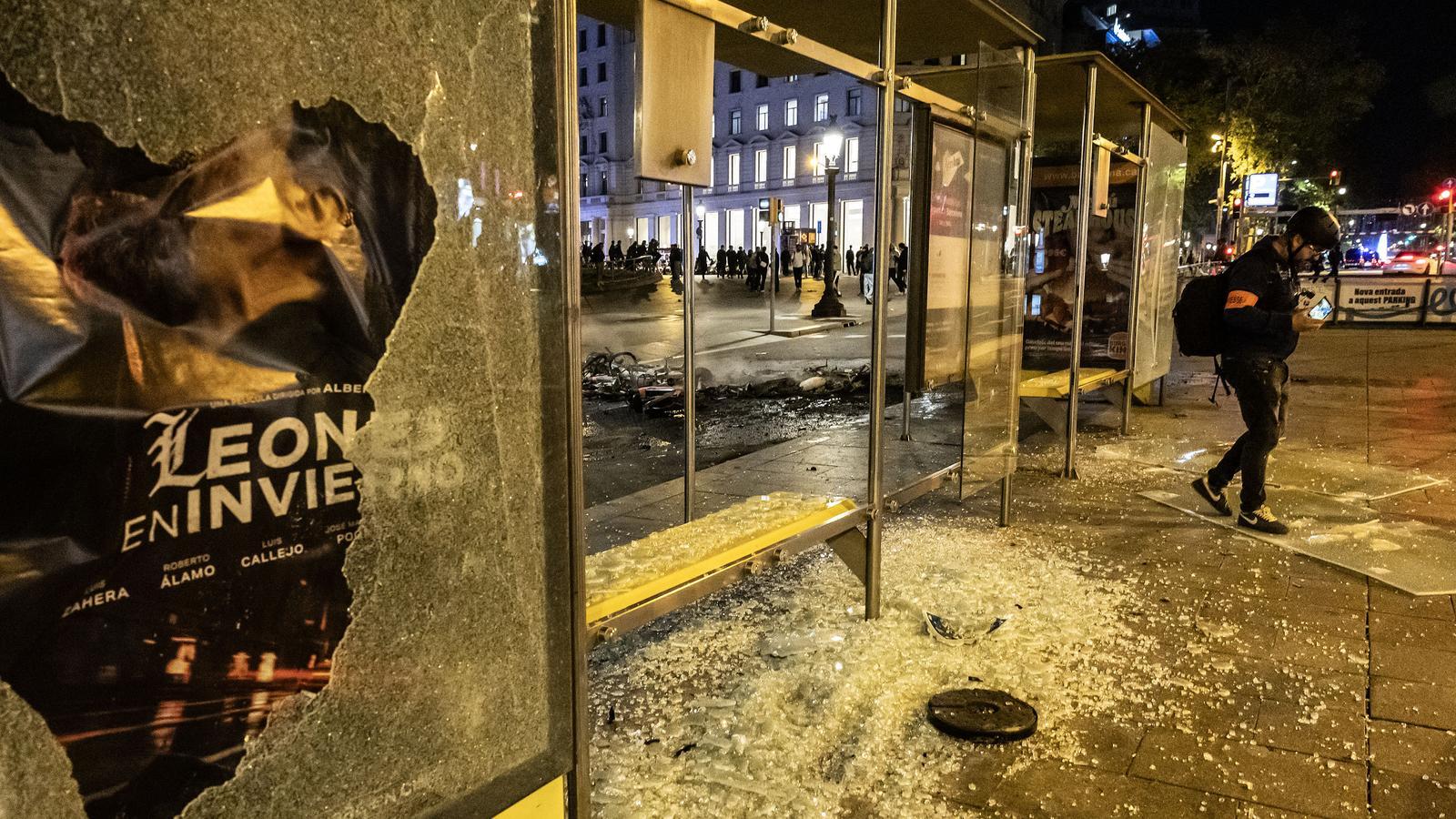
BarcelonaHow to stop the domino effect of Telegram channels and social media accounts calling for new riots of the Blocus style, as seen on Saturday in Barcelona, is currently one of the main concerns of the Mossos d'Esquadra. Doing so by requesting a court order is a process that can be slow, and platforms often have slow rhythms as well. For this reason, as ARA has learned, the Catalan police have requested help from CITCO, the Intelligence Center against Terrorism and Organized Crime, which depends on the Ministry of the Interior.
Attached to this body is another one, the UNECI, the National Unit for the Removal of Illicit Content on the Internet, which is exclusively dedicated to removing content of a terrorist nature and linked to violent extremism. The Mossos, however, believe they can also help in the fight against Blocus, especially in those online spaces where violence is defended.
For the moment, the Ministry of the Interior does not confirm that the UNECI is focusing on these Telegram groups, although the Mossos state that after their request, made on Monday evening, the platform has closed two groups that were inciting participation in new violent protests next Saturday in Barcelona. Shortly after, in a statement, Telegram remarked that it "supports the right to express oneself freely and to demonstrate peacefully." Despite this, it added that "incitements to violence and to cause damage to property are expressly prohibited and are removed as soon as they are detected".
Closures in one hour
From the UNECI, they use legal requirements that oblige service providers (websites or social networks) to remove or block terrorist content throughout the European Union within a maximum period of one hour. These requests are used selectively when there are reasons of urgency or gravity, for example. In parallel, this unit also makes non-binding communications so that platforms review the content and delete it voluntarily.

According to the entity's balance sheet, published a few months ago, 62 orders were issued in 2023; there were 72 in 2024 and 48 last year. All orders were executed by the platforms, that is, they deleted the required content. In 2025, the last year with updated data, the company with the most removal orders was Internet Archive (27), followed by Pinterest (6), Scribd (4) and TikTok (3). In fact, last year there was a drastic reduction in requests on previously predominant platforms such as Telegram, which went from 90 orders between 2023 and 2024 to just one in 2025, or the disappearance of orders on Facebook, X or Google Drive. In total, most of the orders were linked to jihadist content.
The alternatives
If the Mossos have turned to this new and little-explored path until now –as long as we are not talking about terrorist content– it is because the usual channels are not always easy to navigate. First, to close groups and delete content, but, above all, to know who is behind a username.
According to police sources expert in this subject consulted by ARA, knowing who is behind an account –precisely what they are trying to do now with Blocus– depends on the expertise of that user and the collaboration of the platform. In the first place, most social networks allow creating accounts with easily falsifiable details, such as an invented name or an email address created for the occasion. For this reason, the most useful element is usually identifying what the IP address is, since it allows for better locating the device from which it was created or the network to which it was connected. However, to know this, a judicial authorization and the collaboration of the platform in question are required, which can drag everything out for a few months. Furthermore, VPNs –an encrypted connection that hides the IP– or other remote servers are being used more and more, which makes it difficult to attribute an internet connection to a specific person.
Depending on the jurisdiction
Once again, the collaboration of the platforms is key. Above all, the Mossos face complications with those companies located in foreign jurisdictions such as Russia or China, as was originally the case with Telegram or TikTok, although they are now spread out to other parts of the world such as Singapore, Dubai or Ireland and are adapting more to European policy. These two platforms, precisely those most linked to the Blocus movement, are usually the ones that cause the most problems for the police. However, police sources point out that Telegram has improved lately. In 2024, its CEO was arrested in France accused of not having curbed the criminal use of the application.
Often, behind a user of any platform, there is an email address, a fact that ends up leading the police to Google. And, in this case, the process is not quick either because a judicial request must be sent to Ireland. Now the Mossos have an investigation team dedicated exclusively to deciphering these accounts and trying to find out who is behind Blocus.
While the police investigation advances and the minors arrested for the riots continue to be brought before the courts in a staggered manner – it is being done this way to avoid overwhelming the courts –, the Generalitat has already announced that it will appear as a private prosecutor in these cases. The Minister and spokesperson for the Government, Sílvia Paneque, recalled that thecriminal responsibility of minors between 14 and 17 years old is individual, but that parents or guardians may have to assume joint civil liabilities if determined by the judge.
