The acid test for the teaching mobilization arrives
This Saturday a demonstration has been called with families in Barcelona and on Thursday the unions are calling for a new strike in the schools

-
CAT -
CAST
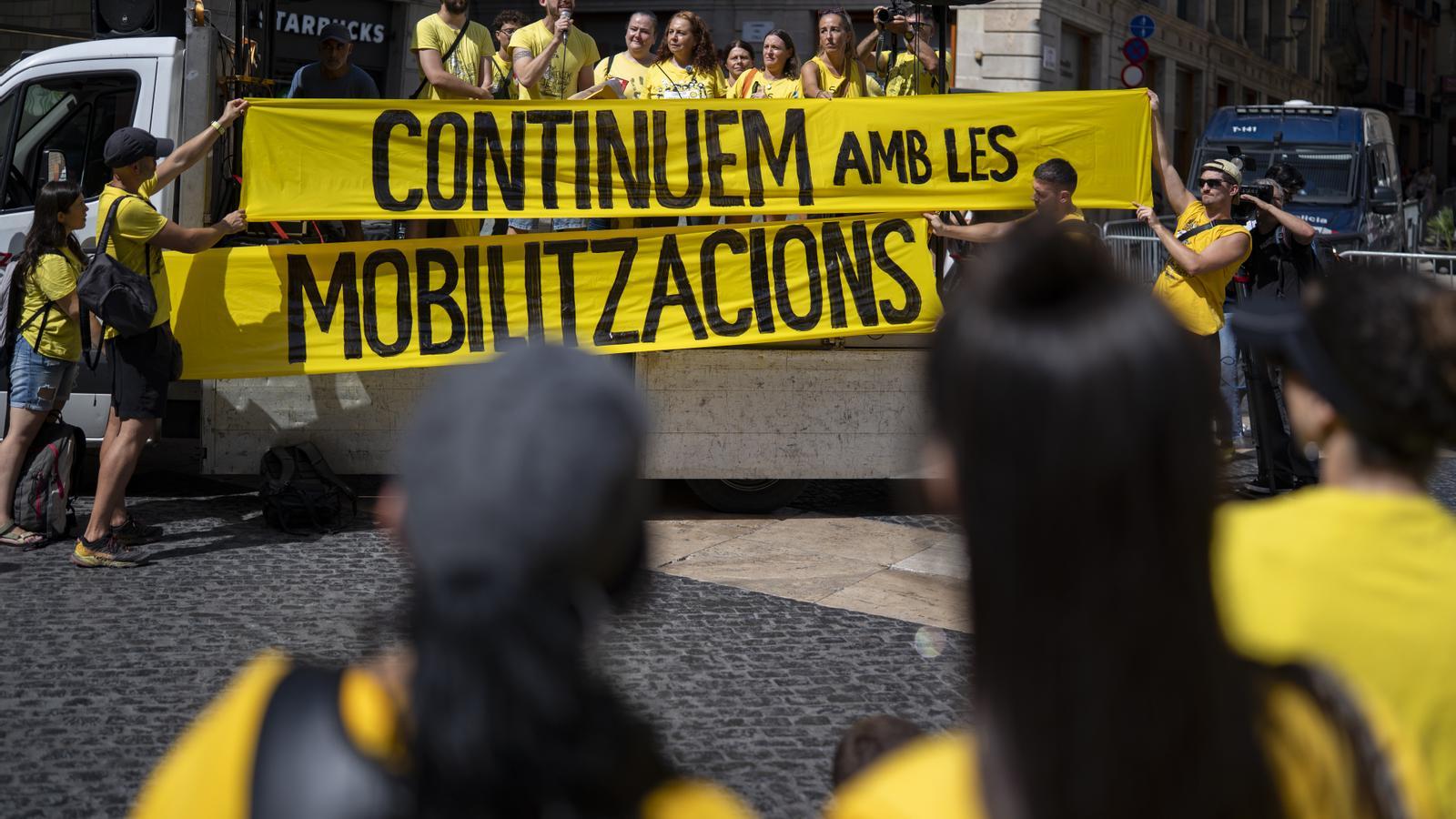
BarcelonaFrom “let’s see how it goes” to “going all out”. This Saturday, the educational community is called to take to the streets in a new demonstration to demand improvements in public education, but the protest comes at a time when it is difficult to gauge the mobilization mood of teachers, unions, families, assemblies, and students. The call is made just two and a half months after the last strike that was called on the first day of the school year –with a turnout of 12% according to the Department of Education and 30% according to the unions–; ten days after the general housing strike and still reeling from the intense end of the last school year, with a dozen strikes between general and territorial calls. On the horizon, there is a new strike call for Thursday the 26th, the end of the term, and union elections in 2027.
“Perhaps society has the feeling that since the start-of-school strike we are no longer mobilized, but what we have been doing is a lot of work in the assemblies to reorganize, to define the objectives of the struggle, and to forge alliances within the educational community,” asserts Laura Gómez, from the Educational Assembly of Catalonia, the umbrella group that encompasses the teachers' assemblies of hundreds of schools and institutes in Catalonia and which in the latest mobilizations took on a relevant role in the negotiation. “The most important thing about this demonstration is that, finally, it is being called jointly with teachers, families, students, and unions. It is a step forward in the sense of uniting the efforts of the entire educational community,” defends Gómez. At the same time, she dismisses the idea that after the drop in turnout for the start-of-school strike they have adopted a low profile.

The spokesperson for USTEC –the majority union among teachers–, Iolanda Segura, is also optimistic: “You never know how these things might go, but we expect maximum participation, as it was one of the most voted-for mobilizations in the consultation we held with the collective”. Segura also defends the cross-sectional nature of the call: the manifesto is signed by eleven different entities ranging from the teaching unions opposed to the agreements signed with the government –USTEC, CGT, Intersindical, COS, and CNT– to the Educational Assembly, student unions, the Rosa Sensat Teachers' Association, and the AFFAC, which brings together the majority of the country's PTAs. “We have joined all those organizations and entities that defend public education, which is a very clear message to the administration, which until now does not seem to show any willingness to negotiate,” insists Segura.
While both the Educational Assembly and the unions point out that the main objective of the demonstration is to get the Government to sit down again and open the door to making more proposals than those agreed upon last school year, the protest manifesto breaks down a large number of demands that have been entrenched in the sector for years: more funding and strengthening the public network –with the long-awaited 6% of GDP for education and the reduction of ratios–; the real free nature of education (canteen, camps, excursions, materials...); the lowering of ratios and more resources for inclusive schools; pay improvements and consensus-based curricula; the vindication of the 0-3 sector; resources so that Catalan is a vehicular language in schools; improvement of center infrastructures, and more decision-making capacity for teachers and families in the centers. “We understand that a negotiation is always a middle ground; so we have gone with maximum struggle objectives,” admits Gómez.
Families
Families are also invited to this demonstration, led by AFFAC. Although the start of this school year has been marked by the refusal of teachers at more than a thousand schools to organize field trips and camps in order to pressure the Government –which has caused the frustration of many families–, the federation of AFAs insists that it is the Department of Education that must take action. "It is very important to be able to safeguard outings and camps, but in this regard, we are not looking so much at the teachers," explains the director of AFFAC, Lidón Gasull. And she justifies the families' mobilization this Saturday: "This demonstration is yet another expression of the concern held by the educational community because it is considered that there is no sufficient response being given to the structural problems that the educational system has.
And what about Education?
Although the Minister of Education, Esther Niubó, has not publicly spoken directly about the demonstration or the strike in recent weeks, also marked by the calling of state elections, various measures have indeed been announced in recent months. This week, new details have been approved to compensate for school trips (one of the measures, the 50 euros of compensation per night that had already been agreed upon months ago), and since the beginning of the school year, a national debate on education has been opened, led by the Education Council of Catalonia. Furthermore, the Government points out that this year there are a thousand more teachers than the previous year, 500 new reception classrooms, and that, within the framework of the agreements signed with the unions, by 2026 teachers and professors will have earned about 1,500 euros more per year.
