Pedro Sánchez's dilemma: to call elections for November 29 or not
PSOE leaders already assume a convocation, but the Spanish president remains hermetic

-
CAT -
CAST
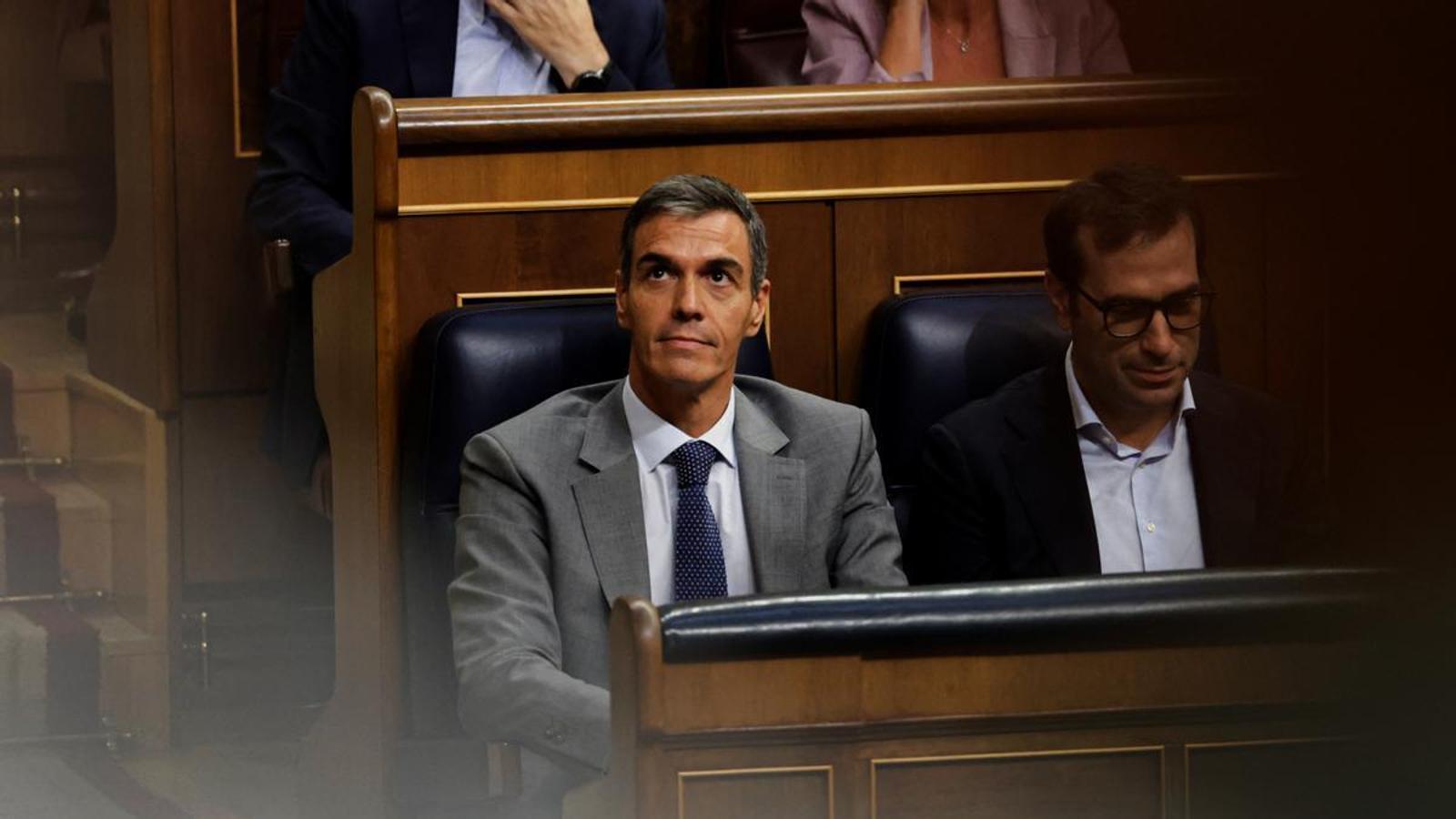
MadridPedro Sánchez has had to make many complicated decisions this legislative term, but this is the definitive one. It could be a final masterstroke or a definitive mistake. The Spanish president has the immediate calling of early elections on the table following the defeat in the Congress of Deputies on Friday regarding the housing regulations. Although for the first time in many months Junts had sat down to negotiate with the Spanish government, eventually Miriam Nogueras' group struck down both decrees together with the PP and Vox and forced Sánchez into a period of reflection this weekend to decide whether to call early elections. They could be held immediately, on November 29, with the right to housing as the central theme, in an attempt to mobilize the left in the face of unfavorable polls. Although PSOE leaders are already leaning towards an early election, the final decision rests with Pedro Sánchez and it is not yet known if he has made a definitive determination.
The Spanish president wants to gain perspective. On one hand, to evaluate the social mobilization resulting from the indignation over the vote by Junts, the PP and Vox –yesterday there were about thirty demonstrations, the largest in Madrid, while there were riots in Valencia–; and on the other hand, to study with data in hand if it is the most appropriate time to go to the polls. The other option would be to maintain the plan to hold the elections in 2027, just as he has been repeating for months.
The arguments in favor of calling early elections
In the last few hours, the chats of the socialists and the left in general have not stopped buzzing. In the PSOE, there are many leaders who are clear that it is time to bring forward the electoral contest. They reaffirm that it is a window of opportunity similar to the one they could have had if the budgets had failed, which were expected to include great social spending, to bring the elections forward to March. "The right to housing gives us a narrative," reaffirms a consulted leader, who finds it hard to see that between now and July, when the legislature ends, there will be a similar peak of mobilization that could favor the left.

In fact, the campaign for the PSOE is clear: to focus on everything that, with the approved housing decrees, could have been avoided. Yesterday, already in campaign mode, PSOE sources warned: "With the decree-law in force, no more Maricarmen. Because of the PP, Vox and Junts, investment funds will be able to continue evicting vulnerable people". In fact, there are those who predict an increase in attention towards this phenomenon from now on.
Other socialist leaders also see the early election not so much as an option to return to government –polls suggest that the PP and Vox are bordering on 200 deputies–, but to try to achieve a good result, and even opt for the first position, even if Alberto Núñez Feijóo ends up governing. An option that would give the party stability to transition towards the post-Sanchismo era.
The fact is that the problem the socialists have is not so much their result as the arithmetic difficulty to be able to govern. Their left is not organized. Sumar, which will run under the name Broad Front, continues without a visible face –it seems the debate is between Mónica García and Ada Colau–, while Podemos has Irene Montero. It is not the same whether there is a confluence or not, which will depend on the names that are put on the table. "We are absolutely prepared", stated this Saturday Yolanda Díaz, who is stepping down. There are those who advocate for performing electoral surgery in the smallest constituencies and for only the PSOE to run there to maximize the number of votes, or for the left to ally in a single list in the Senate.
The arguments against the call
However, not everyone within the party sees it that way. There are those who consider that calling elections now would mean handing over the government to the PP and Vox, when there are still options to continue the legislature for at least a few months and develop everything that the Spanish government has pending. To begin with, the debt forgiveness for the autonomous communities is about to be approved, from which Catalonia would benefit by 17.104 billion euros. Or the financing bill which, having already passed through the Fiscal and Financial Policy Council, must soon be brought to the Council of Ministers and processed in Congress, where Junts will again hold the key. Because of all this that is pending, the president of Esquerra, Oriol Junqueras, asked yesterday for “political responsibility from Sánchez” and “that he fulfill the commitments and stop playing with the needs of Catalonia”. He also addressed the president of the Generalitat, Salvador Illa: “We demand that he defend Catalonia above the interests of the PSOE". He asked Junts "to decide whether it wants to defend the interests of the country or continue to side with the PP and Vox”. For his part, Illa remarked yesterday that, if the PSC "had had 26 deputies instead of 19 [therefore, replacing the 7 from Junts], the two decree laws would have been approved on Friday".
Those within the PSOE who support not advancing the elections also warn that the polls would be in two months and that nothing guarantees that the public conversation will continue to revolve around housing. They recall that Ceuta is still not resolved and the judicial machinery remains active, with the sword of Damocles of the party's indictment in the Leire Díez case. At the same time, between March and April is the trial against the wife of the Spanish president, Begoña Gómez, who depending on the result of the elections might have to face it already outside the Moncloa. In fact, there are those who consider that this moment, that of Gómez sitting in the dock, could be another lever of mobilization for the PSOE base.
The break with Junts
As much as there may be arguments for and against the early election, the decision not to call an election should be accompanied, sources consulted admit, by an attempt at reconciliation with Junts to try to give continuity to the legislature. An approach that is now very difficult because Friday's vote broke all bridges with Miriam Nogueras's party. Before that, the Spanish government had the hope that, with the return of former president Carles Puigdemont, new winds could blow with the Junts members. A return, on the other hand, that could accelerate next week: on Tuesday the Constitutional Court is scheduled to issue the first ruling favorable to the amnesty for the leaders of the 'Procés', which would already send Puigdemont's case to the desk of the investigating magistrate of the Supreme Court, Pablo Llarena, to decide whether to withdraw his arrest warrants. “Let him stay in Brussels,” shouted the Tenants' Union at the Junts headquarters on Friday. Pedro Sánchez will continue, in the coming hours, to weigh his options.
