Tanja Grass: "We did things in the nineties that nowadays would not be allowed"
Director of Drap-Art

-
CAT -
CAST
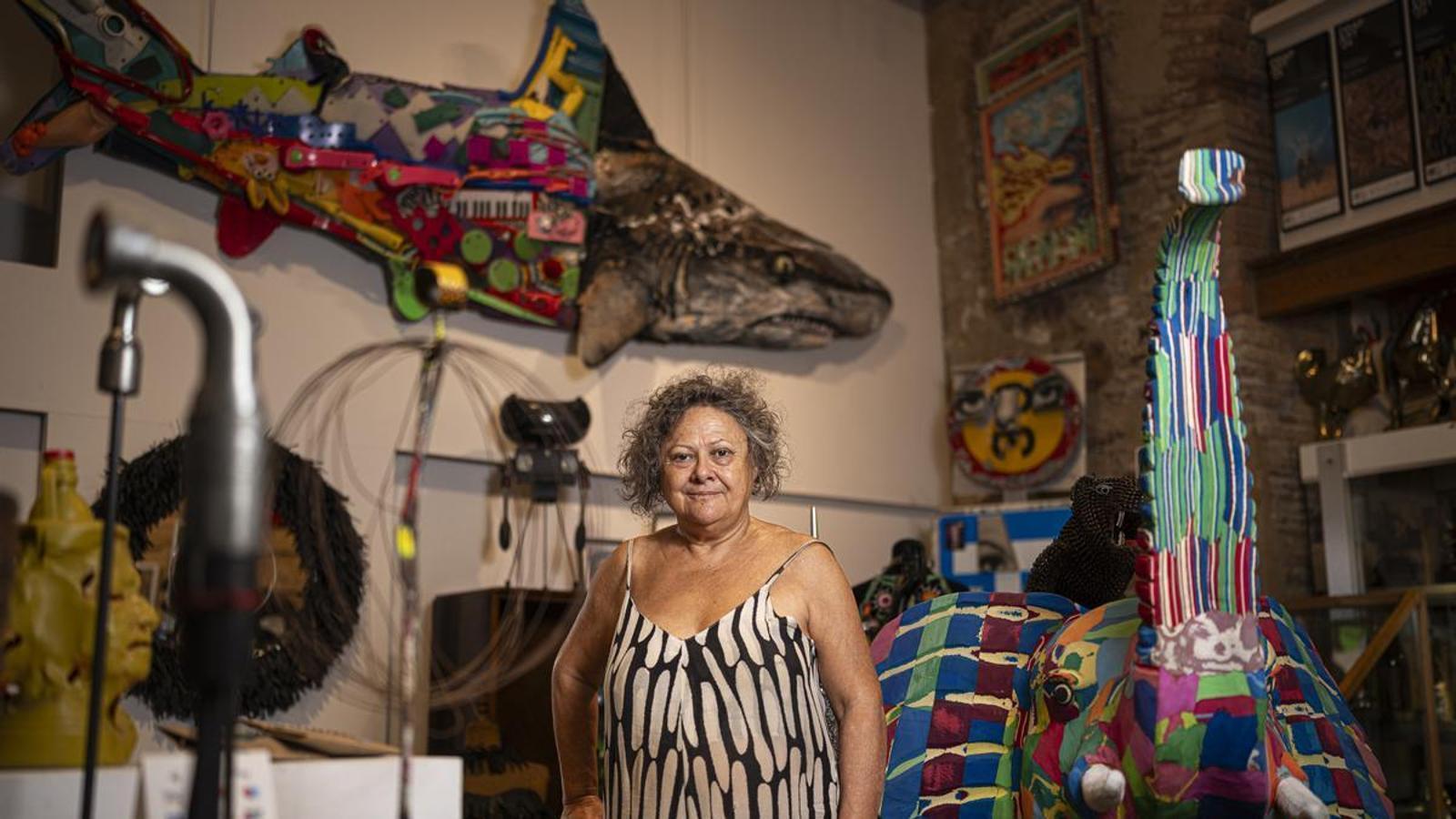
Insect-shaped pins made with electrical resistors and fuses. With this discreet jewel by Christian Konn began, one could say, the adventure of Drap-Art. Critic Rosa Pera saw them and invited him, along with other Barcelona artists, to participate in a recycled art festival held in the north of France, La Braderie de l'Art de Roubaix, and a whole expedition of friends went there who, upon returning, decided to organize their own festival in Barcelona. This is explained, in a documented and enlightening article, by Xavier Theros in the book Drap-Aires. Stories of the Drap-Art Festival, which gathers the thirty years of the festival with a whole selection of photographs by Consuelo Bautista. If Theros is the chronicler of the Barcelona art scene of the nineties, there is no doubt that Bautista is the one who has best known how to portray it. There is also, of course, a text by Tanja Grass, Christian's partner and, from the beginning, the soul and driving force of this festival that began in 1996 and has had continuity in different formats throughout the years. Until today. The next one will be from November 17th to December 21st in various spaces in Barcelona's Gothic Quarter and before, in October, there will be parallel festivals in Formentera and the Ebro Delta.
There is a long genealogy of artists who have created works with waste material, from Picasso and Duchamp themselves to Pistoletto and Cuixart. But, in general, Drap-Art artists and their philosophy of sustainability seem to be associated more with craftsmanship than with museum art.
— The thing is that many of these great artists who have used assemblages and collages with waste, some of whom we are also recovering at the festival, have never been analyzed from the point of view of environmental reflection, even though in many cases it was implicit. And the Drap-Art artists, on the other hand, have not linked much with these people either. Perhaps some have been inspired by them, but in other cases everything has arisen spontaneously because they come from the craft world, from amateur art, or they just had the need to do something with the rubbish they had around them.
How would you define the spirit of these Drap-Art artists?
— They go against the current of what everyone wants now, which is to be successful and sell a lot. They like what nobody wants, discarded materials. And if selling art is already difficult, imagine art made with waste. At the festival, in these thirty years, there have only been three editions where we had significant sales, of 10,000 euros in works in total. The rest, that is to say, 90%, have been editions with very modest sales. People look, but they don't buy.
Drap-Art emerged in a very special moment of the late eighties and nineties in Barcelona in which many initiatives and collectives arose, some of which are still active.
— I had grown up in Formentera and Christian and I had lived for a few years in Germany, where he was studying jewelry, but the goal had always been to come to Barcelona. There was something like an explosion of the underground. We started going to all the events, performances, and concerts that were happening then. Everything was very free, a moment of creative effervescence in which a bunch of groups, artists, collectives, and small events emerged that were done simply because people felt like doing them. And perhaps institutionally there was also more willingness to grant them that freedom. We did things in the 90s that today would not be allowed. Such as street performances without asking for permission, occupying spaces like the Transformadors community center. We had the approval of the institutions, but very little bureaucracy.

Has it changed much?
— Look, Barcelona is a city that attracts a lot of creativity and there are always young people from everywhere who come and do things, but nowadays, those of us who started doing things back then see that everything has become very bureaucratized. Perhaps there is more bureaucracy here now than in Amsterdam or Berlin. And, therefore, perhaps more things are happening there now than here, because if there is one thing artists do not like, it is bureaucracy. Here they have to fill out I don't know how many forms for everything, and on top of that, everything has a cost. Everything gets complicated and that is why they leave.
Were you born in Formentera?
— No, I was two years old when my parents moved there. They were artists, bohemians, who didn't fit into that Germany of the 60s, of the economic "miracle", the modernization, the paving of highways and all that. They didn't like it at all, nor the rehabilitation of the old Nazis that happened at that time. They didn't feel comfortable at all in Germany and found Formentera as a place to escape. A more natural place, with very sincere and simple people, a fantastic landscape and a very affordable cost of living for a young artist.
And what was the island like when you were little?
— When we arrived there, there was only one boat that connected Ibiza and Formentera once a week. And everyone lived on farms scattered throughout the countryside. There were the three towns, Sant Ferran, Sant Francesc, and El Pilar de la Mola. La Sabina was the port, but practically no one lived there. And Es Pujols didn't exist, I think. Life there was very solitary, and you were very connected to nature, to the livestock. It was like a paradise from the Middle Ages in which the exchange system still worked. When we arrived there in 1965, it was a very traditional society but also very open to outsiders, because there was an endogamy problem, and they knew it. For them, having new people arrive from outside was a positive thing. Later, Vietnam veterans and the first major drug traffickers began to arrive.
Did the Vietnam veterans go there?
— Yes, many very screwed up Americans, very drug-addicted, very out of it, and also people from the Los Angeles drug scene. Together with the veterans, their dealers also arrived. In the Saint Francis cemetery, an American woman had settled, and she would dig up the dead and wear baby skulls as a necklace. In a super-believing society, that was very scary. Those are things I don't remember, because I was very young, but my parents had told me about it and I heard it said by other people. Suddenly, one day, 30 hippies naked, all painted and with flowers.
Break with the somewhat idealized image of the hippie movement of that time...
— There was everything, there were very nice and very cool people, with whom my parents also became friends. Young people, many from good families, who had lived through '68, with progressive ideas, who traveled through India and then stopped by Formentera, and played the guitar, or the flute, or a sitar, and held parties in the woods during the full moon... All good, but there were also the others. And this created a very strong rejection among the island population, and there was "the hunt for the hairy ones." They would catch the men, because they didn't do anything to the women, they would shave them and put them on the boat to Ibiza. They kicked them out. There were one or two years of this hunt for the hairy ones. And more or less, coinciding with this time, the tourists began to come. The Swedish women, the German women, and a bit of gigolo tourism. And families, too. Especially from France and Germany. And many ended up buying houses. And then, in the late 80s and early 90s, the Italians arrived, who, in a way, drove out the Germans, because they made a lot of noise. And now we find ourselves in a situation that is once again quite international. We have Germans, French, North Americans, a bit of everything. And the Catalans and the people from Madrid have also discovered it. And the rich from all over the world.
Are there any Formenterans left?
— There is an awareness that we are a diverse community, composed of descendants of farmers, which is how the islanders define themselves, and of descendants of outsiders. And this awareness is very rewarding. We have about 12,000 registered people and then, especially those of us who are of a certain age, we all keep track of each other. And that is also beautiful. I find that society, in general, on a global scale, is very polarized nowadays. Even those of us who want diversity do not speak to those who do not want it. Then we are already excluding some people. But we are already used to the fact that we are a small community. We must all speak with everyone.
Do you have any artistic activity?
— Yes, now from October 5th to 17th I am organizing an art fair there that includes exhibitions and also a debate to take the pulse of the current island culture. My demand is that Formentera needs an art center, a proper place where we can exhibit and store the work of artists who have passed through the island for more than 60 years and have gifted their work. There is no good place to put them.
And one of them is your father...
— Yes, he painted but soon retired from galleries, and adopted a dynamic of only selling to people he knew. And also only portraying people after having met them. Then, of course, he didn't sell much. He sold very expensively, that much is true. He charged for it. Now he has an anthological exhibition at the Puget Museum, in Ibiza, until December 31st. Helena Ruiz, the museum's director, is a very special and very brave woman, because she sometimes bets on artists that no one knows, trusting her own criteria. She takes a stand. That is what a good curator does.
