The great promises that are accumulating for Salvador Illa
The president of the Generalitat has launched several announcements during the last days to put an end to the educational and housing crisis

-
CAT -
CAST
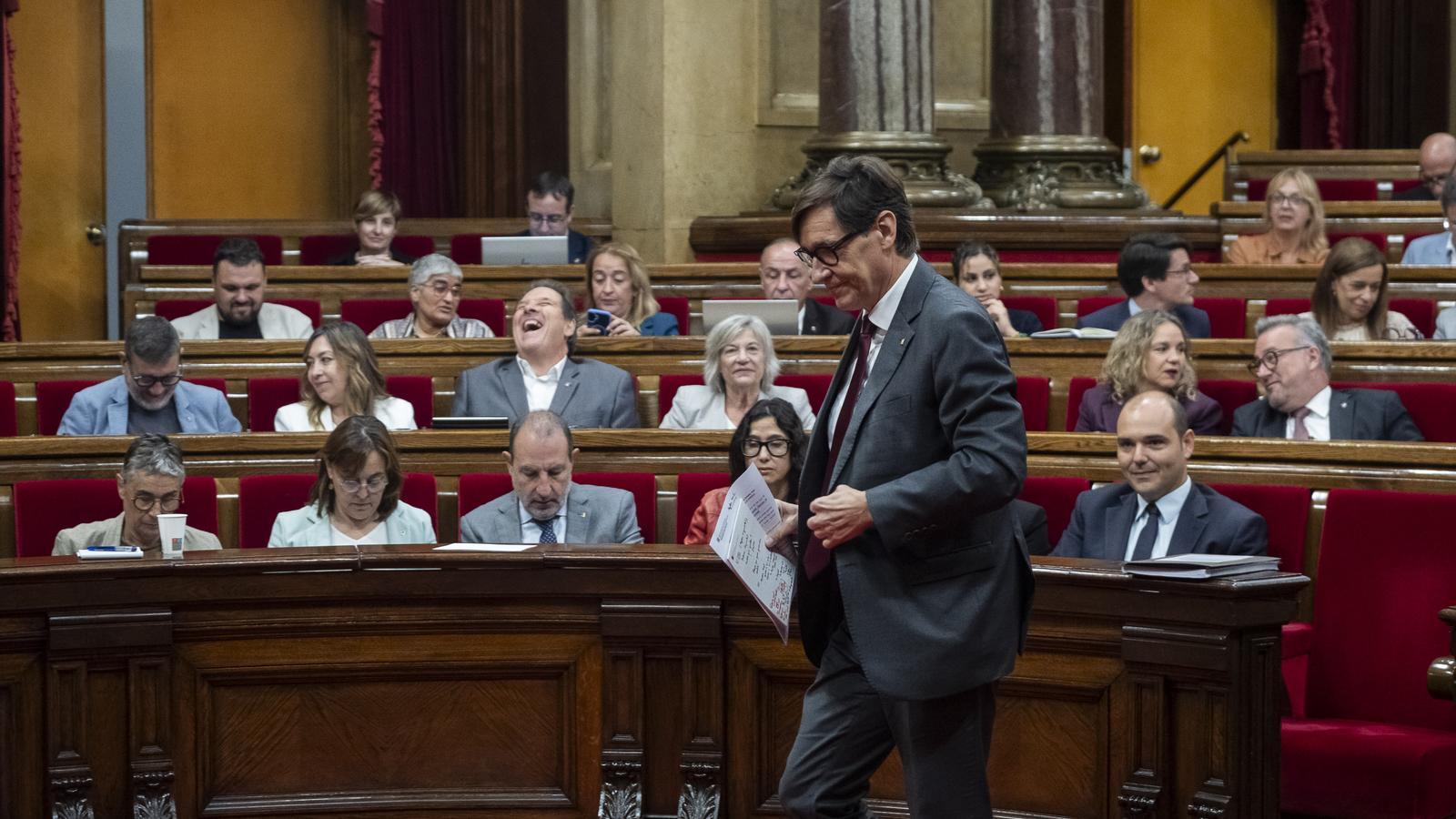
BarcelonaThe Catalan political year has begun as it ended: to the rhythm of crises and major announcements from the Palau de la Generalitat. In this week's general policy debate, Salvador Illa reaffirmed the measures he had already made public—especially when addressing such burning issues as housing or education—and added new ones. However, the homework is piling up for the President of the Generalitat, and the opposition and his own parliamentary partners, ERC and Comuns, already demanded "deeds and not words" and that he abandon the "grandiloquence" to really solve the problems, "now and not five years from now".
The President of the Generalitat returned to making headlines with new announcements. In the first intervention of the debate, Illa promised the creation of a fund to buy flats from vulnerable citizens who are about to be evicted, and the shared purchase between the administration and individuals over 40 years old who want to acquire a first home. These measures, however, did not convince the opposition either, which labeled them as "empty promises and rhetoric", nor the allies of Esquerra and Comuns, who qualified them –respectively– as a "drop in the ocean" and "insufficient". These initiatives have a budget of 25 and 100 million euros, respectively.
In fact, Comuns abstained in the resolution that was to validate Illa's new housing announcement, which caused Parliament to vote it down. Sources from Comuns say it is a way to give a "warning" to the socialist executive and warn them that they must comply with the investiture agreements and the proposals already announced. Be that as it may, the Government ensures that it will carry them out anyway.
On the other hand, Illa also announced during the general policy debate that the Generalitat wants to expand by 15,500 the places in nursing homes for the elderly and by 4,500 for people with disabilities; a regulation to reinforce the authority of teachers and professors; the expansion of loans to help young people pay for the down payment on a home and to become independent, and a plan to identify and convert land into buildable land to build 217,000 flats and houses.

The most ambitious promise, however, is that of obtaining 50,000 affordable homes by 2030. According to the Minister of Housing, Sílvia Paneque, 10,000 apartments have already been achieved since they presented the plan in 2024. Government sources and also those of parliamentary partners assure that they are complying and will comply. However, these data do not coincide with those of Catalan builders. The president of the Chamber of Construction Contractors of Catalonia (CCOC), Lluís Moreno, assured ARA, when Paneque announced that they had already reached 10,000 homes, at the beginning of September, that "only 3,000 apartments put out to tender and awarded are recorded for them".
6% of GDP in education
In the midst of an educational crisis, Salvador Illa proposed a debate with all political forces to reach a national pact to decide the Catalan education model and promised to reach 6% of the gross domestic product (GDP) in education investment. The president, however, has not set deadlines or explained how he intends to reach it and, at this moment, this percentage is at 4%. The opposition, Esquerra and Comuns see it as a dead letter if there is no clear roadmap, they criticize that he did not even mention it to them before making the announcement and that he now wants to share responsibility with all parties by creating a working group formed by the parliamentary groups to find a way to reach 6% of the GDP in education.
Also in education, the president of the Generalitat committed two weeks ago to air-condition all classrooms in the country's educational centers by 2031. The opposition reproaches him that it is a plan that is partly intended to be financed with money from municipal and supramunicipal administrations, and that it has not been coordinated with the town councils. Comuns also asks him to accelerate the deployment of this plan and set a not-so-distant deadline.
Crime figures
Another of the fixations of the Illa government is security, especially as the municipal elections approach. The president reiterated in the general policy debate that his executive has managed to reduce crime figures and mentions thefts, robberies with violence or intimidation, home burglaries, or car thefts. However, there are more serious crimes that are rising, such as homicides, fights, crimes involving injuries, and sexual assaults with penetration, according to data from the Ministry of the Interior. And, according to data from the Generalitat itself, during the first six months of this year, incidents in which someone has fired a weapon have increased by 45%. In this context, and given the growing concern for security, the Illa executive has committed to promoting more measures: toughening sentences associated with the possession of weapons and considering the display of weapons an aggravating factor when imposing a sentence. It remains to be seen whether the president of the Generalitat will be able to make this legal reform a reality and complete all the homework before the deadline expires.
