Ceuta does not mark the end of Sánchez

-
CAT -
CAST
MadridThe migration crisis in Ceuta represents yet another serious complication for a weary government, now without permanent allies, but led by a president determined to continue and finish the legislative term. The hypothesis of a miracle that would allow the socialists to rebuild alliances and projects for a new stage in power next year seems increasingly implausible. Thursday's debate in Congress highlighted the solitude of Pedro Sánchez, criticized by all the parliamentary forces. Yet once again he managed to remain standing, without falling exhausted onto the canvas. Feijóo tries to strike the socialist leader with ever more force and knock him down for good. There is no longer any kind of respect or consideration between the two. And despite this, the feeling always remains in the air that the president of the PP will have to keep waiting, because his blows—which would be quite forceful against other opponents—do not have much effect on Sánchez, who shows no signs of looking for any other way out than to stake everything on one card whenever he decides to call the next general elections.
A battered president and an opposition leader who cannot find the moment to break him. This is the image I was left with as the highlight of the debate. Feijóo has many reasons to be optimistic. The polls are going very well for him, and the Spanish government has given a strong impression in recent weeks of being overwhelmed by circumstances, unable to find a coherent discourse on the motives and background of the migration crisis in Ceuta, and on what needed to be done to restore normality in this autonomous city. Morocco is not a reliable neighbor, but the fight between the Minister of the Interior, Fernando Grande-Marlaska, and the Minister of Defense, Margarita Robles, has generated a confusion that they should have avoided. If the Spanish government believes that nothing proves, for now, that Morocco prepared and directed what Sánchez himself described as a “violation and attack on the territorial integrity of Spain,” it makes little sense for two ministers to argue about the content and relevance of existing reports in relation to the increase in attempts to cross the border irregularly during the days preceding the arrival of more than 70,000 immigrants in Ceuta on July 31.
Without having managed to reconcile the positions of the opposing ministers, Sánchez had to use his authority to set out in the debate what should be understood as the official version of the facts. The Spanish president continues to say that he has no evidence that Morocco caused the massive arrival of immigrants, but he has now added a cautionary clause. He did so to warn that he will act if it is eventually revealed that this involvement existed. He cannot say otherwise. But what is relevant is that he no longer excludes the hypothesis of the intervention of the Moroccan regime. In any case, this warning is rather preventive, because in parallel he said that he had given the order to make public all the reports that the Spanish executive has had at its disposal regarding the antecedents and consequences of the aforementioned massive arrival.
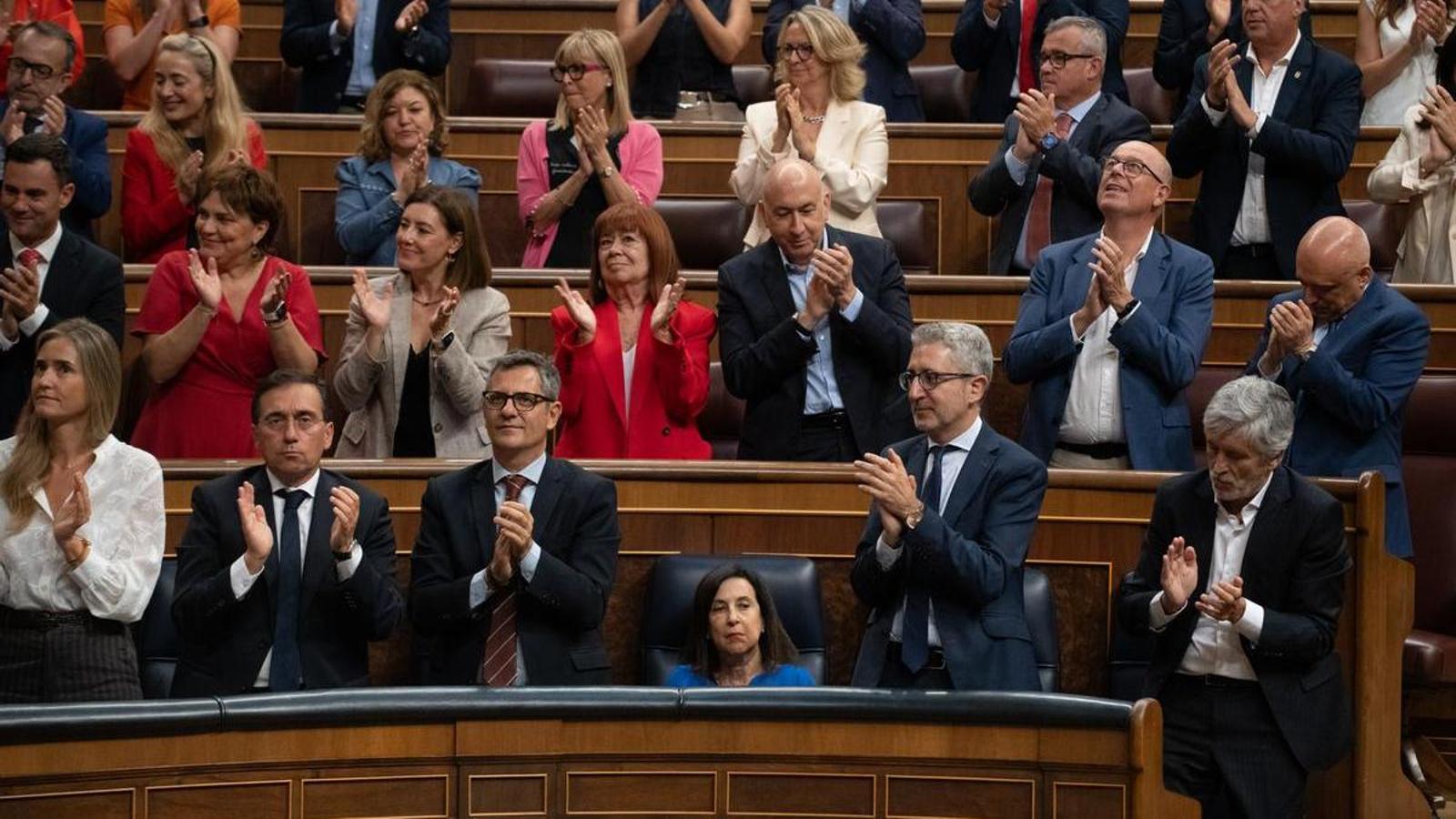
The entire blue bench of the hemicycle applauded this decision, but with the significant abstention of Margarita Robles, who remained seated in her seat, with a consistent gesture of circumstances when she ran a hand through her hair. I believe it is unlikely that there is a report that warns with data of an alleged operation prepared by Morocco, or that any other would make the Spanish government aware of the imminence of an attack on the "territorial integrity" of Spain. Sánchez gave some figures that limited the warning to the existence of an increase in the arrivals of immigrants swimming at the end of July, without this assessment being able to give cause to think of a massive entry. It will be difficult for us to find a police or intelligence service analysis in which it is specified from how many people one can speak of a mass arrival. In the end, it is what the Minister of Justice, Félix Bolaños, said when he explained that "there was no prior information on the magnitude of the assault", because any attempt to quantify the mobilization that was taking place would have remained a speculative exercise.
Unfounded cross-accusations
In short, the Spanish government will not fall because of this migration crisis, despite its responsibilities, due to the inefficiency made evident by not having organized a preventive structure capable of producing useful reports for the police, given that there had already been very serious similar events in 2021. And also due to the insufficiency of the response provided to guarantee the security and rights of the population of Ceuta. Sánchez's argument during the debate, defending that everything would have been much worse with a PP and Vox government, is no excuse. It is true that Feijóo is taking a big risk by making a pact with Vox, but it is obvious that this hypothesis, however plausible it may be, does not reduce the government's responsibility.
Furthermore, it is very serious that to defend the thesis of the existence of a supposed complicity of Sánchez with the Moroccan regime, both Feijóo and Abascal used the idea that the Rabat government has very compromising reports on the Spanish president, since they had wiretapped his phone in the past. According to this theory, the socialist leader defends Morocco because he is a victim of blackmail. It is an accusation that cannot be made without proof. Deductive analysis procedures have limits. It is equally obvious that if one day it were proven that this humiliating situation existed, the socialist leader's responsibility would be immense. But before accusing a president of “treason” – as Abascal did – it is necessary to rely on facts, not speculations.
The background to all this is the desire of the PP and Vox to see Sánchez involved in some criminal proceeding. Feijóo was also explicit when he said that the Spanish president would answer “before justice” in relation to the migration crisis in Ceuta. But for the moment there is nothing to rely on, not even the report from the National Immigration and Borders Center (Cenif), which speaks of the “total permissiveness” of the Moroccan police during the massive arrival. Of course, Sánchez also sees the hands of Russia and Israel in this crisis, but he should prove it by putting more data on the table.
