"The women murdered during the Civil War obsess me"
Alana S. Portero publishes 'Cosamala', where she transforms the real case of the crime of "the seventeen 'roses' of Guillena" into an ambitious gothic altarpiece set in Andalusia in 1937

-
CAT -
CAST
GuillenaThere are novels that feed on chilling real crimes and, by narrating them, bring them back to the table to show the horror the victims suffered. Cosamala (Seix Barral), by Alana S. Portero (Madrid, 1978), goes a little further, because it transcends denunciation through recreation and transformation, thanks to a prose of precise and unsettling beauty, of an episode of the Spanish Civil War experienced in Guillena, a municipality located about 20 km north of Seville. An episode that still shakes everyone who hears about it today, both for its brutality and for the chronological proximity of its discovery.
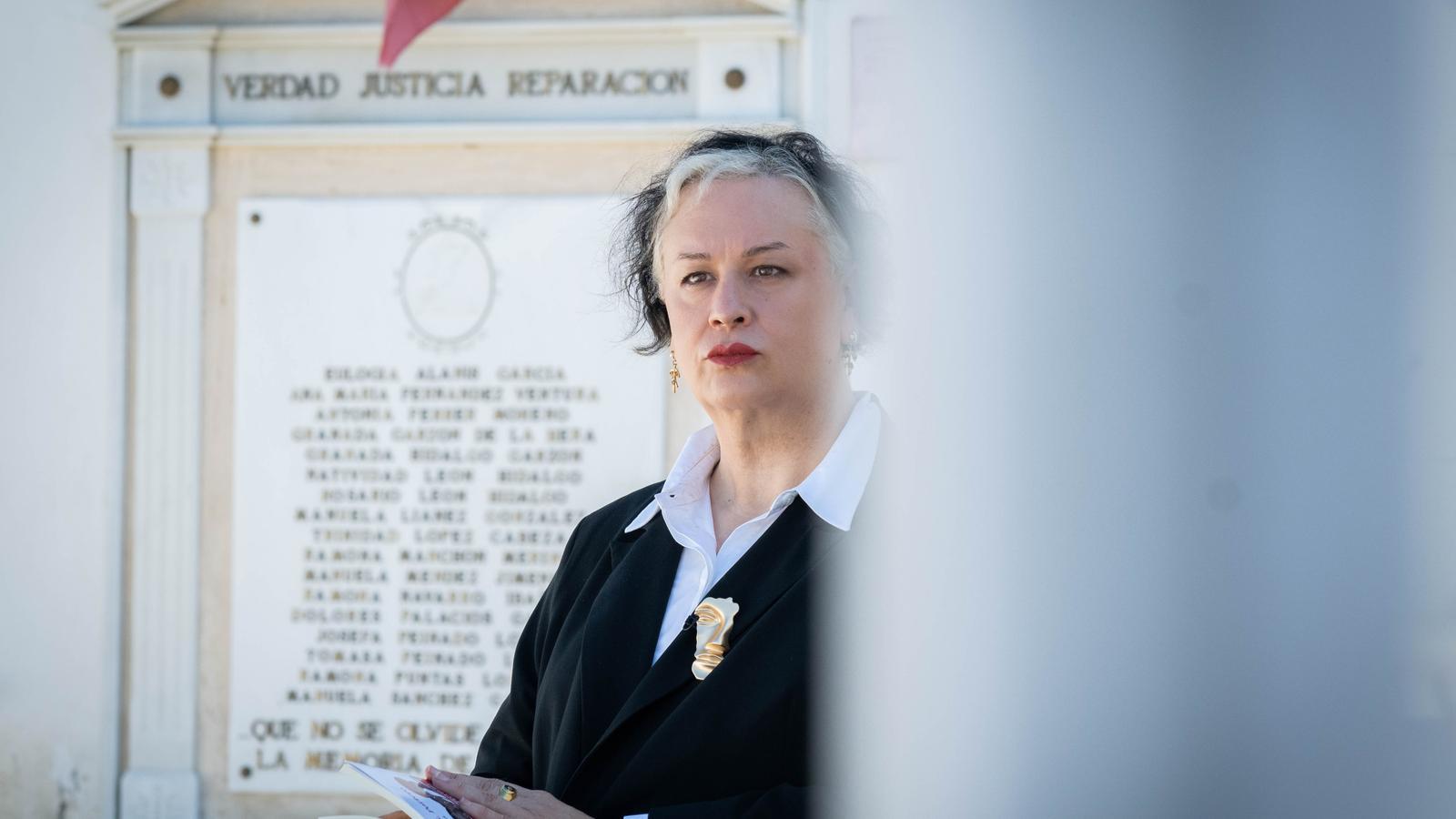
"If it hadn't been for the testimony of José Domínguez, who saw, when he was only 8 years old, how they buried the bodies of several women from the town on the outskirts of a nearby municipality, Gerena, the excavations would never have begun," explains María Dolores Sánchez, president of the Association for the Recovery of Historical Memory 19 Roses of Guillena, in front of the town cemetery gate, next to Alana S. Portero. Of these nineteen women between 24 and 70 years old, relatives of Republicans, who were imprisoned in the premises of the current town hall, only two were able to escape execution. The other seventeen, after having their heads shaved, being tortured and humiliated, were murdered by members of a Falangist column—under the orders of General Queipo de Llano—between November 6 and 8, 1937. They were executed and buried very close to the olive tree from which José Domínguez observed the events, which, many years later, he dared to recount. "The excavations allowed for the identification of the bodies of the seventeen roses of Guillena—recalls Sánchez—. If in 1937 they took them away by truck to kill them far from home, at the end of 2012 their remains returned to the town accompanied by a caravan of cars with their relatives and, finally, they were able to rest in the cemetery".
Sowing terror town by town
At that time, Alana S. Portero had just released her second book of poetry, Irredento (Endymion, 2011), and had not yet decided to write narrative. "My best friend's mother is from Guillena, but I didn't know that until they exhumed the seventeen victims and she spoke to me about it," she says. "What happened there is a paradigmatic case of systemic violence against women during the Civil War. It is still difficult to explain in words what happened in Andalusia in those years. Terror was sown village by village. The massacres were horrifying." Portero began writing Cosamala shortly after presenting in Barcelona La mala costumbre (Seix Barral, 2023), a novel about a young trans woman from a working-class family on the outskirts of Madrid during the 80s and 90s of the 20th century that became an editorial phenomenon: more than 125,000 copies have been sold and it has been translated into almost twenty languages.
"The women murdered during the Civil War obsess me," the author acknowledges in Guillena. "When I started Cosamala I set out to write a dark, Lorquian, and horror story starring a part of those seventeen women who ended up dead." Among them are Trinidad la Camacha, who knows how to contact the afterlife; Manuela la Esterona, whom her fugitive husband visits clandestinely; Dolores, who does not take long to lose her husband because of a falangist's whim, and la Tórtola, a waitress in one of the village bars, always under suspicion for being homosexual and a transvestite. All of them, desperate due to the growing repression, will end up opting for the path of witchcraft. "One of the great feminicides in history was the one practiced against witches. Cosamala is a novel in which realism reinforces the supernatural dimension of the story. It is my tribute to one of my favorite literary genres, the gothic," says Portero.
Truth, justice and reparation
Alana S. Portero finds it difficult to contain her emotion and indignation regarding the real events that inspired her novel, whether from the current town hall of the Andalusian town, walking through its quiet streets, or at the cemetery, in front of the memorial tombstone for the victims, where one can read the words truth, justice and reparation and the message "May the memory of my people never be forgotten in life". "Since Sophocles' Antigone, we have known that one of the worst punishments in a war is not allowing the victims of the enemy side to be buried with dignity —the author recalls—. A funeral for someone who has left us is the way we have to move forward. Without this ritual, how do we heal the wound? In a war, not allowing families to say goodbye to the dead is an absolutely disproportionate punishment." Until the seventeen dead women of Guillena were identified, their relatives could not be reunited with them. "There are neighbors in the town who left their homes after saying “I'll be right back” and of whom nothing was ever heard again —explains Blanca Domínguez Marcello, granddaughter of one of the seventeen roses–. The cruelty towards women during the war was common, but what happened here was extraordinary. I hope it is never forgotten."
