Carme Arcarazo: "I sleep very little and at the same time moments of euphoria overcome me"
Spokesperson for the Tenants' Union
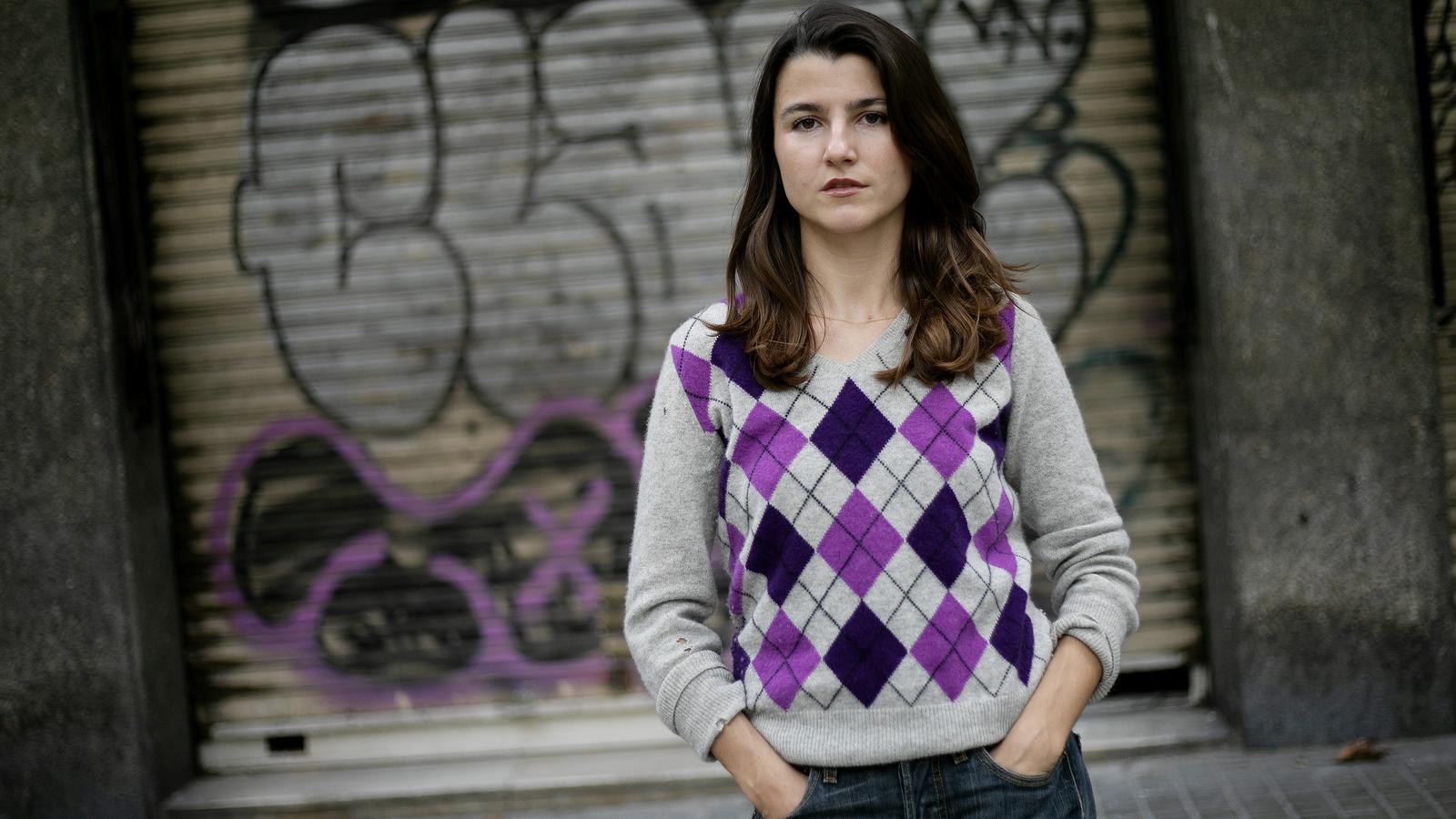


In her profile, she has the typical strip of passport photos taken in a photo booth: she says she loses her ID card very often. And it is very easy to imagine Carme Arcarazo (Barcelona, 1996) so passionate about something that she forgets her wallet. An economist specializing in urban policy and spokesperson for the Tenants' Union, the whole country has seen and heard her enough on the radio and on television sets in recent weeks, and has captured the energy she radiates. We had agreed to talk about what happened with Maricarmen, the calling of elections, and the call for a general strike, and we almost had to cancel because Arcarazo does not want to divert attention from the cause. We saved it with the idea that certain personal experiences help to concretize political ideas.
How are you?
— Well! I sleep very little and at the same time moments of euphoria come over me every other minute. People are starting to believe in politics again, which is not the same as believing in politicians.
Biographical preamble: when was the first time your blood boiled over politics?
— I studied for my baccalaureate in Bosnia, on a scholarship at a school where there were people from all over the world. 2012: austerity, Greece, Merkel... Some German students accused us, those from southern Europe, of having caused the crisis and said that we deserved the punishment. And I, who thought I knew how to speak English because I got good grades at my public high school in Barcelona, realized that I did not know enough for a debate like that. I was dying of rage and helplessness.
After graduating in political science and economics you went to Mexico.
— I didn't know what to do with my life. I was tired of technical knowledge and I applied for a scholarship to do a semester of humanities. I chose Mexico because at 17 I had read The Savage Detectives, by Roberto Bolaño.
Politics will pursue you.
— I found a job in an urban policy laboratory in Mexico. In a very large and unsafe city, we implemented a night bus line and closed off streets so that children could play in them. I learned a lot.
Also the hardest side of politics.
— I went south, where my job was to help local activists and journalists. They are highly threatened, and the simple fact that a European person accompanies them protects them. Mothers of disappeared students who demanded truth and justice, communities that wanted to stop the multinationals that were polluting their rivers... In a state co-opted by drug traffickers, I understood the power of grassroots politics when you cannot trust public representatives.
With the pandemic you are forcibly repatriated: what brings you to the political cause of renting?
— The problem of the commodification of housing is global. Capital no longer invests in the productive economy because apartments provide more money: rents rise at the same time that we lose industry. I arrive in Barcelona and I am aware that, if I want to move out of my parents' house, I will have to share a room and 20 of the 40 hours of my work will go to support someone who does not need the money. The rental market is the antithesis of meritocracy.
And why not fight directly for wages?
— Class struggle depends more and more on housing, which is no longer a sectoral cause because it brings together very different people. Access to property is becoming more decisive than the job you have.
Why should you succeed where the PAH failed?
— The Tenants' Union would not exist without the precedent of the PAH. That said, we have learned that some mechanisms of classic trade unionism must be recovered. It is necessary to return to membership and to formal and lasting organization, which had been forgotten in favor of more ephemeral and dispersed forms.
You are still very far from the muscle that unions had in the past.
— We must engage in pedagogy after decades in which traditional unions have lost credibility and the working class has lost the habit of organizing. It is necessary to explain that it is very important to be part of a space broader than family and friends, and to be active in some collective political space. If working people want to live better, it is not enough to go to vote every four years. Union membership helps precisely because this requires time and money that not everyone can dedicate to it.
What have been the mistakes of the previous generation of the left?
— Whitewashing the socialist party. Entering governments at any cost and staying there when nothing more is being done. The general strike on November 11th is called against the real estate employers' association and the politicians who kneel before them, but also against those who have been dragging their feet for eight years.
Pedro Sánchez has taken advantage of the Maricarmen case to call for elections. Will the fight for housing not be politicized?
— Rather than seeing how the Union is co-opted by the PSOE, we will see how the PSOE is cornered by the Union. Thanks to Maricarmen's case, the socialists have approved two decrees they did not want to approve. If a progressive government is re-elected, it will emerge from elections conditioned by concrete commitments regarding housing and the pressure of a general strike. If they do not comply, we are very clear that it will be necessary to increase conflict through mobilizations, regardless of who governs.
Will you enter politics?
— No. Furthermore, a spokesperson for the Tenants' Union signs that they will not be a militant in any party until two years have passed since they ceased to be one. But the fact is that I am already engaging in politics: today, unions have much more impact on changing things than any party.
On social media they defame you by accusing you of being posh.
— They seek to make us feel inadequate to create divisions. But today the level of inequality is so high that the only real division is between those who have to work to live and those who do not need to. And there is no one in the union who does not need to work and who is not paying rent.
What do you earn from the union?
— Answer: we spokespersons are not released. I work 40 hours a week and my activism takes place either before 9:30 a.m. or after 6:00 p.m.
How much rent do you pay?
— I am a tenant and I have been living in a shared apartment for four years. We started by paying 900 euros and now we pay almost a thousand.
You work at IDRA, a think tank that conducts housing studies. Doesn't that make you dependent on the same politicians you have to monitor from the Union?
— The bulk of IDRA's funding comes from competitive research projects from the European Union; we have almost none from the administration. Our job is, simply, to produce reports on how to democratize the economy. Meanwhile, political parties let themselves be advised by real estate lobbies, and some councilors and ministers do not stop passing through revolving doors to work in the real estate sector. I would really like it if they paid more attention to the answers we propose than to these pressures!
I leave you two lines to convince the skeptics about the strike.
— It is not normal that rents have doubled in the last decade, that food prices have increased by 42% and gasoline does not stop rising, while a few do not stop getting rich. The general strike is the main instrument that those of us who have to work to live have, to say to the powerful, to those who live off our work: "Enough is enough".
