The Supreme Court amnesties Junqueras, Turull, Bassa and Romeva and lifts their disqualification
Manuel Marchena complies with the Constitutional [Court] with harsh criticisms against the "unnecessary grandiloquence" and the "invasive reasoning" of the ruling

-
CAT -
CAST
MadridTwo years and four months after it came into force, the amnesty has fully reached those convicted of embezzlement in the Procés trial. The Supreme Court, led by Manuel Marchena, has applied the law to four members of the 1-O Government who were disqualified until 2030 and 2031: Oriol Junqueras, Jordi Turull, Dolors Bassa and Raül Romeva. In this way, they regain all political rights and will be able to run for elections again, hold public office or, for example, return to teaching at the public university. The final green light for the pardon comes just over seven years after the Supreme Court's sentence and five years after they left prison thanks to pardons. The decision, taken reluctantly and entering into a dialectical battle with the Constitutional Court (TC), is Manuel Marchena's penultimate intervention in the judicial persecution of the October 1st referendum. His last dance will be the application of the total amnesty to Carles Puigdemont, Toni Comín and Lluís Puig, who are still waiting. Before that, Pablo Llarena will need to conclude the summary, a final step he will take in the coming days.
The Supreme Court's decision to amnesty the four former ministers comes exactly two weeks after the Constitutional Court resolved the appeal for protection (recurs d'empara) presented by Dolors Bassa and ordered the high court to amnesty the embezzlement. “We assume in its entirety the operative part of the sentence,” describes the Supreme Court's order with resignation. The fact is that Marchena is very harsh with the TC, both with the text of the sentence, which he presents as a “resolution signed by seven magistrates” –those of a progressive nature–, and with its role in correcting the Supreme Court's decisions. Although he denies wanting to enter into an “institutional clash,” he does not spare reproaches and sends a battery of darts against what he believes are “superfluous epithets” and “manifestly dispensable and absolutely unnecessary considerations”.
“The unnecessary grandiloquence of the terms reveals a desire to embellish reasoning that invades the jurisdictional sphere belonging to the Supreme Court with expressions intended to camouflage the intensity of the interference,” argues the judge who presided over the 'Procés' trial. What is he complaining about? He protests because the Constitutional Court's ruling reprimanded the Supreme Court for having made an “extensive and unpredictable interpretation” of the amnesty, distancing itself from “common sense” and “logic” and basing itself on a “drastic contradiction” and a “teleological reduction”.
Likewise, he forcefully charges against the decisions of the Constitutional Court, which he believes “have widened to unprecedented limits in its own history” the space that the Magna Carta reserves for constitutional guarantees: “The mutation into a final instance with the capacity to review the interpretation of any legal norm is blurring the design intended by the constituents of 1978,” he laments. He also recalls that there are fourteen magistrates – five conservative members of the Constitutional Court, who issued a dissenting opinion, and nine Supreme Court judges – who “have defended” the same interpretation of the amnesty and who are also victims of the “disqualification” by the Constitutional Court: “The significant number of magistrates who have expressed their agreement with the thesis makes it very difficult to accept with naturalness the irrationality attributed to the appealed decision,” replies Marchena.

On the other hand, after having spent two years refusing to make a move, the Supreme Court acknowledges that it is “evident” that among the effects of the extinction of criminal responsibility derived from the amnesty is the elimination of criminal records. However, this “requires an administrative resolution” from the Ministry of Justice. Therefore, the high court will notify the department headed by Félix Bolaños so that it can act. This will also allow for the erasure of the records of Carme Forcadell, Josep Rull, Joaquim Forn, and Meritxell Borràs.
The Government, the Moncloa, and the independence movement celebrate the decision
A few minutes after the news broke, the spokesperson for the Government of the Generalitat, Sílvia Paneque, expressed the “celebration, joy and satisfaction” of the Catalan executive regarding the Supreme Court's decision. In turn, the president of the Generalitat tweeted that "politics wins over judicialization, agreement over blockage and the future over the conflicts of the past". "Despite the resistance of some, Catalonia continues to advance in political, social and institutional normalization," added Salvador Illa. From Madrid, the Spanish government spokesperson, Elma Saiz, also celebrated the application of the amnesty “in its entirety” and boasted that it means “more coexistence”.
Junqueras: "They are right to fear us"
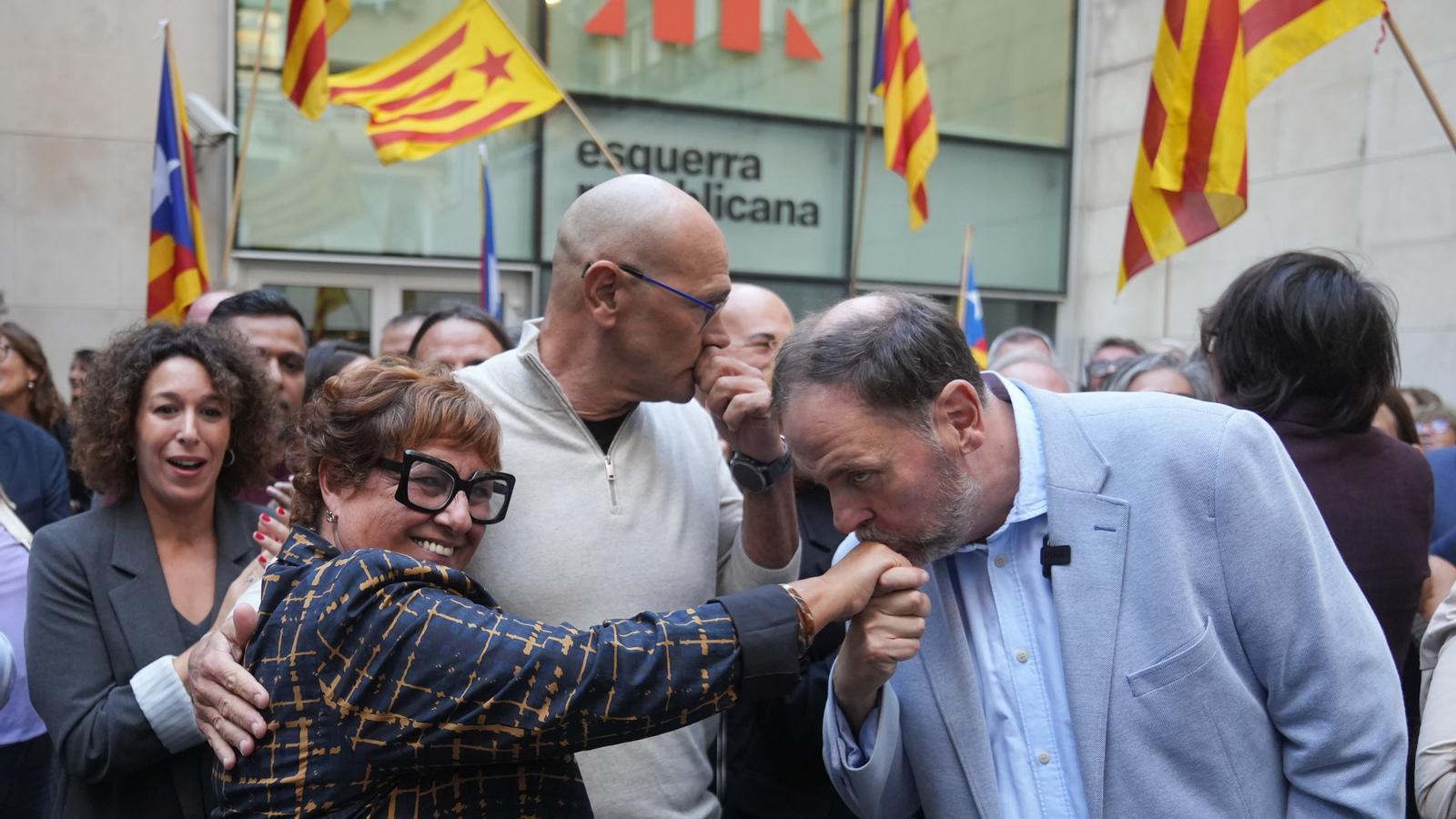
The independence movement has also claimed victory. Oriol Junqueras has celebrated the end of repression and lashed out against the judicialization of the Process: "They had no need to prevent us from doing our job. If they have done so, it is because they are afraid of us and have been very afraid of us. And they are right to be," he stated. The republican leader made these remarks at the ERC headquarters, where the party gathered its national council to ratify the candidates for November 29th. In fact, dozens of republican officials filled the headquarters' courtyard with hugs for Junqueras, Romeva, and Bassa. One of them was the ERC leader's hug with former Generalitat president Pere Aragonès. Gabriel Rufián, the ERC candidate for November 29th, arrived later, just in time for the start of the national council.
"There are two children who are getting their father back with the conditions to do his job as a university professor," Junqueras added, to highlight that until now he could not even exercise his professional role. The current republican leader, who aspires to be the ERC candidate for the presidency of the Generalitat in 2028, was unable to run in the February 14, 2024 elections and has not been able to return to being a history professor at the Autonomous University due to the Supreme Court's conviction.
For his part, Raül Romeva, who was Minister of Foreign Affairs, had to resign from presiding over the Irla Foundation, linked to ERC, due to doubts about his disqualification. "We continue to defend and believe that what we did was legitimate and useful and is irreversible," stated Romeva, who also remembered those to whom the amnesty has not yet been applied. For her part, Dolors Bassa resigned from her seat as a deputy in Parliament in March 2018, just before returning to prison, and has not returned to institutional politics. In fact, she learned of the Constitutional Court's verdict while traveling in Senegal with a friend. "Repression ends and politics returns," added Bassa.
From the Junts headquarters, the party's secretary general and recently amnestied Jordi Turull, who was also unable to run in the Parliament elections, boasted of a "new victory for the independence movement." "The joy will not be complete until we see it also applied to the exiles," Turull pointed out, however, in a press conference. Thus, he embraced the "celebration" after the stubborn "prevarication" of the Supreme Court and maintained that "many memories" come to him after "Marchena and all of the 'Toga Nostra' (Our Gown) have had to capitulate." The leader of the Junts members, former president Carles Puigdemont, concluded on X that, "dragging their feet, late and grumbling, but the Supreme Court has no choice but to sign the capitulation."

