Santiago Auserón: "Music is my way of thinking about life"
Musician. Performs at the Casino l'Aliança del Poblenou

-
CAT -
CAST
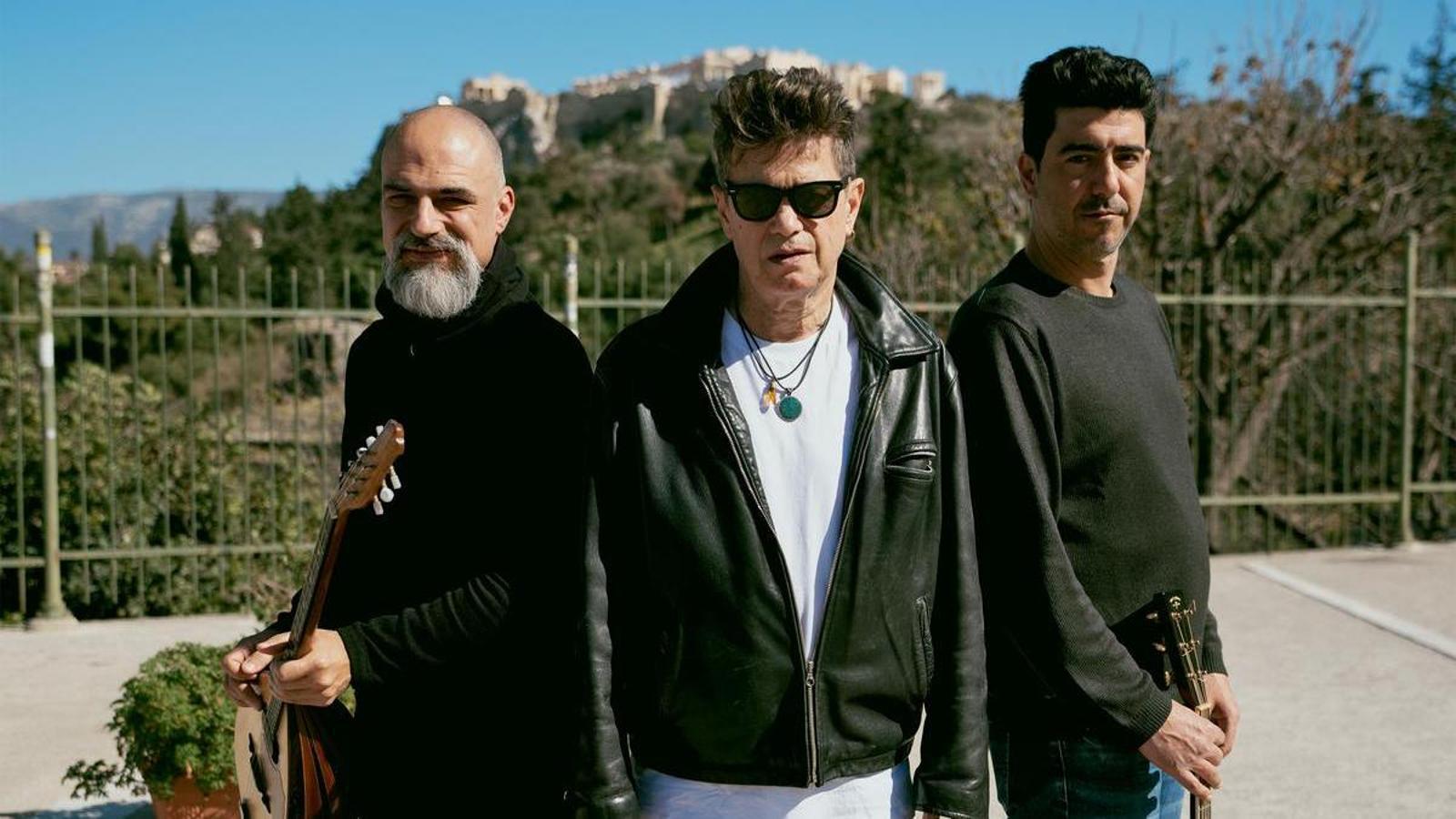
BarcelonaSantiago Auserón (Zaragoza, 1954) picks up the phone in Athens. He is rehearsing there with Greek musicians Vaggelis Tzeretas and Thodoris Karellas the repertoire for concerts like the one he will perform this Friday, October 23rd, at the Casino l'Aliança del Poblenou (9 PM), in Barcelona, as part of the Cruïlla Concerts. With them, he recorded the album Nerantzi (La Huella Sonora, 2025). It is Auserón's journey to the East, adapting to Spanish the shining eyes of rebetiko, one of the most unique manifestations of Greek popular music.
Your interest in Greece is not new. You even published a thesis on Hellenic thought in ancient Greek music, but you had not made any album. Was Nerantzi a kind of pending task?
— What I had pending was getting to know modern-day Greece. It even made me a bit nervous, because since adolescence I have lived with an ideal Greece in my head. During my time as a university student, ancient thought touched me very deeply, especially that of the pre-Socratics, the naturalists of the Ionian coast. It is a very attractive area not only because philosophy was born there in cities like Miletus and Ephesus, which today are part of Turkey, but also because epic poetry was born on the nearby islands. It is considered that Homer, or the dynasty of the Homeridae, the guild of the Homeridae, was born on the island of Chios, which is also very close to the Ionian coast. And the oldest lyric poetry also comes from islands like Lesbos, an area where an explosion of culture occurred that I believe is due to the crossbreeding between diverse traditions. All of this has consequences to this day. Later on, when I was already involved in the craft of songwriting, ancient Greek lyric poetry was also very useful, because I found in it forms upon which the evolution of verse in our peninsular languages was based.
Why were you apprehensive about visiting modern-day Greece?
— I had other urgent priorities. My travels have always been motivated by an interest in musical discovery, by the knowledge of the cities or areas where the music that interested me most at one time or another was produced. I spent thirty years traveling towards the side of the New World, towards the west. And the trip east, to Greece, was pending. Do you know when I started to get interested in what is happening with contemporary Greeks? From the 2008 crisis, when Greece entered a very deep crisis. I had read ancient history, but not the contemporary history of the 19th and 20th centuries, that of independent Greece after Turkish rule. I was seduced by a history full of tremendous ups and downs, with a very strong cultural identity of which we can still say that it is the origin of Western civilization, of the concept of democracy, of autonomy, and of free thought.
However, you took a few years to do it.
— It's just that I was so involved with the Cuba topic... And the tours around Spain didn't leave me much space either. Finally, I decided to rest and travel to Greece. I was immediately seduced by the character of the Greeks and the appeal of a difficult language that nevertheless contains lexical roots of our languages, both Spanish and Catalan and in general of all Romance languages. And immediately after I thought: now I need to get to know the music.
How did you get into Greek music?
— On my first trips I heard the sounds of the hospitality circuit, the typical duo of acoustic guitar and bouzouki, a very primitive instrument that dialogues with all kinds of music. One day, after visiting the ancient agora, I went into a nearby restaurant called Muses. Well, from the name it already seemed like it would be a good place to sit for a while after having visited the places where Socrates dialogued with his disciples. While I was having vegetable soup, music of the highest level played by a duo began to sound. I returned several times over the days, for the music and for the soup. And, finally, I greeted them and explained to them that I thought they were very good, that I liked what they did a lot, that they were traditional and inventive.
Were Vaggelis Tzeretas and Thodoris Karellas?
— Yes. We were chatting for a while, and they asked for my contact details. And shortly after, they wrote to me: "We already know who you are, the one from Radio Futura and Juan Perro. We are very interested in doing something with you." Then they proposed that I adapt one song from each into Spanish and go to Greece for a concert they would be holding in a venue in Athens. I prepared an adaptation, and I studied some songs from the traditional 20th-century repertoire to arrive with some background. We gave a very emotional concert, with the venue full of musicians, some from the more folkloric branch and others from the jazz scene. I started making friends, and I decided that I had to go there several times every year. They already proposed that I continue adapting tracks, and we decided to make an album. Finally, in November 2024, we got into the studio in Athens.
You said that both of them are musicians of a very high level.
— Yes, but to earn a living they have to play in restaurants in the hospitality circuit. They work a ton of poorly paid hours a day, almost in terms of slavery. But that very thing makes them a musical machine with a very high level of coordination, complicity, and sonic solidity. I think that is what impressed me when I heard them for the first time, and that is why I wanted to record an album only with the two of them.
When you were talking about musicians who have to play in restaurants, I remembered that Greek rebetiko was born in taverns, perhaps in a more marginal context...
— Taverns and brothels, yes. Rebetiko was born in the cities that were Greek in present-day Turkey, and that Greece lost following what they call the great catastrophe, in the 20s of the 20th century. More than a million Greeks who lived in Anatolia emigrated towards the Balkan Peninsula, mainly towards Greece, but not only, because they also spread through the Balkans. They settled where they could, or lived in tents on the beaches, as Syrian or Palestinian refugees later had to do.
A hundred years later, this wound between Greeks and Turks remains clearly visible in Cyprus.
— Yes, it is a very deep wound in contemporary history. But notice how things are: just like in the West, black slaves gave rise to wonderful music that later spread across the entire planet. This historical wound led to the music that was made in cities like Smyrna, in Anatolia, such as rebetiko (which is a word that comes from Turkish), spreading to the other side of the Aegean when most of the musicians were looking for a living at the port where they arrived. The taverns and brothels of Piraeus, the port of Athens, became the center of rebetiko. A music was born there that was initially purely marginal, comparable to blues, tango, flamenco, to all the music that stems from a concrete social life. But, little by little, it transformed into a national music, adopted by the entire population, which assumes its particular sensitivity, drama, passion, and also a somewhat dark humor. And even educated musicians approach it, the rebetiko.
In fact, on the album there are songs like La espera that seem to establish a connection between rebetiko, bolero, and tango, as if they were musics that could be joined together.
— I think that the rebétiko musicians were people who had a lot of musical information, because they were in ports where ships from all over the world passed through. Then, suddenly, there are rebétikos in which you hear elements from Cuba or New Orleans.
For example, Marea de alcohol, which has that Cuban touch on the guitar.
— Yes, cha-cha-cha, absolutely. In some mythical Greek films, you can see that the orchestras providing the music for society parties are playing mambo, cha-cha-cha, and rumba.
On the album you adapt Phaedra, by Mikis Theodorakis. Were you looking forward to it?
— Yes, yes, I wanted to see how Theodorakis' songs sounded in Spanish. It's something that had been going through my mind for a long time.
And the Bitter Orange would be like the challenge, right? I mean, for you to compose a song in the Greek style.
— I did not intend to compose any song. What happened is that we had made a repertoire of ten songs, of which the publishers rejected two for us because the rights owners did not authorize the adaptations into another language, Spanish. There are two pieces that made us believe they would authorize us to adapt into another language, Spanish. They kept us in suspense until the last moment. We recorded them and mastered them. They were finished and, suddenly, the publishers said they were giving us permission. Then I found myself obligated to start looking for royalty-free repertoire and at the same time write something, which was this Naranja amarga, inspired by the walks I take through Athens. That way we were able to complete an album of a reasonable duration.
In parallel to this project, you have just released the song Balada del tenor afligido with Academia Nocturna, with whom you are preparing an album.
— Yes, it's just that the stress of having to work on two important projects at the same time has fallen on me again. I try to fit things into the calendar one after another, but then everything moves, everything changes, people keep changing dates, and once again I've gotten myself into a mess. We already had the release date agreed upon with our collaborators for digital distribution and all that, and we preferred that the single came out while I was going to Athens. It couldn't have been any other way.
TheBallad of the afflicted tenor is rock-soul. Is it the color that will predominate on the album?
— No. Soul is underlying for me, like musical information from childhood. Rock-soul, both British and African-American, was my music from childhood to adolescence, and even when I started working in a band. On the new album there are touches of soul, but it opens up to many genres. Some songs are more influenced by the music my colleagues make, who are jazz musicians from the various Catalan schools. In others there is more of a rock-soul accent, in others there are still some Cuban flows and in others I am trying to introduce a bit of the incipient experience from Greece as well, to open up the two wings a little, the west wing and the east wing.
You still keep your passion for music very much alive, don't you?
— Yes, that is my way of thinking about life. What motivates me is moving. I still have a bit of a student's drive, I continue studying philosophy, noting things down, writing..., which requires concentration from me. And I also have to move to make a living and ensure there is a project to keep the team united, both the band and the people who help us from the office. This obligation leads me to do the things that I am most passionate about.
You have this responsibility that I also see in other musicians who, from a certain age, could retire, but who continue working because they have to support a team.
— Of course, there are quite a few younger people working with me, and I cannot leave them stranded. But I don't see myself stopping either. I would do the same, but in private.
