Did you know that the first "building" by Gaudí that is preserved are some public toilets?
The ARA Premium Club visits the Nau Gaudí, jewel of the modernism of Mataró

-
CAT -
CAST
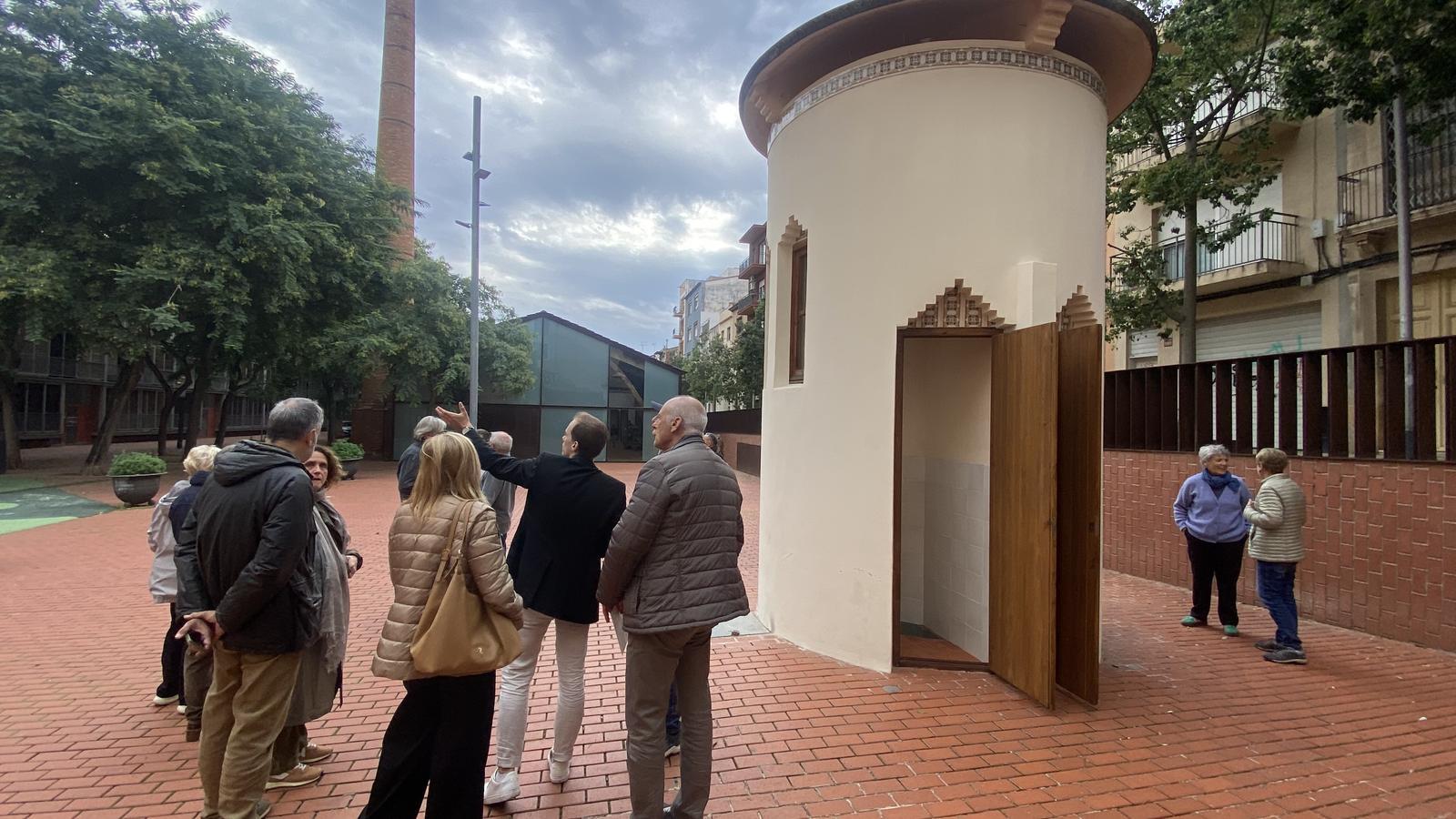
The first building by Gaudí that is still standing is not a house. They are some toilets he designed for the workers of the cooperative La Obrera Mataronense in the capital of the Maresme. The members of the Premium Club have had the privilege of entering them, and verifying that they are not just any toilets. It is a large brick cylinder, inside which there are four small enclosures (unisex toilets!) with natural light and good ventilation. The kiosk is decorated with tiles. Some have eight-pointed stars (symbol of Freemasonry). "For Gaudí, function, form and aesthetics were inseparable, even in these latrines," commented the guide, Set Simon, a cultural manager, who has conducted important research into the professional link that Gaudí had with the cooperative La Obrera Mataronense and its director, Salvador Pagès, who commissioned Gaudí. The client, therefore, in this case, was not the Church or the bourgeoisie, as in Gaudí's later works.
Prior to the latrines, Antoni Gaudí had designed one of the small houses for the workers. Thirty of them were to be built, but they were never constructed. Gaudí had drawn the workers' neighborhood by the sea, near the train station, with the chimney on the inland side of Mataró so that the sea breeze would carry the smoke towards the mountain. In the small house that Gaudí made (the brilliant architect's first building), the director of the cooperative resided for a few years, but it was demolished.

Gaudí's great treasure in Mataró is the so-called Nau Gaudí. It was the cotton bleaching warehouse, built in 1883, after the small house (from 1878) and the latrines (from 1878-1880). The Nau Gaudí is located right next to the latrines and the chimney (which has also been very well preserved).
"Salvador Pagès defended that cooperativism would lead to the emancipation of the workers, and would guarantee better living and working conditions," commented the guide to the members of the Premium Club inside the Nau Gaudí. This magnificent warehouse is made of 13 parabolic arches. It is the first time that Gaudí "experiments" with parabolic arches as structural elements, a "solution" that would become one of the most unique characteristics of his architecture. "A good part of the wood of these arches is original. It must be taken into account that the building was half-abandoned for a few years and they held up very well. It is Flemish pine wood, very resistant," assured Set.
After years of industrial use, abandonment and restoration, the Nau Gaudí reopened in 2008. It now houses the Consortium of the Contemporary Art Museum of Mataró and the Bassat Collection. These days, one can see the temporary exhibition "Gaudí, Pagès and the Worker," curated by Núria Poch and Ignasi Riera, which explains with plans, models and texts this exciting history of "zero-kilometre Gaudí."

ARA continues to schedule numerous activities for the Premium Club. Some of the upcoming ones planned include a route through the giant murals in La Bisbal del Penedès, with wine and oil tasting included, and visits to the Opisso Museum, the Espai Cràter and the Montsacopa volcano, the Banksy Museum, the Moco Museum, the "Sharks, the Guardians of the Ocean" exhibition at Cosmocaixa, the historic center of Ponts and the Egyptian Museum of Barcelona.
Remember that if you are a subscriber and you join the Premium Club you will be able to enjoy other advantages such as browsing Ara.cat without advertising or gifting a complete digital subscription to whoever you want.
