Underground and in the area of Maria Cristina: the preferred location for the future bus station on the Diagonal
The location is not yet officially decided, but the employers' association, the platforms and the administration have brought positions closer together

-
CAT -
CAST
BarcelonaThe University area, Maria Cristina, the surroundings of Francesc Macià or the center, near Plaça de Catalunya. These are the four options that the administration has been studying for some time to locate the future intercity bus station for the Diagonal. It is an infrastructure that over the last year, with the chaos of Rodalies, has proven to be a first-order necessity to guarantee mobility in the metropolitan area without saturating the surface traffic of this great Barcelona avenue even more.
The debate about where and how to locate it is not new, but in recent months the negotiations have intensified and consensus seems close, especially in the area of Maria Cristina. Industry sources point to this area as one of the most favorable for installing an underground bus station. The employers' association is also on board, and the latest public statements by the mobility representatives of the Generalitat and the City Council, Susi López and Lídia Torres, also align with this view. The analysis –zone by zone– of the possibilities adds even more points in favor of Maria Cristina, although this location also has some downsides, as pointed out by industry sources and also by the association of experts for the Promotion of Public Transport (PTP).
Possible locations for the future Diagonal station

From left to right on the map of Barcelona, the University Zone is the first section that is on the table for engineers and mobility planners (see chart). It is an area that still has "a lot of space" available to accommodate infrastructure underground. However, at the same time, it is the area furthest from the center of Barcelona and, although it could connect with the L3 metro line, this location would complicate "door-to-door" mobility. In fact, only university students heading to the Diagonal campus would have their mobility 100% solved; the rest of the passengers would need several transport changes to reach their destination. "Getting a little further into the city" has been, in this sense, one of the historical requests from user platforms and those in defense of public transport.
On the other side of the map is the option that possibly accumulates the most negative points within the sector: the city center. While it "would have very good access and excellent intermodality", they admit from the PTP, locating the bus station closer to Plaça de Catalunya than to the Diagonal would significantly lengthen travel times, because upon entering the urban grid, traffic lights and congestion would greatly complicate commercial speed. Furthermore, it would be very difficult to find space for it, both underground and on the surface, and practically impossible to find an area for stops and schedule adjustments, which in the sector's jargon are called regulations.
Of the two remaining options, Francesc Macià and Maria Cristina, the former is considered a "lost option". The L8 works, which opened and dug up the subsoil of Francesc Macià, are now quite advanced and some technical profiles consider that the opportunity to build the bus station at the same time as the railway works has been lost. But the schedules for both projects were very out of sync: while the L8 tunnel is already a reality, the bus station still does not even have an official agreement and this means that it still has to be designed on paper. Re-opening the square now with a train station underneath becomes, therefore, a more uncomfortable option. "This is what has led to it being ruled out. The L8 works were the perfect moment, and it has been a very lost opportunity," corroborates the president of the PTP, Carles Garcia.
The consensus: Maria Cristina
There remains Maria Cristina. An intermediate point between the remoteness of Zona Universitària and the complications already presented by Francesc Macià and the center of Barcelona. Building the station underground at this point would avoid traffic congestion if a double bus lane is guaranteed on the road, and it would ensure slightly better intermodality than Zona Universitària. Facing this diagnosis – formulated last week by the PTP at the annual conference of the bus employers' association, Fecav –, the director of Mobility of the Generalitat, Susi López, and the one from the City Council, Lídia Torres, agreed. The complicity also extended among the sector professionals attending the conference.
“It is well connected, very close to l’Illa Diagonal and, above all, there is space. It is the only place within Barcelona where there can still be space,” argues Garcia, who adds that this point also has “cons,” such as that it forces intermodality to reach the Eixample and that it increases “door-to-door” times compared to Francesc Macià. “We would have preferred Francesc Macià, but it seems it will be Maria Cristina,” he concludes. “It needs to be in a place perfectly connected with the L3, the future L9, and the tram. And, in this sense, both Palau Reial and Maria Cristina are good options,” agrees Joan Carles Salmerón, director of Terminus Center for Transport Studies.
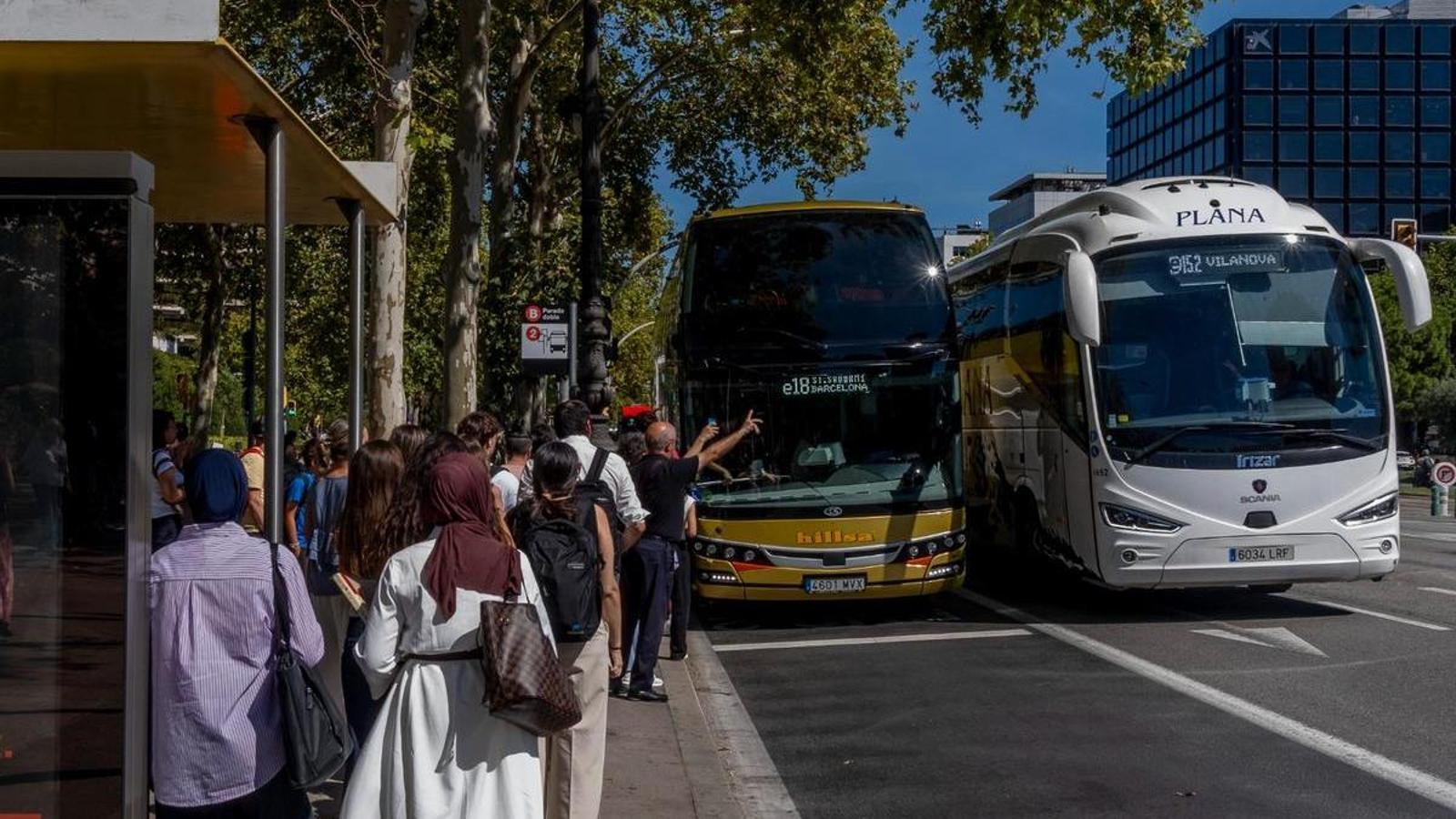
Sources consulted by l’ARA point out that this new infrastructure could be located specifically on the Diagonal, between Gran Via de Carles III and Numància street. Despite being “a sufficiently wide space,” some sources point out that even so, “it could become too small” to handle the 1,800 buses that make a stop on the Diagonal every day. Currently, every morning and every afternoon, at peak hour, hundreds of people stop at this point, now on the sidewalks, to wait for the buses that have a stop in this area.

How will it be and what does it imply?
“Dimensioning is extremely important. There must not only be the places for boarding, that is to say the platforms, but also the services, the cafeteria, the ticket sales spaces, toilets for users, space for company offices and also, most importantly, plenty of space to be able to stop the buses”, points out Garcia, the president of the PTP. “Apart from the platform, a parking lot will be needed to keep, for example, all the reinforcement buses, so that they can regulate time outside the platform”, he continues.
Salmerón, the director of Terminus CET, adds that the station must “invite you to enter”. “They are the showcase for public transport. They must be easy and friendly”, continues this expert in the sector, who ensures that apart from all the services mentioned, there also needs to be charging zones for electric buses and an area to clean the vehicles. “The intercity bus plays an essential role for the future of public transport and we must equip it with these infrastructures that it does not have. In Madrid they have a bus station in each of the entry corridors –recalls Salmerón–. We cannot afford for our buses to continue stopping on the sidewalks of Barcelona”, he summarizes.
Once the location is made official, another debate will come: that of the works and their implications. After the tram connection along the Diagonal and the works for the L8 at Francesc Macià, this great artery will have to be prepared again to undergo another major surgery, now to locate the new bus station there.

