The human tower revolution that is cooking in the faculties
More than thirty years after its birth, the university groups are experiencing a technical escalation without precedents
-
CAT -
CAST
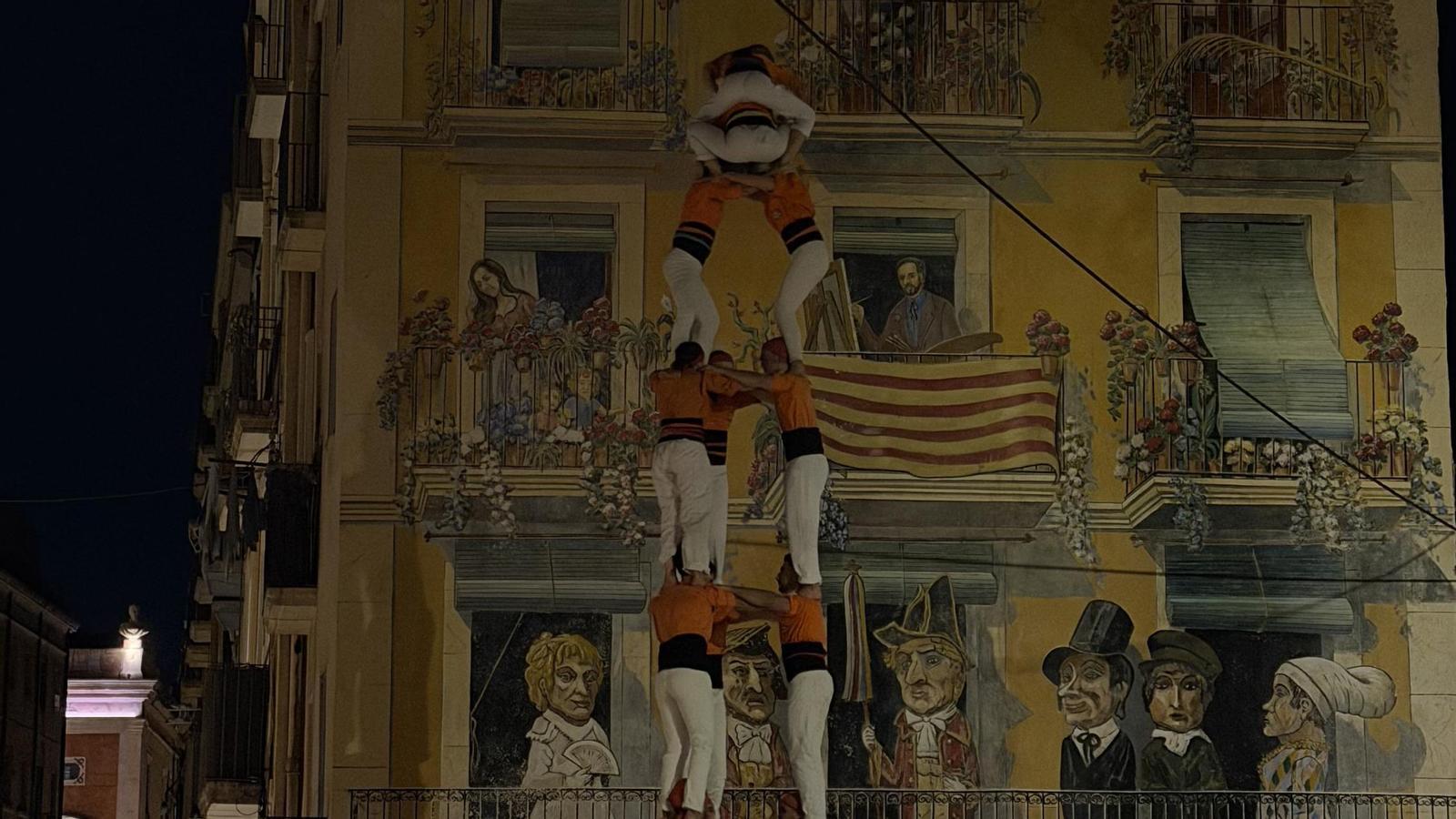
BarcelonaOn November 12, at the Plaça dels Sedassos in Tarragona, the Pataquers of the Rovira i Virgili University (URV) unloaded the 3d8f before the university winter season officially began. That same afternoon, at the Raval de Montserrat in Terrassa, the Bergants and the Arreplegats were rehearsing the same construction. Three groups working on eight-story structures only two months after starting the academic year. A snapshot that would have been hard to imagine a decade ago.
More than thirty years after the birth of the first university group at the Autonomous University of Barcelona (UAB), the phenomenon has transcended the campuses. Behind this technical escalation lies a social transformation that is also redrawing the conventional human tower world.
Two out of every three university human tower builders had never built human towers before joining a faculty group. This is revealed by a study from the Center for Prospective and Analysis of Human Towers (CEPAC), prepared by Marta Farrés and Guillermo Soler based on 660 surveys. Among those who had no prior experience, 37.6% are already part of a conventional group, 45.3% are considering joining one, and only 17% rule it out.
This transfer especially benefits small and medium-sized groups, which not only gain arms for their bases but also young people with technical knowledge and the ability to take on responsibilities. But this ability to attract new human tower builders has also allowed the groups themselves to face increasingly ambitious challenges.
Is there a ceiling?
Before the 2024-2025 academic year, only the Arreplegats and the Ganàpies had successfully completed eight-story human towers (castells de vuit). In a single academic year, the Pataquers, the Bergants, and the Marracos crossed this threshold, the latter doing so with a loaded 3d8f.
With eight-story towers becoming increasingly contested, the technical ceiling has continued to rise. In November 2025, the Arreplegats loaded the 2d8fm again and, a month later, they crowned the first university-level 3d8sf. The Pataquers, for their part, only needed one year to go from debuting eight-story towers to completing the pd7fm.
The progression, however, is not exclusive to the leading groups. The Xoriguers, the Trempats, and the Emboirats have expanded their repertoires, while more modest groups, such as the Descargolats or the Llunàtics, have gained complexity with six-story towers. The increase in social mass, which in some groups reaches double or triple what it was just a few years ago, explains a large part of a growth that takes place under particularly demanding conditions.
Building a group with an expiration date
Unlike conventional groups, university teams must rebuild a good part of their squads every September. The departure of 'castellers' who finish their studies coincides with the arrival of young people who are often inexperienced, and the calendar forces them to find replacements and pass on knowledge in a matter of weeks. Winter performances are concentrated between November and Christmas, usually with four fixed events per term.
This constant renewal turns the groups into a school of leadership, where students can take on positions of responsibility in a few years. At the same time, the technical escalation and the presence of adults on the upper levels accentuate the need to strengthen fall prevention and health training.
Despite this growing demand, university groups have not renounced one of their most defining traits: the party. If for years this side fueled the prejudices of a part of the 'casteller' world, today the results in the square prove that technical rigor and the playful dimension can coexist. The celebrations following the events help to weave a network of relationships that goes beyond the faculties and the shirts.
A network that, like the knowledge acquired in the rehearsal yards, does not necessarily disappear when the degree ends. Among the students who have stepped into a rehearsal yard for the first time this September, there could be the future leaders of the country's groups. Some still do not know what a 'folre' is. Perhaps, in a few years, they will be the ones in charge of directing it.
