Four surprising love stories with Catalan literature
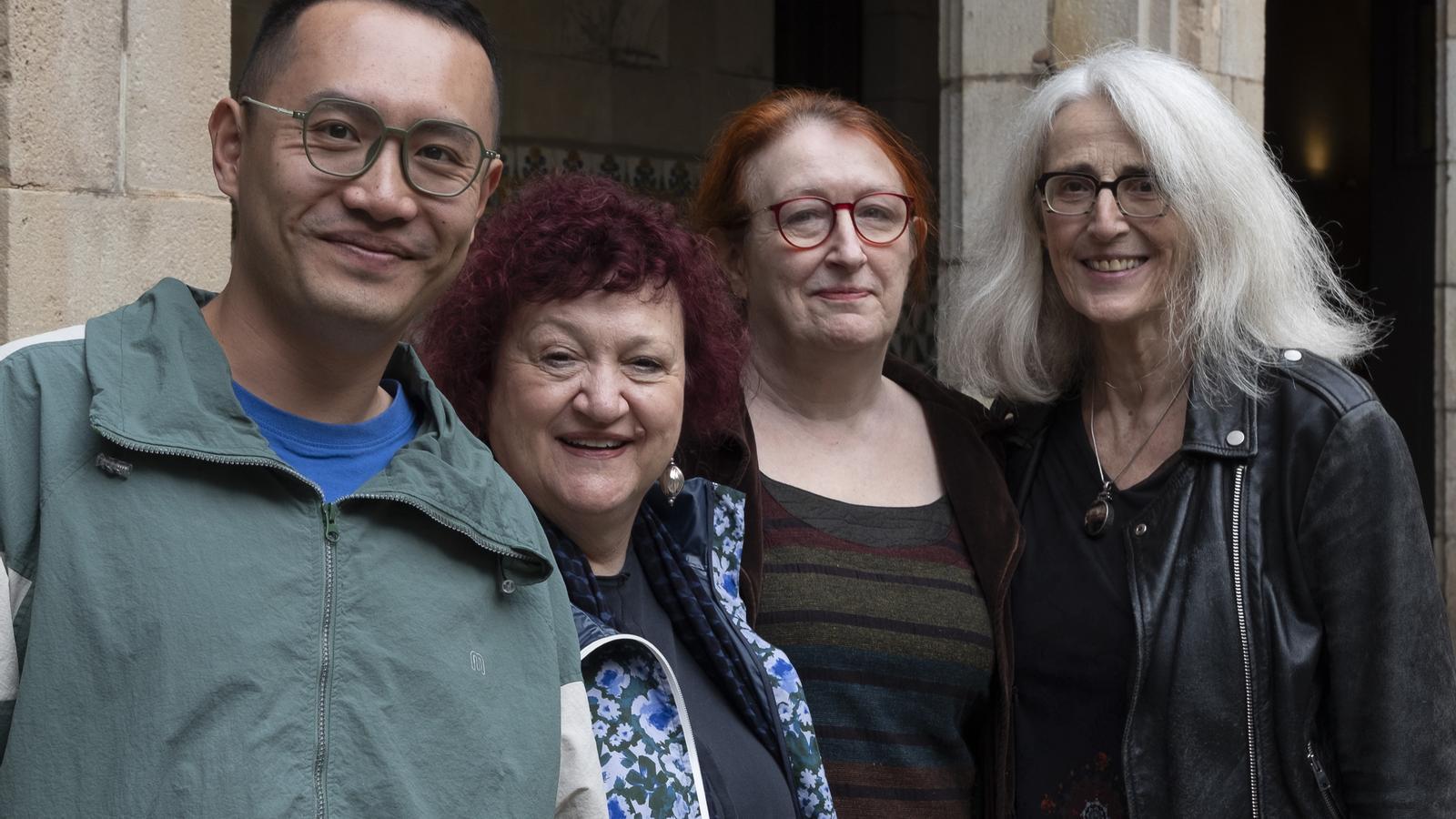
Almost 150 translators have participated in the first edition of the forum that the Institut Ramon Llull has organized in Barcelona. Among them were profiles of ages and interests as different as those of Annie Batts, Marialena Carr, Xu Guo and Maria Khatziemmanouil, who arrived at Catalan through unsuspected paths
-
CAT -
CAST
BarcelonaThe celebration of the first International Translators Forum has demonstrated the international power of Catalan literature, which in the last two decades has doubled the number of translations –it has gone from 174 in 2007 to 381 in 2025– and has been the guest of honor at fairs such as Frankfurt (2007), London (2016), and Bologna (2017), and next year it will have a prominent presence in Turin. Each of the nearly 150 translators who have traveled to Barcelona arrived at the Catalan language in different and surprising ways. We have chosen four from very diverse generations and interests.

ANNIE BATS: “It is very good news that there is a bit of everything in Catalan literature”
For a few years now she has become the French voice of Eva Baltasar. She started with Permagel in 2020, and now her version of Ocàs i fascinació has received the Médicis Étranger award.
— The Médicis represents a very big step for Catalan literature in France. It is difficult, if not impossible, for a literature that does not have a state behind it to be recognized there.
Ocàs i fascinació is the fourth book by Eva Baltasar that she has translated and, like the other three, it has been published by Verdier.
— It is a strange case of editorial loyalty to an author and a translator. It happens less and less, unfortunately. I arrived there through the recommendation of Maria Bohigas, from Club Editor. Six years after publishing Permagel there, Maria, Eva, and I were on the steps of the restaurant La Méditerranée receiving the award. I had always looked at the Médicis from afar, with great respect, and suddenly I found myself right inside it. It was a great day. And the champagne was delicious.
What does an award like this represent for Catalan literature?
— The Médicis underscores the recognition of Catalan as a national literature.
Your journey as a translator from Catalan to French began long before Permagel, didn't it?
— Yes. In fact, I started by translating from French into Catalan. The first book was Exercises in Style, by Raymond Queneau [Quaderns Crema, 1989]. We worked on it four-handedly with Ramon Lladó, just as we did, years later, with Life: A User's Manual, by Georges Perec [Edicions 62, 1998]. The first translations I did into French were of poet friends: Víctor Obiols, Carles Torner, Jaume Subirana... In 2005 I published the French version of La palmera de blat, by Mercè Ibarz. A little later arrived Desertar, by Arnau Pons [2010], and an anthology of the poetry of Maria-Mercè Marçal, Trois fois rebelle [2013]. The latter had a certain impact. I remember that some poems were even set to music.
How did you come into contact with Catalan?
— While I was studying French philology I spent a few days in Barcelona. It was in the late 80s, the moment when the city was starting to become Catalanized again. I liked that it was a language that sounded close to Occitan to me, and that luckily it was not so minoritized. When I returned to France I studied Catalan. I would buy records by Raimon and Sisa at the Catalan-Occitan bookstore in Paris, I would read Mercè Rodoreda, Ausiàs March and J.V. Foix... I wanted to do my thesis on Sol, i de dol and, even though it did not prosper, I translated all the sonnets from Foix's book.
Will Eva Baltasar continue translating?
— I am currently working on his latest novel, Peixos. I have two more projects in mind: I want to translate Trast, the latest poetry collection by Biel Mesquida —whose Llefre de tu [2018] I have already translated—, and do something by Víctor Català, although I do not know whether to choose Un film (3.000 metres) or prepare an anthology of short stories.
What do you like about Catalan literature?
— Just as it happens with French literature, I do not like it in its entirety, but only some books and authors. I treat it like any other literature that I read. It is very good news that in Catalan literature there is a bit of everything.
MARIALENA CARR: “Oceanography and the poetry of Felícia Fuster are two of my great passions”
She was born in Tarragona, the daughter of a Valencian woman and an American man, but she learned Catalan in the United States.
— We were a Spanish-speaking family, and we returned to the United States when I was about 10 years old. There, I studied biology and completed my thesis. I had always been curious about Catalan, even though I hadn't learned it, and I didn't get into it until I was doing my postdoctoral fellowship. My goal was to eventually translate J.V. Foix, but I pushed myself too hard. I have written poetry and prose, and translation was just another game on the sidelines of my work.
Have you always been dedicated to science?
— Yes, my career has been 100% scientific. I have dedicated myself to scientific oceanographic research, and I also ran an environmental science center at Columbia University. When the pandemic arrived, my husband suffered a brain hemorrhage. I spent a long time without leaving the house to be able to help him, and it was then that I enrolled in a poetry translation course. There, I chose Salvador Espriu, an author I like very much. There came a point when the professor told me that a magazine was looking for translators for an anthology of unpublished Catalan poetry in English that they were preparing. It was necessary to find someone who was not part of the canon, and that is how I came to the first book by Felícia Fuster.
What did you like about Fuster?
— Oceanography and the poetry of Felícia Fuster are two of my great passions. Fuster was someone who had been born in Catalonia, just like me, and ended up settling in Paris, from where she wrote her work. Fuster turned me into a translator. She captivated me so much that I translated all of her poetry, but it hasn't been until recently that I managed to get a contract to publish 70 of her poems in a volume. I still don't know if it will be an anthology or one of her books, but I am doing it for World Poetry Books, an emerging and highly awarded publisher that only publishes translations into English. Fuster will be the first Catalan woman in the catalog.
Do you have other ongoing projects?
— I have translated two short stories by Anna Dodas i Noguer for anthologies and I am working with Julia Sanches to translate the poetry of Eva Baltasar. We have already published a selection in the London Magazine. I would also like to translate Una història és una pedra llançada al riu, by Mònica Batet.
Their interests in Catalan literature do not coincide with the major trends in the publishing sector.
— I read what I find new and interesting. When I decide that I will translate someone, it is because reading them has transformed me and made me think.
XU GUO: “The study of Spanish and the love for Gaudí and for García Márquez brought me to Catalan culture”
How is it that someone just over thirty years old has ended up translating a modernist classic like Solitud, by Víctor Català?
— First of all, because it is a novel that I like very much. The author uses a very rich vocabulary to describe the fauna, the flora, and the landscape. If I hadn't lived in Catalonia for a season, I wouldn't have fully understood the particularity of the settings where Solitude takes place.
It is your first translation, I imagine it has been a significant challenge.
— Yes, it has been a great challenge, whether because of the narrative techniques the author employs or when it comes to creating the linguistic particularities of the characters. The shepherd's idiolect, for example, put me to the test, because it is very particular. When I gave the text to the publisher [Shanghai 99 Readers Culture], I had to adapt it to a standard register, because that is what is customary in Chinese.
Has received any kind of feedback about the translation? What is interesting about Mila's life in China?
— I have read some very interesting comments on a website that is the Chinese equivalent of Good Reads and is called Douban. There, some readers explain that they have connected with Mila's life on a solitary mountain, and also with her perseverance.
Is there a long way to go in the translation of Catalan classics into Chinese?
— Yes, even more than in contemporary literature. In Chinese, there is a large presence of translated Anglo-Saxon and Japanese literature. There is also a focus on major awards like the Nobel, or classics like 1984 by George Orwell. What arrives depends not only on the decision of the publishers, but also on the government's approval. In the case of Solitud I found that the publisher had decided the title for me when I saw the cover.
What title does it have, in Chinese?
— It is more explanatory and lyrical. It goes more or less like this: The wind of the mountains knows my feeling of loneliness.
How did it reach Catalan?
— It was from the third year of the Hispanic Philology degree, when I spent a period of time in Salamanca. In addition to deepening my knowledge of the language, I took a trip to Barcelona where I came into contact for the first time with that language that I had been introduced to in a Spanish culture course within the framework of the Spanish state. On that occasion I learned a few simple words of Catalan, but I remained interested in the language.
How is it that it persisted?
— I ended up returning to Barcelona to do two master's degrees at the Autonomous University. The study of Spanish and the love for Gaudí and García Márquez led me to Catalan culture. Mercè Rodoreda was almost the only Catalan author that Gabo liked: the first full novel I read in Catalan was The Time of the Doves, and from then on I didn't stop until I reached Solitud.
MARIA KHATZIEMMANOUIL: “You Catalans have the best theatre being made in Europe”
Is it true that you discovered Catalan on the island of Paros?
— Yes. It was in 2009, in a translation workshop organized by the Institut Ramon Llull and the Athens Book Institute, where I was a teacher of theatrical translation. I coordinated those sessions in which three Catalans and three Greeks participated. During the workshop, two translations were made, one of Iannis Tsiros into Catalan and one of Carles Batlle into Greek.
What happened after that?
— Until that moment I barely knew that Catalan existed, but from then on my ties have not stopped growing. With one of the members of the Paros group of translators, Dimitris Saras, we have worked together on nine works. He gradually grew my interest in Catalan theatre, until I decided to translate an author on my own. I chose Josep Maria Benet i Jornet. I wrote to him to see if he would give me permission, and from there a great friendship was born that I will never forget. We kept it up until his Alzheimer's allowed him to.
In less than twenty years he has done a lot of work.
— I have translated about fifty works only from Catalan by authors such as Guillem Clua, Josep Maria Miró, Lluïsa Cunillé, Sergi Belbel and Marta Buchaca. I am about to present an essay on the 100 most important plays written in Spain during the 21st century and half of those I have chosen are Catalan.
Which elements would you highlight in Catalan dramaturgy?
— There are very interesting and modern forms that I do not find in Spanish, which is a more traditional theatre. Furthermore, the themes it touches upon are urgent and contemporary. You Catalans have the best theatre being made in Europe. In Greece, they are increasingly clear about it, because they are asking me for more Catalan translations all the time. There are authors who are very successful, such as Josep Maria Miró, Marta Buchaca, Jordi Galceran, and Esteve Soler, a unique case thanks to his two trilogies, which began with Against Progress [2008]. Soler writes the world upside down. His proposal is very original.
What is your latest translation?
— I have just finished The Irishman's Bones [2021], by Víctor Borràs. I am convinced that a production will soon be made in Athens, even though I am increasingly being asked for plays from more diverse places in the country.
