Barcelona illuminates Christmas with a round spectacle
100,000 people approach Passeig de Gràcia for the lighting of the lights
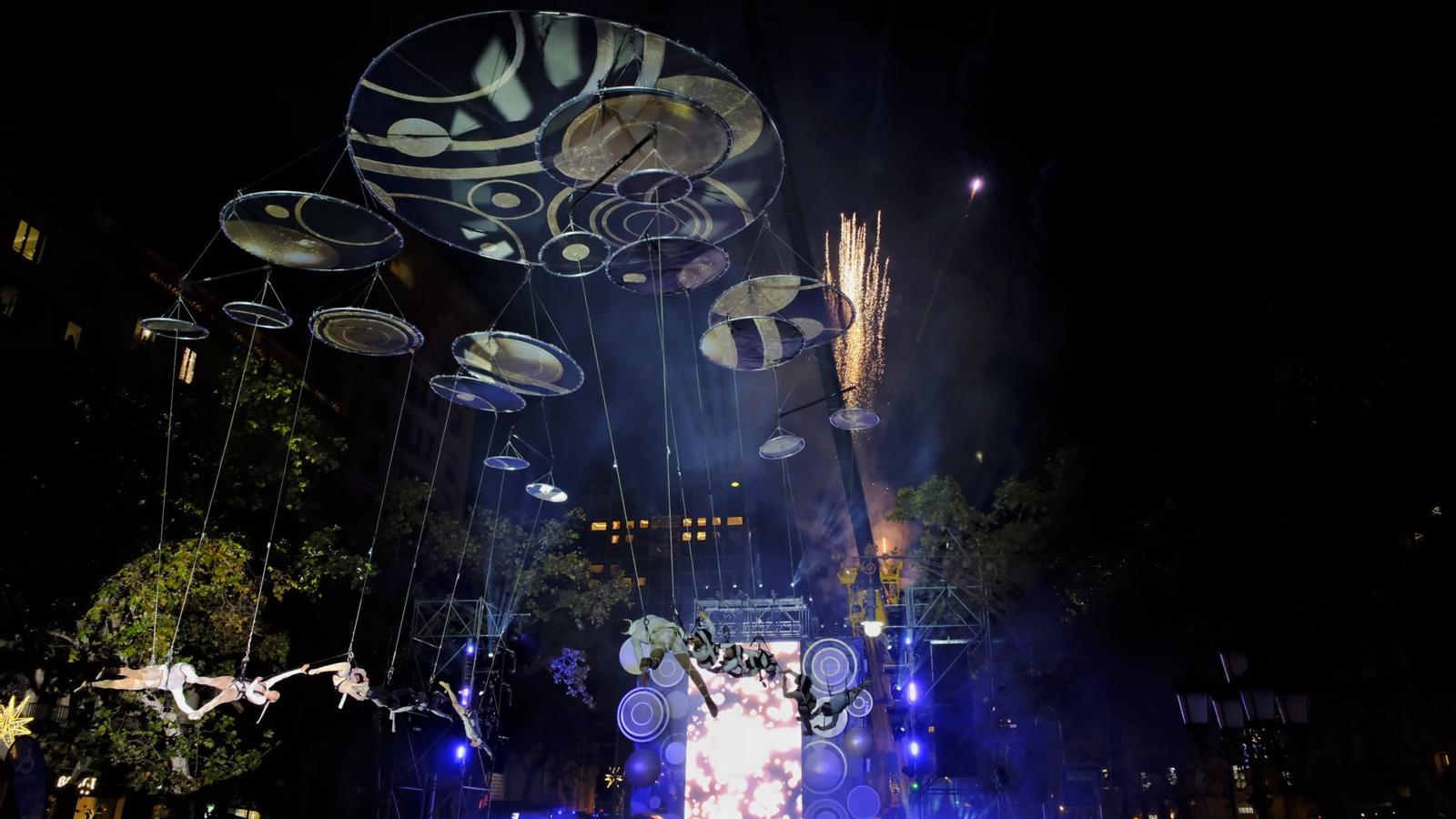

BarcelonaIt was meant to be a tribute to the circular shapes of Christmas and it ended up being a well-rounded show. Barcelona turned on its Christmas street lights this Thursday with a high-flying spectacle, literally and metaphorically. For just over twenty minutes, several artists flew over a packed Passeig de Gràcia. Even those who had gone there dragging their feet and who were grumbling halfway through the show about wanting to go home ended up captivated by the performance.
It was cold, which helped to anticipate a Christmas that is still almost a month away. Scarves, gloves, and wool hats were the uniform for the vast majority of the 100,000 people who, according to the Urban Guard, gathered in the city center. The new layout of the stage, in the higher and wider part of the promenade, helped to decongest an avenue where last year—when the lighting ceremony took place on a Saturday—some crowds were experienced.
The fact that almost the entire show took place above the heads of the crowd also helped to spread people out, which guaranteed good visibility from all over the street. The first to kick off the show were the folk music duo Alosa, who, perched on a swing raised above the modernist lampposts of the boulevard, slowly descended to the stage while singing classic Catalan Christmas carols.
It was the starting point of a show, curated by Jordi Duran i Roldós and under the artistic direction of Bonvehí Arts & Events, that left the attendees stunned. After Alosa, the next to touch the sky of Barcelona were five acrobats from the Spanish-Argentine company Voalá, who gave way to one of the most magical moments of the night when a dancer from the Italian company Studio Noè flew along the Passeig de Gràcia suspended in the air by 300 white helium balloons.

Raffel Plana's soundtrack finished setting the mood for a show that sought to commemorate the circular shapes of Christmas, such as the baubles that decorate trees, snowflakes, balloons, or cava bubbles. After the acrobats, the show recovered its more grounded connection to the city with a children's choir singing the official Christmas carol that the city debuted last year.
The Christmas carol was the final step before turning on the lights, which culminated in the last great trick of the night. The Voalá acrobats appeared again with an aerial dance number in which they spun on a large mobile structure of circles, before the fireworks put the finishing touch on the show and gave way to the countdown to the Holidays.
Without Plaça Catalunya yet:
Once the show is over, it is time for selfies with the Christmas lights already lit both on Passeig de Gràcia and the rest of the city. The only spot that could not be illuminated this Thursday was Plaça Catalunya, where until a little over a week ago there was the protest camp for housing that the City Council evicted. The forecast is that the lights will be fully installed in the coming days.

The lighting of the two avenues that are debuting designer lights this year has, however, been switched on: Rambla Prim, with a colorful proposal by Hey Studio, and Passeig de Maragall, with a design by Jordi Canudes and Ingrid Picanyol that invites you to walk along this avenue to be able to read the light poem that Picanyol herself has created.
Apart from the streets that are illuminated by the commercial axes and associations, the city council is once again lighting up Ronda de Sant Pere, Carrer de Balmes, Plaça d'Urquinaona, La Rambla, and Avinguda del Paral·lel, which has the entire street illuminated this year.
This year, the city—which has been distinguished as the European Capital of Christmas 2026—also recovers the 'Galet', the luminous element designed by Ramon Bigas, which can be seen in twelve municipal markets, at Plaça del Rei, and at the intersection of Rambla de Catalunya with Carrer de Provença. Furthermore, the windows of unique buildings are also being illuminated, such as the Convent of Sant Agustí or the Torre de les Aigües del Besòs, in a proposal inspired by the Central European tradition of Advent windows. In addition, there are luminous totems at 26 points in the city and more than fifty illuminated ornamental fountains.
