Miriam Ponsa: "When my father died, I said to my mother: 'Do not throw anything away. I want everything'"
Designer
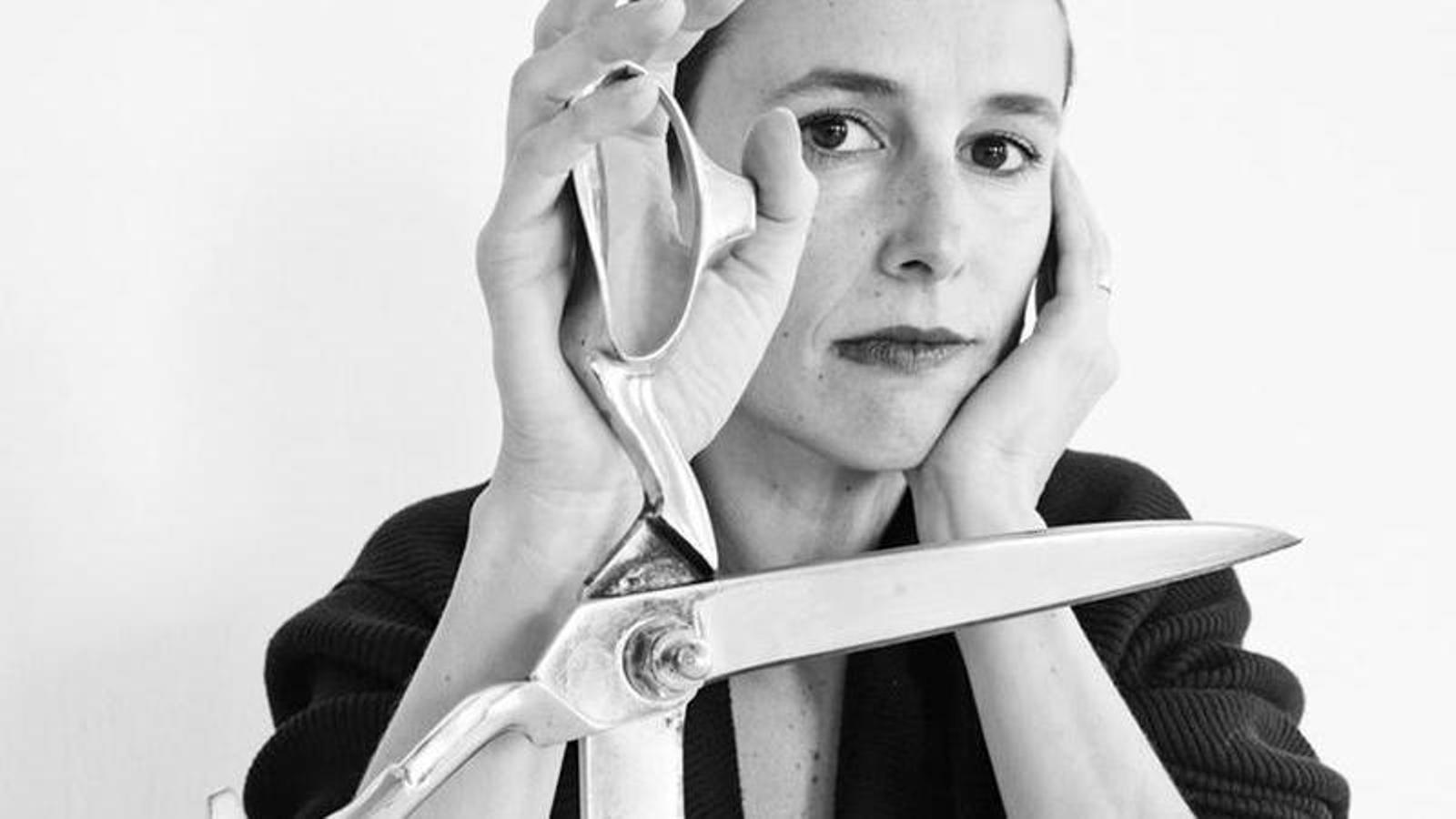

The head, which dreams, and the feet, which take root. It is what Miriam Ponsa needs to visualize of the characters she builds for her fashion shows. When she is creating a piece but does not yet quite know what it will be, she places it on her head, like the fabric seen in the photo and that, even though she did not know it yet, ended up becoming a sweater. The designer presents on Tuesday the collection Papa, in tribute to her father, a textile entrepreneur and... magician.
Opening the closet of a dead person must be doubly painful for someone who works in fashion.
— One of the first things I did when my father died was to tell my mother: “Do not throw anything away. I want everything, even if it is stained or torn. And the shoes, too”.
Why hold a parade about the father?
— Because he and I had a very special connection. I hesitated a lot about whether I wanted to share it. But he was such an inspiring figure that I did not want to stop paying tribute to him. I also dedicated two collections to my children when they were born: Roc and Bruna.
Papa, and not Francis?
— I considered it, but it was Dad from the beginning. To me, he has always been Dad.Dad. For me, he has always been Dad.
How do you explain a whole life in a few pieces?
— Choosing. My father had so many hobbies that it was very easy for him to get distracted. For example, at one point he decided to buy violins online in auctions. So I have used three axes: textiles, tailoring, and magic.
The textile?
— My father's textile factory made the thread for doll hair, curly or straight, and with that I have crafted all the artisanal pieces in the collection. For me, craftsmanship is a dialogue with the material. Working with this thread is as if I were with it.
The tailoring?
— He dressed very classically: wool vest, shirt, blazer, dress pants. I must say that he was not always coordinated: a blazer from here, some pants from there. Some of these pieces, well arranged, will appear in the fashion show.
And the magic?
— When she retired, Miriam Ponsa, the shop, was on Princesa street, near El Rei de la Màgia. My father used to come to help us and, on the way, he would go into El Rei de la Màgia, and he ended up getting hooked on it. He did it for fifteen years, always for free, in hospitals and nursing homes.
And will someone come out with a bunny and a hat?
— Don't [laughs]. I explain the magician through tailoring. I'm not interested in the shine: the magic must be in the shapes.
Not a single sequin?
— He already brought the sequins himself. Magicians like to be eccentric, and he took that literally. When my son was five years old, I made them two identical blazers, full of sequins, and they went on stage dressed the same. We were laughing our heads off. He loved magic so much that he went all the way to China to see an exhibition.
At the time of the textile relocation?
— Everyone was going to China to manufacture, and my father went there for the magic. His production always stayed in Catalonia. But a Chinese girl who was staying at my parents' house told them about that exhibition and…
How?
— My parents' house was like a boarding house. This girl stayed with them for a year and a half. Some friends of mine and my brothers stayed there for periods of time, even when we no longer lived there. The company representatives would stay for lunch and dinner.
And you do it too?
— Yes, we often have lunch all together at home with the team. My father was a great example: he had a large company, but it was very much a family one. Ours is smaller, but it is also a family.
Works at the family factory.
— And I live above it, in the same apartment where my father lived as a child. Where my grandfather had the looms, now we hold photo shoots and parties. One of my childhood memories is precisely the smell of the oil from these looms. And the noise. For me, this is home.
But he did not continue with the family business.
— At the factory, labels were also woven, the kind that any piece of clothing has sewn on, and my father counted on me to take care of that part of the business. But that was industry, and I said: “Listen, family, I have to set up my own business.”
How did he come up with it?
— Actually, thanks to him. The easiest thing would have been to continue at the company, but I had seen an entrepreneur at home and for me it was normal to want to do something new. He always told me: “Miriam, you can. Come on. Do it”. He made me take every train that passed by. Some were not worth it, but I learned from that too.
Did he end up understanding her decision?
— At first he didn't pay much attention to me, but later he helped us a great deal: he was always looking out for us. And when I was awarded the Creu de Sant Jordi, he was so proud of it…
Did they resemble each other?
— Too much. He had a lot of character and so did I, and we would clash. But we had such trust that we could get very angry and the next day say to each other: “I’m sorry, but I had to tell you”. And he was –and I still am– very playful: at the table, suddenly, he would throw a plate at me for me to catch it. Let’s see those reflexes!
What a danger!
— They were experiments. Sometimes he would take us to a full restaurant, without a reservation, to see if we could find a place to sit. I had a terrible time [laughs], but I learned that, even if you have nothing, you can find ways to achieve it.
What do you see of him in his children?
— Hard work, persistence, generosity. And safety: he was the man who, when they were months old, would throw them into the air, way up, and catch them again.
Born on a Friday the 13th…
— He always said that he had been very lucky in life. I also feel that way. Sometimes, I go to meetings with women and the topic of fathers always comes up. Almost always, I am the only one who can only say good things about them. Everything was joyful, easy, happy.
