From watching it to living it: why do immersive experiences fascinate us so much?
This new form of cultural leisure allows one to place oneself at the center of the stories and enjoy them in a closer way
-
CAT -
CAST
BarcelonaI open a curtain and step into an unknown world that reveals phrases, objects, and thoughts from one of the most iconic figures of all time: Salvador Dalí. Artisanal pieces, lights, mappings, technology, and virtual reality combine masterfully throughout a journey that surprises at every turn. I am talking about Dalí Cybernetic Boulevard, a permanent immersive experience dedicated to the Catalan genius that can be seen at Casa Amatller (Passeig de Gràcia, 41, Barcelona). This project recovers and expands with new content the material from the original exhibition, Dalí Cybernetic, premiered in 2022 by the Ideal Centre d'Arts Digitals.

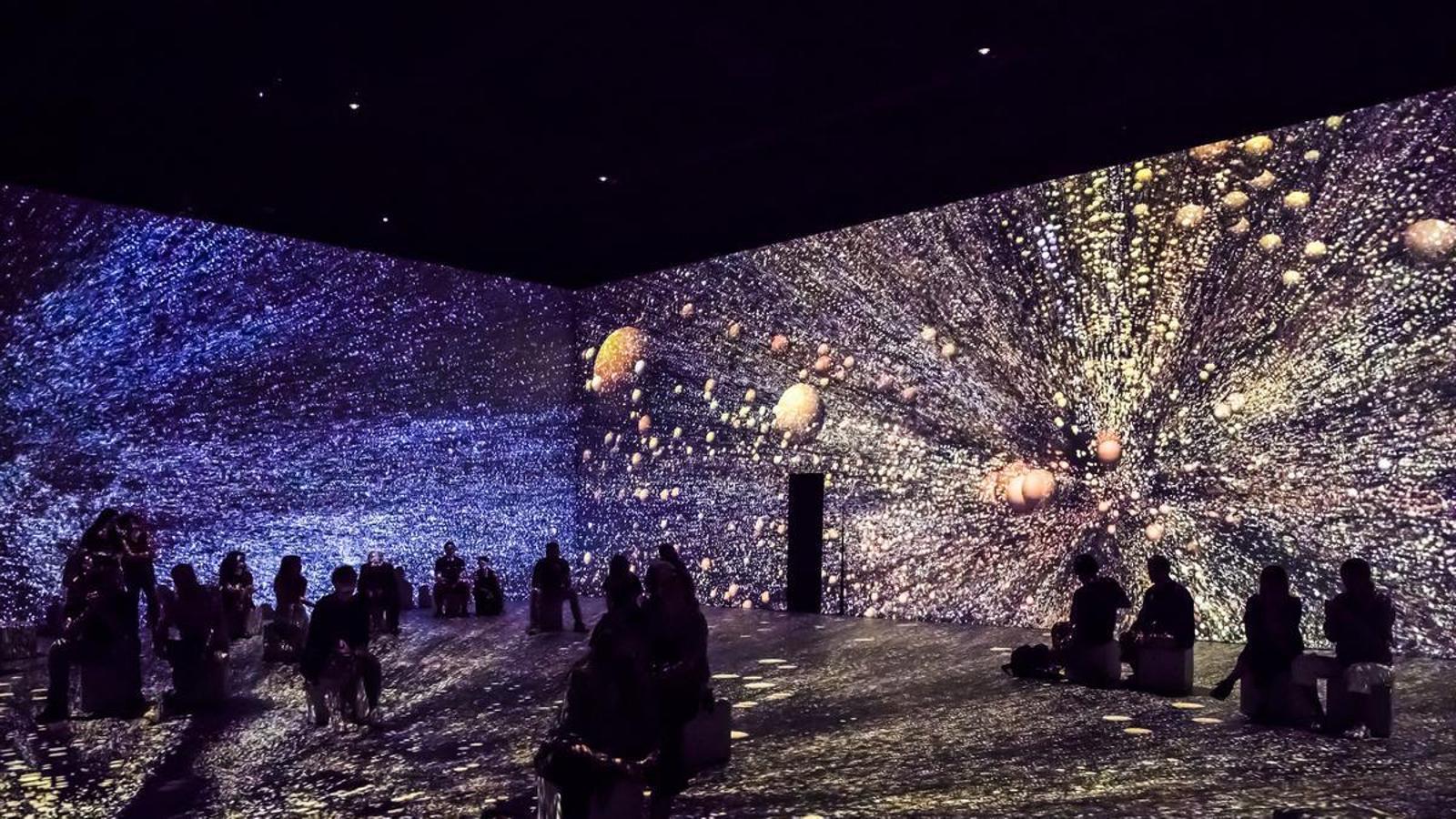
This reference space, the first center in southern Europe dedicated to the production and exhibition of digital arts, promotes immersive experiences, a phenomenon that is gaining more and more followers. Before talking about this boom, Jordi Sellas, director of Ideal, differentiates what an immersive experience is from what is not. "It seems that everything is immersive. The Cubana theater was, and so was Sónar. This concept has become popular, basically, because it is related to digital arts. Now everyone uses the immersive label, even in a somewhat excessive way. In the end, it is a label that helps sell tickets," explains Sellas.
"It is like a trend, but we work with digital arts, and these contribute to immersivity, which is our territory. In the end, immersivity is what generates, through your senses, the sensation of being immersed in a space different from your usual reality," he continues.
Complementary experiences
Since the birth of Ideal in 2017, they have championed immersiveness as a wave linked to digital arts. Both Dalí Cybernetic Boulevard and Dinosaurium, the new full-scale dinosaur experience that Ideal premiered this week, have changed our way of consuming culture and entertainment. "Technology allows us to place ourselves at the center of stories. As a spectator, you can be the protagonist of an experience that had never existed in the same way. And this is the great value it has," he explains.

However, Sellas clarifies that this new form of cultural leisure does not replace going to the theater, to a museum, to an exhibition, or to prehistoric ruins. "They are complementary activities, which open the door to new ways of connecting with the public," the expert nuances. Nevertheless, he assures that immersive experiences can lead people who do not normally go to museums or exhibitions to become interested in art and culture.
Moreover, interactive audiovisual content can drive us to understand original works. "For example, many people who came to see the Jules Verne immersive exhibition ended up buying Twenty Thousand Leagues Under the Sea, his most iconic novel. Immersive experiences encourage people of all ages to have the motivation to read or do other things related to an activity they have enjoyed. They feed back into each other," remarks the director of Ideal, who usually premieres two new productions every year.

On the other hand, the screenings are focused on the local public, which constitutes the main volume of visitors. "Our exhibitions are in Catalan as a first language, because our public is local, although we tour around the world and have been present in more than 50 cities, such as Sydney, London and New York", he continues.
A demanding public
Regarding the future of immersive experiences, Sellas is clear about their continuity. "The public will grow up, will mature regarding this type of proposal and, therefore, will be more demanding. This means they will choose the most well-crafted proposals and discard those that exclusively take advantage of a trend or a fashion," he concludes.
Alirio Padeiro, general manager of Eclipso Barcelona, also predicts a long life for immersive experiences. "Virtual reality allows us to access places where we could not go easily. The example we have now is Everest. Having the sensation of summiting this peak without having left Barcelona is impressive," highlights Padeiro.
He talks about Everest: unknown territory, an immersive experience installed in the dome of Las Arenas in Barcelona until the end of February 2027. Adults and children enjoy it equally, just as the director of Eclipso Barcelona explains. "We have had everyone from 8-year-old children to a 92-year-old lady. Recently, a man around 55 years old, after living the experience, told me that he had been to Everest and that the sensation experienced was the same. Imagine that!", he explains, satisfied.
In addition to Everest, Eclipso Barcelona has two more experiences active: Titanic and Coliseum. The first allows us to submerge ourselves to almost 4,000 meters deep in a submarine and tour the lounges and decks of the most famous ocean liner of all time. The second transports us 2,000 years back to the imperial Rome of the 1st century to experience the atmosphere of the Colosseum arena.
Seven experiences worth enjoying
Apart from Ideal and Eclipso, in Catalonia there are other spaces that combine virtual reality with disciplines such as digital art, audiovisual shows and interactive experiences. We offer you a selection:
Gaudí Centre
Located in Reus (Tarragona), the center is dedicated to the life and work of Antoni Gaudí. This interactive tour throughout three floors allows us to delve into the universe of the Catalan architect. The space features multi-screen projections, tactile and sensory models, and personal and original objects of Gaudí, such as the only handwritten notebook of his that is preserved.
The cry of Tàrraco
The amphitheater of Tarragona, a UNESCO World Heritage site and one of the great Roman vestiges of Catalonia, can be seen in a different way thanks to this proposal, which allows you to relive the historic hemicycle through mixed reality glasses, which superimpose digital reconstructions onto the real space. In The Cry of Tarraco, visitors will be able to imagine what a day of games was like in the Catalan city, with gladiators, animals, and the public in the stands.
Vall de Boí Romanesque Centre
Also a Unesco World Heritage site, the Vall de Boí Romanesque Centre, located in Erill la Vall (Lleida), functions as a reception area, interpretation center, and starting point to discover the valley's Romanesque ensemble and imagine how people lived there from the 11th century to the present day. Audiovisual and virtual reality tools complement the visit to the temples and allow for contextualizing their architecture and pictorial decoration.
Roca dels Bous Immersive
This proposal, which is experienced in situ at the archaeological site of Roca dels Bous (Camarasa, Lleida), shows how immersion allows for the dissemination of scientific research and prehistory. Through virtual reality glasses and educational video games, at Roca dels Bous Immers we can travel 50,000 years back and walk through the same places inhabited by the Neanderthals, an extinct human species that shares a common ancestor and part of the DNA with us.
White Rabbit – The Off-Museum of Barcelona
The center offers a journey based on Catalan culture and traditions, such as the castellers, the Saint Jordi's Day, and the correfocs, reinterpreted from a contemporary perspective. This is achieved through artistic installations, visual games, mirrors, and spaces designed for interaction. White Rabbit features ten interactive and sensory rooms, some of which include mirror mazes, sculptures, and murals created by local artists linked to Barcelona.
Luminescence
It is an immersive and multisensory experience of lights, video mapping, and 360° music designed to rediscover great monuments of historical heritage in cities such as Barcelona, Seville, London, and Paris. The Luminiscence shows turn the interior of a basilica into a stage of light and music, with large-format projections.
Torre Glòries Viewpoint
Located at a height of 125 metres, the Mirador Torre Glòries, the only one in the Catalan capital with a complete 360° perspective, allows you to observe points of interest, such as the Sagrada Família and Montjuïc, from new perspectives. Optionally, the visit can be completed with the art installation Cloud Cities Barcelona, suspended more than 130 metres high and formed by 113 interconnected spaces that resemble drops of condensed water or a large spider web.
