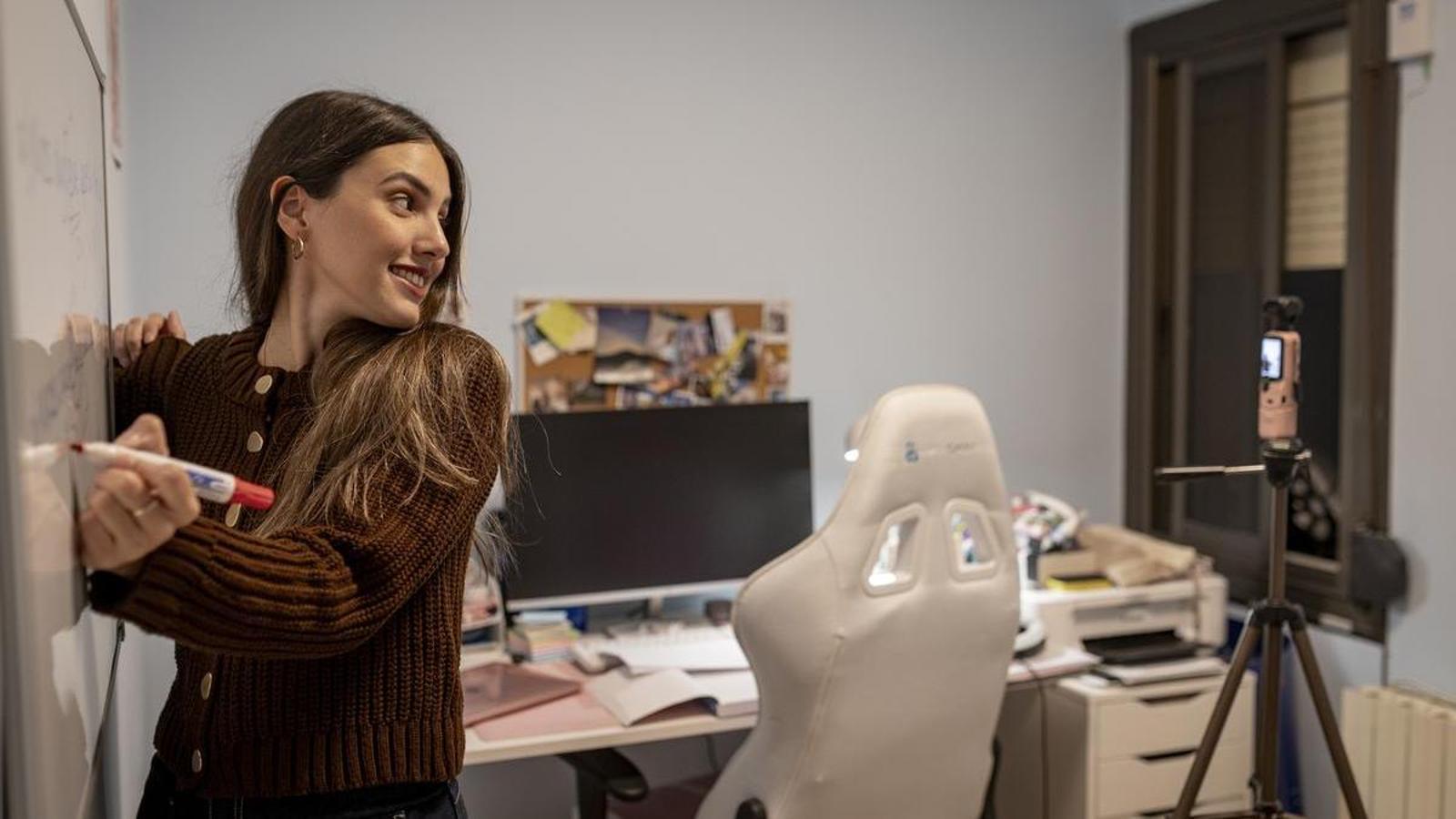
Susanna Martínez worked at a school in l'Escala based on the Montessori method. She liked it so much that, when she later had to join another staff, with a very different way of working, she brought ideas and activities she had learned back then. She saw that they were well-received, to the point that a colleague encouraged her to post them on social media and share them. Thus was born the Instagram profile @propostes.per.infantil, a space that Susanna feeds with what she puts into practice in the classroom, with the simple goal of "building a network and helping each other".
She creates materials and offers the possibility of sharing them via email with anyone who wants them. "We always have a lot of work and look for ways to do things differently," explains Susanna. "Sometimes you have to create it yourself to fit the needs of your children, and it's worth making it known."
The lockdown was the context for Judit Teixidor to create @emarmestra, also on Instagram. She remembers reflecting a lot on who she was and what she was doing with her life: "I needed to find my space and create something that was only mine," explains Judit. She decided to explain her day-to-day life from a teacher's perspective: she wanted to convey what moved her, what she was learning, and everything that emerged from the children. At that time she shared ideas and resources for colleagues in the sector, but now she is aware that among her followers there are also many families. "I think that, without thinking too much about it, my content has been focusing on parents," says Judit. Little by little, in addition to topics related to the educational world, she has been doing outreach with the intention of reaching people more alien to her world. "There is a lot of misinformation about what we teachers do inside the classrooms and it is very difficult for us to honestly expose what we see and experience there," she justifies.
The followers, little by little
Susanna has just 5,500 followers, and Judit, 21,000. These are not remarkable figures, but they have achieved them by working alone and as an extra activity to their jobs. For Judit, an account with 500 followers is just as important as one with 500,000, "if what is displayed there is coherent and makes sense." She defends that what she shares on social media is "a reflection" of what she lives. "My profile is genuine: it is not planned nor is it perfect; on my account we laugh, cry, and get angry," highlights Judit as one of the reasons why she believes she is liked. In her case, the growth has been "gradual, slow, and not at all intentional," and her profile has evolved just like her, but she has maintained the essence of sharing what moves her. Propostes.per.infantil, for its part, is growing, but Susanna is not very aware of it. She does acknowledge, however, that when she publishes material to which she has dedicated many hours, she does make a small call to get new followers, only so that her work is valued.
Judit and Susanna are two of the teachers who create educational content on social media and can come to be part of what are callededu-influencers, profiles that in recent years have been proliferating both with the intention of sharing knowledge and practices and of explaining the day-to-day life in the classrooms and making known a profession as close to families as that of a teacher. Many colleagues in the profession, especially in the infant and primary stages, use them as a source of inspiration to update themselves and get ideas to put into practice, a phenomenon that is viewed with interest and some concern by the Rosa Sensat Teachers' Association. From this entity, they have long been observing the rise of edu-influencers and they relate it to the growing interest in everything surrounding education, both among professionals and among families. They see, therefore, the positive side that education is part of the social agenda, but they also see some risks. Therefore, and beyond this initial intention of making pedagogical reflections and networking, the association considers it a very complex phenomenon that must be addressed with caution.
'Influencers' in secondary school
Although proposals and activities for the little ones are very common, social networks have also filled up with secondary school content and subjects, where the followers are, in addition to families and professional colleagues, the students themselves, who already have mobile devices and can take advantage of the content to entertain themselves, learn, and interact.
Isa Rubio is a Spanish language teacher and also started sharing videos during the lockdown. At the beginning, she only did it to test it and chose TikTok, where the bulk of her students were. And she saw that videos related to school worked for her. After a couple of years, she started appearing on screen herself and saw that it was liked even more. First, she shared anecdotes from the school, then part of the syllabus, but the real boom came when she started making videos about the university entrance exam (selectivitat).
Now, six years after having started, Isa Rubio can boast of having 364,000 followers on TikTok and nearly 30,000 on Instagram, where she started much later and trusts she will continue to grow in the near future. Her target audience is young adolescents in secondary school and high school, although she knows she also has university student followers who have stayed on her profile after following her before the entrance exam, as well as education professionals who are interested in how she works. From time to time, she dedicates a reel to this group, but she mostly focuses on the student body, who know her mainly for the examples and exercises of "minimal pairs", which appear in the entrance exam and which Isa takes advantage of to explain. One of the most satisfying situations she experiences as a result of her experience is, precisely, that a user thanks her for the videos because, thanks to having seen them, they answered the exercise on the exam correctly.
One more job
Neither Susanna, nor Judit, nor Isa have left their jobs since they started creating content for social media. Nor do they consider it, regardless of how many followers they have, because all three agree that their profession is teaching and that social media is simply a complement. "I have never wanted my profile to become a second job," asserts Judit, who is an early childhood education teacher with a specialization in the English language. Since she is very demanding of herself, she spends many hours preparing all the content she posts, and therefore, she cannot publish every day or even every week.
All three prepare the content themselves to post online and manage collaborations, which are not yet paid. For the moment, Susanna only collaborates with professionals like her who propose working together on teaching materials. She has not yet dared to accept proposals from brands because that would be a requirement and she wants to avoid it; she prefers to post when she can and when she wants to. Brands of school products and literature have mainly contacted Judit, and she has begun working with them, always prioritizing her values. "My followers know that I wouldn't advertise anything that didn't fit with the perspective I try to convey," she explains.
Isa also dedicates a lot of time to it. She uploads between two and three videos a day to TikTok, and part of her success is due to this consistency. "It's a lot of content, my head is working all the time," the teacher acknowledges. Although she does not do careful planning, she spends between two and three hours a week recording the videos, which she then has to edit. She can end up spending about ten hours a week on @isarubio. "This is also a job, but mine is in the classroom and explaining language and literature," she adds. For now, she has only done some collaborations in exchange for products, but she is very clear that, even if she could make a living from social media, she would not do it either. "I am a teacher and I make videos, not the other way around. In fact, if I weren't a teacher, I couldn't do them," argues Isa.
Professional 'influencers'
Opening a profile just to try it out and ending up turning social media into a source of income is what happened to Eva Mateu. She is an early childhood and primary education teacher and has worked in various schools of active education. Her philosophy is that the teacher is just one more element in a child's learning, with the child truly being at the center of this whole process. Motherhood, however, changed her path "unintentionally," because she saw that "accompanying your own child is much more transformative and complex than accompanying those of others," and she began making videos to share her experience. And she has been successful, because, in a few years, she has gained nearly 250,000 followers interested in her ideas about parenting and also in the snippets of personal life that she shares in her videos.
Eva does not rule out being able to make a living from social media and La Colmena, a new space for support in motherhood and parenting that she created "so that no family feels alone" and into which she pours everything she has learned through practice. She cannot say she has achieved it yet, but she does see it as a possibility and, above all, as a path that allows her to balance work and care for her two young daughters. In fact, this is one of the most important reasons why she has left the educational system aside: she did not understand why she had to leave her own daughters to take care of other people's children.
Although she describes her projects as "small and emerging," she considers that for them to continue, it is necessary to "do things right." She estimates that she dedicates between four and five hours a day to both projects, as she creates the audiovisual content all by herself. She does, however, work with an agency that helps her manage interviews and other appearances, and also to understand how this environment and brands work so she knows what direction to take. For example, she is clear that, to accept commercial collaborations, she must share their values.
She herself is surprised by the momentum her profile, @evamatsa_, has gained, because she does not have much of a strategy when it comes to making reels and she was convinced that motherhood did not interest anyone beyond herself. "I am active and curious, and I did not imagine myself creating content about motherhood," she acknowledges.
Social media, another world
Having a profile on social media not only exposes one, but also generates a series of new situations that edu-influencers must also learn to manage, such as negative comments. Isa has even had to disable comments because, depending on details like the clothes she wears, the video can reach the wrong audience. She has encountered people who are very unempathetic and lack boundaries. "The interaction through a screen makes some users take liberties they wouldn't take in person," says Judit. Eva is also surprised that people don't differentiate between the real world and the world of social media, and she often encounters people who greet her as if they knew each other, even though she has never seen them before.
But not everything is negative. Judit, for example, is happy to have been able to meet other professionals and enrich herself with their practices. "We have a very powerful tool for connection and outreach at our fingertips, and I love it," she summarizes. Eva asserts that it fills her with satisfaction to have been able to "change the perspective" of some families after seeing her content. Isa has also received expressions of "love and gratitude" from other teachers or students who, with her reels, have passed exams: "That is priceless."
The danger of posts and reels
On social media, especially Instagram and TikTok, short videos showing magical recipes are proliferating. "Today's society is excessively short-termist and seeks quick solutions to problems," highlights Pau Sobrerroca, secretary of the Rosa Sensat Teachers' Association. In the field of education, the danger is that this content is "more dogmatic than reflective." For this reason, he calls for critical thinking. "Sharing practices is very interesting, but on social media everything seems perfect to us," adds Sobrerroca, who also stresses that a proposal applied in another context and by another teacher may not work or may present certain errors.
From the Association, therefore, it is argued that, before replicating the ideas seen on social media, it is necessary to review the practice and dedicate time as a team to verify that it is aligned with the project, the center's concept of the child, and the school's values. "We must ensure rigor because, if not, it will all be a puzzle of external pieces," assesses Sobrerroca.
At Rosa Sensat, moreover, they are also worried about another consequence of this entire boom: that it replaces the need to share experiences and practices in person. "When there were no social networks, inquisitive teachers felt the need to meet," says Sobrerroca. "We cannot fall into the error of stopping the sharing of human experiences just because we already see it on video." For this reason, he insists that, under no circumstances, can edu-influencers replace teacher training, nor participation in talks, conferences, and workshops.