An experiment to test the importance of the way to school
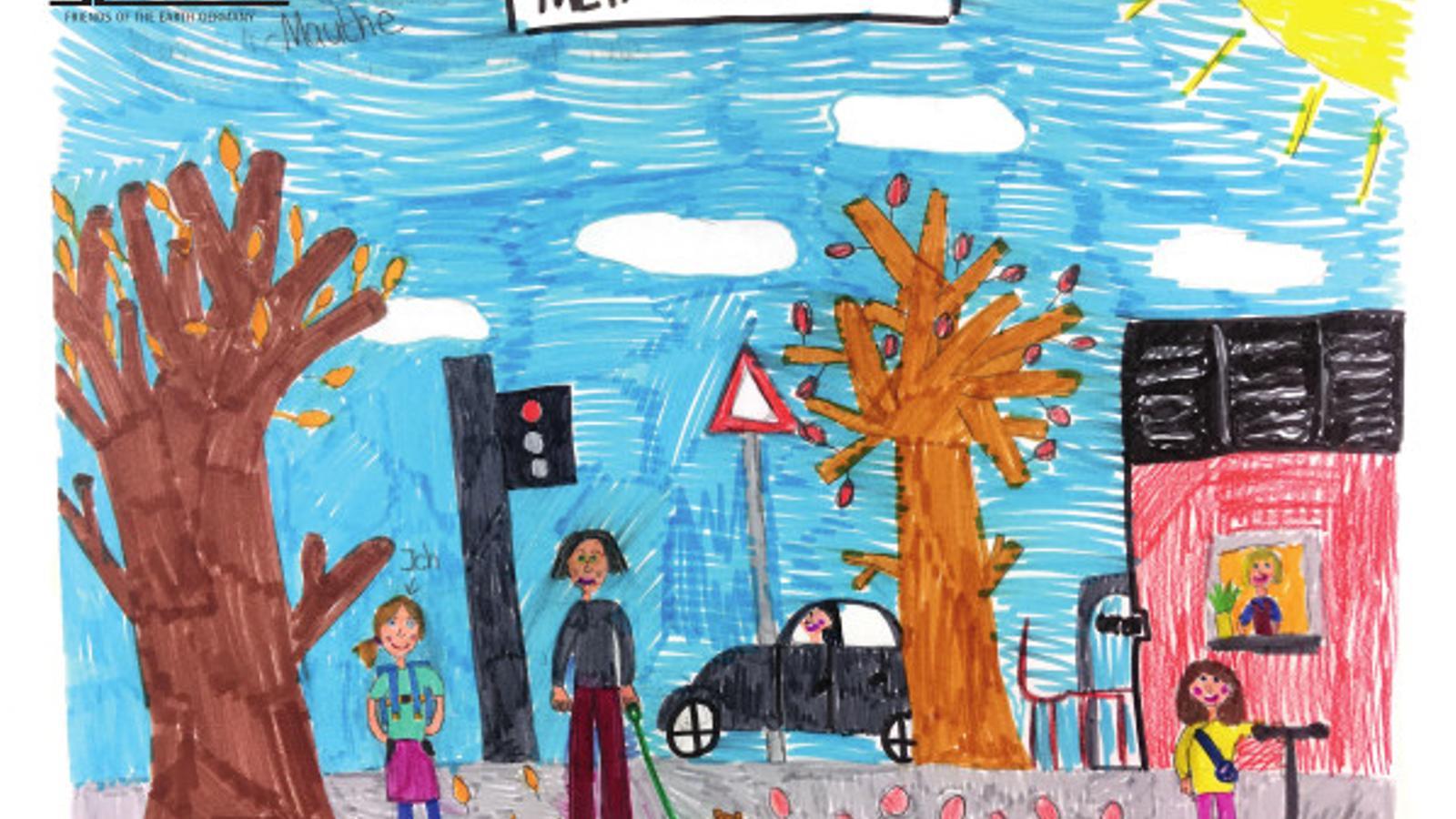
What do children draw when you ask them to draw their way to school? And what changes if this path they travel on foot... or look at from the window of a car?
-
CAT -
CAST
BanyolesA few years ago, the drawings of two seven-year-old children caught the attention of Swiss researcher Marco Hüttenmoser. Both had received the same assignment: to show their route to school in a drawing.

Samuel's drawing mostly showed the layout of a road. William's, on the other hand, was full of houses, trees, colors, and small details he had found along the way. And it wasn't just about these two children.
239 drawings and two very different ways of representing the path
In 2004, Marco Hüttenmoser analyzed 239 drawings by children aged between 3 and 10 from Ticino, in Switzerland. The research collected drawings of the route between their home and school or kindergarten. And in many of those drawings, a pattern appeared. Those who walked tended to represent a world full of details: trees, houses, people, animals, gardens, shops, intersections, colors... The path was full of things they had seen, experienced, and encountered.
In contrast, in many of the drawings of those who went by car, the path became empty. Roads, bends, intersections or roundabouts appeared. In some cases, there was practically nothing between home and school. Hüttenmoser even observed that some of the elements they drew were places where the car had to stop or slow down.

But be careful with what we conclude from it
These drawings do not prove that traveling by car causes a certain way of perceiving the world. We are not dealing with an experiment that allows for the establishment of a direct cause-and-effect relationship. What we find is a pattern observed by Hüttenmoser that leads us to a much more interesting question, one upon which Francesco Tonucci has been inviting us to reflect for years: what happens during the journey to school?

We have the feeling that, from adult-centrism, we think that the journey to school is only that, a space between two important places.
Home → school.
And that with our pace of life we prefer not to stop and think that everything that happens between these two points is extremely important.
The path is also a place where they can make their own decisions
If they walk, the possibility opens up to meet other children and decide if they want to share a piece of the path with them. If they want to talk, play, walk or run. And it also allows them to stop in front of an interesting bug or a mysterious spot on the ground. To see that the tree has lost its leaves, to collect them, to step on them…

Discover a shortcut and decide whether to take it. Gradually recognize the streets, the shops, the corners, and the people of the neighborhood. Inhabit it!

The sociologist Vincent Kaufmann, director of the Laboratory of Urban Sociology at EPFL, highlights that the journey to school is an opportunity for children to get to know the public space they are part of, gain independence, and interact with other people outside the home.
Do we let them go alone or have we built places where they can do so?
When we talk about child autonomy, it is easy to place all the responsibility on families. At what age should we let a child go to school alone? Should we let them go without an adult? What if something happens to them? But perhaps we should ask ourselves another question first: have we built places where they can do so?
Streets they can cross, sidewalks to walk on, safe paths for cycling. Neighborhoods to meet in. Environments also designed with the height, pace, and needs of childhood in mind. Child autonomy does not depend solely on families. It also depends on the cities we build.
Let's become small pieces of the real world
The return to school can also be transformative for the adults who accompany children if we decide to give them space and trust in their autonomy, giving them back the path, the neighborhood, and the possibility of new encounters. Opening the door for them to those little pieces of the real world that await them between home and school.

This does not mean ignoring the reality of families. Not all of us live close to the school. Not all schedules allow for a calm walk in the morning. Not all neighborhoods are safe or designed for children to be able to travel through them with autonomy. But perhaps there is no need to turn it into an all-or-nothing situation.
We can ask ourselves: what path to school am I offering? Do I have the possibility of changing it? Can we gift them a walk one day a week? Two? Can we do part of it by bus or car and do the rest walking? Because we know the difficulties of daily life, but we also know that the path richest in experiences is almost never the easiest one. And it is that precisely in that moment that might seem insignificant to us, between one place and another, something should be happening that is very much worth protecting.
As Marco Hüttenmoser wrote when talking about those drawings:
“Where one gets off, life begins”.
