Raquel Elá: "The Catalan school is exhausted"
Teacher with twenty years of experience in Catalonia who chose this profession as a token of gratitude to her teachers from here

-
CAT -
CAST
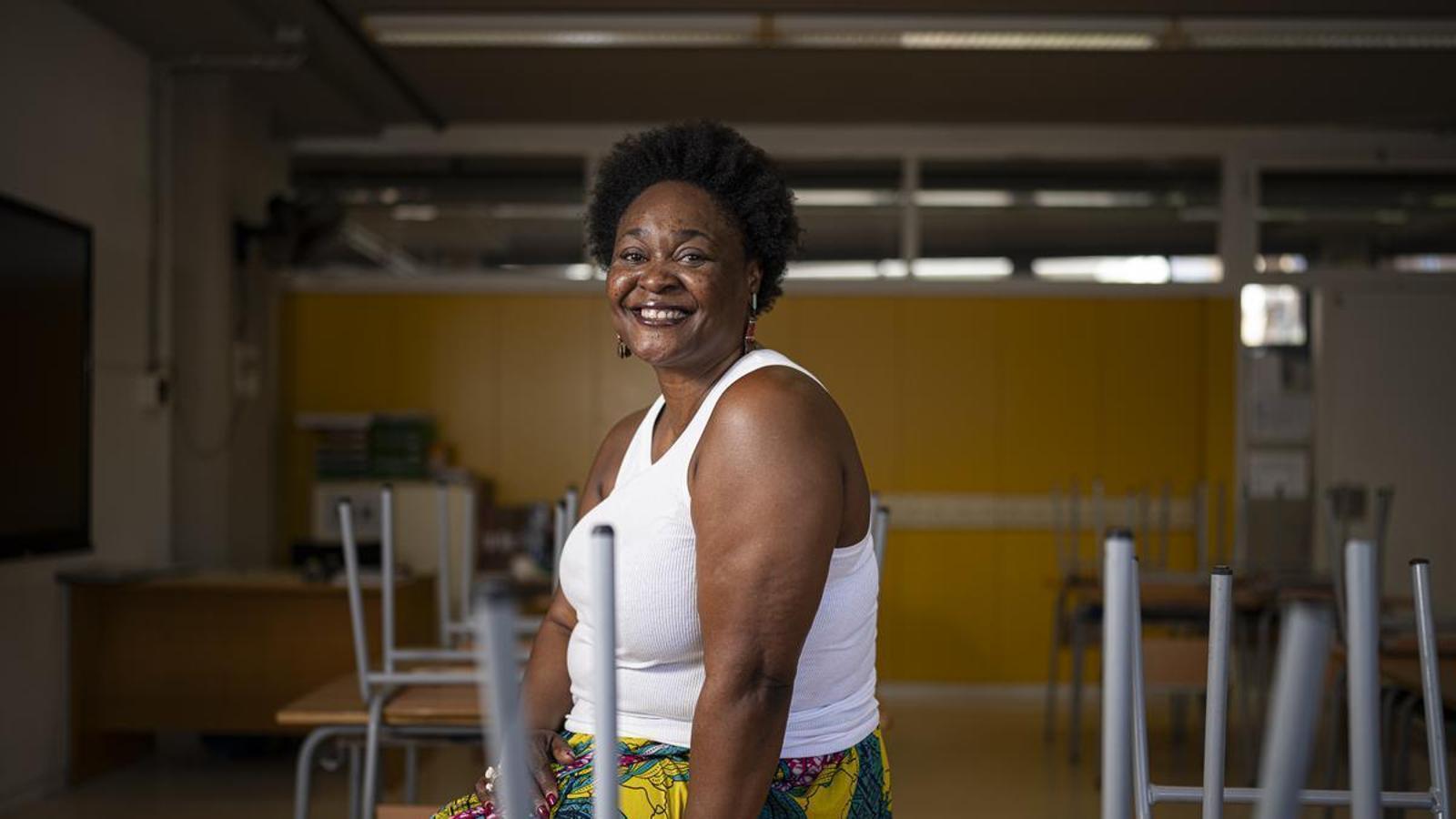
BarcelonaWhen I was eighteen, I didn't know what I wanted to be. It crossed my mind to be a flight attendant and I even weighed the possibility of becoming a criminologist, but the fact that I could reach university thanks to the teachers who had helped me throughout my schooling ended up steering me towards education. And this year, Raquel Elá celebrates her twenty years as a teacher in Catalonia.
She was born in Equatorial Guinea and lived in the Canary Islands until 1991, when she came to Catalonia. She landed in a school with few Catalan-speaking students, which made it difficult for her to learn the language. She remembers it as a time of some conflict due to the difficulty of relating to Roma and foreign-origin children, especially Moroccan, in a single-track school. She had to take advantage of the lunch hours, when they traveled to another center to eat, to have contact with boys and girls from Barcelona. Despite these difficulties, she acknowledges that she keeps many friends from those years and, above all, remembers the affection she had for the tutor at the time. She is now a civil servant and has a permanent position at the Màrius Torres school in L'Hospitalet de Llobregat where, this year, she is the 5th grade Primary tutor.
When this interview is proposed to her, she makes it clear that she does not believe her path is very different from that of many other teachers. The truth is, however, that she acknowledges that unfortunately it is hard to find racialized teachers and professors –she still uses this word even though she does not like it– in the faculty rooms of schools and institutes in the country.
For this reason, Elá does not feel comfortable talking about her "contribution" to the faculty. She understands that for her colleagues she is considered "different", but she believes that for this diversity to have a real impact, there must be many more people of diverse origins on the teams. "I continue to be a minority and for me to contribute, many more people would have to join in," explains the teacher. She believes that teachers see the reality of the school from their role, in the centers, and that it is always as a teacher, but that, on the other hand, the environment in which these same teachers live is not really diverse.
Elá considers that she continues to be perceived as a person of a different origin, despite the fact that there are more and more mixed-race people. “I would really like there to be more racialized people on the teams –she says–, and also for these people to be less afraid to speak up”. In this sense, she believes that there is still some structural racism both in the system and in society and that, often, it has to be her who stops certain jokes that are repeated year after year. “Just yesterday I told a colleague: "Enough with this joke, because I am super-African"”, explains Elá, who believes that limits must be set on certain comments that, because they are so common, end up being normalized.
Anecdotes from all sides
In twenty years of her profession, Elá has experienced many anecdotes that highlight the lack of diversity that still exists among the teaching staff. For example, she has often been mistaken for the mother of another student. In fact, at her current school, there is a Black girl in the next classroom, and the children ask her if she is her daughter. Even so, she acknowledges that the children get used to it right away and normalize her skin color, the headscarves she wears, her hair braids, or the afro style she mixes with Western culture. “Perhaps, by looking at my class, I can provide them with added value,” says Elá, “so that they see they can reach wherever they want and see me as a mirror.”
With parents, she has also been through it all, but she especially highlights that it takes some time until she gets “the stamp of approval” from the families in a process she calls “the first term test.” “They watch how I am with their children, what topics I cover…,” says Elá, who acknowledges that she tries to provide a broader point of view on some issues and that, because of this, some families may show some reluctance. On one occasion, this reluctance was also more explicit. She remembers the case of a student who explained that his parents would vote for a far-right party and that, at a parents' meeting, the father would not even greet her.
And the teaching staff itself is not free of prejudice either. She has found that some colleagues treat her as if she were a novice and teach her things all over again as if she did not have twenty years of experience. And even, during the strikes and protests last spring, she received many comments such as “thanks for supporting us” from colleagues who assumed she was not a teacher. “They don’t say that to white teachers,” says Elá.
Diversity, still a pending subject
She also detects this racism in attitudes such as the fact that students of foreign origin are spoken to in Spanish. She criticizes this because it perpetuates the idea that students not born in Catalonia cannot speak Catalan. “I grew up with two languages and at high school they told me that I had to speak Catalan and that is what I did,” explains Elá. Precisely because of her own experience, she argues that not assuming that a student of foreign origin will speak Catalan can also end up limiting their opportunities. “Speaking and knowing the language where you live opens doors,” she points out.
At their current school, which they consider diverse and respectful, they have opted for a uniform as a way to reduce visible differences among the students. They explain that they have never had any problem with families who, despite their diverse origins, accept traditions and celebrations, but, on the other hand, they do detect that, socially, a hypocritical judgment is made of certain cultural aspects based on origin. This double standard is also detected in cultural and religious issues. They wonder why there is still so much debate about whether schools should celebrate Christmas or how Ramadan should be addressed, while certain absences of native students for holidays are experienced with much more normalcy. “We are much more critical of certain religions and very permissive with local students who take holidays outside the calendar,” they point out.
A vision of the Catalan school
Her perspective on education, however, is not limited to diversity. As a primary school teacher, she also advocates for a certain combination of traditional practices and new methodologies. "We must have patience, mixing old and new things," she explains. This year, as a fifth-grade tutor, she is especially focused on finding ways to improve the learning of mathematics. She acknowledges, however, her own limits: "If you tell me to teach math to ninth graders, I couldn't do it."
With all this trajectory behind her, Elá sees that in recent years the desire to "build Catalan schools" has been lost and that when she started, they did it in a "more natural" way and she noticed that everyone made more of an effort to maintain the language and culture. "The Catalan school system is exhausted," laments the teacher, who advocates for a "change of mindset" and "to stop copying everything that is in fashion." In this sense, she believes that students must be motivated to have curiosity, which has also stopped being done, and to avoid all activities always being playful, that is, that there should be more content that helps to educate boys and girls.
Elá considers that the school has been assuming many changes in the composition and needs of the students –from open enrollment to the increase of students with specific educational needs– without this adaptation always being accompanied by the necessary resources and specialized personnel. "We have been left with the idea that we are all the same, but that is not the case, and we teachers do a lot of work," she says. Now she believes it would be necessary to recover an idea that, in her opinion, has been lost: the consensus on what we want the Catalan school system to be.
This need to question labels is also transferred to the students. “If you get into the habit of using labels, in the end I will believe it: Guineans don’t work very much,” she exemplifies. For this reason, she insists that students must be valued for what they do and not for their origin. This perspective is also applied to the teaching staff itself. Elá argues that teachers must be critical of the educational system, but also of their own practices. “If we make demands as teachers, we must also be self-critical in whatever way we can,” she points out. For her, change also involves reviewing certain behaviors that have become normalized and starting to do so from a very young age.

