“You leave there with another look at life”: what it is like to be a volunteer at children’s hospitals
They walk through the pediatric floors, enter the rooms, play with the children and accompany the families in the most difficult moments
-
CAT -
CAST
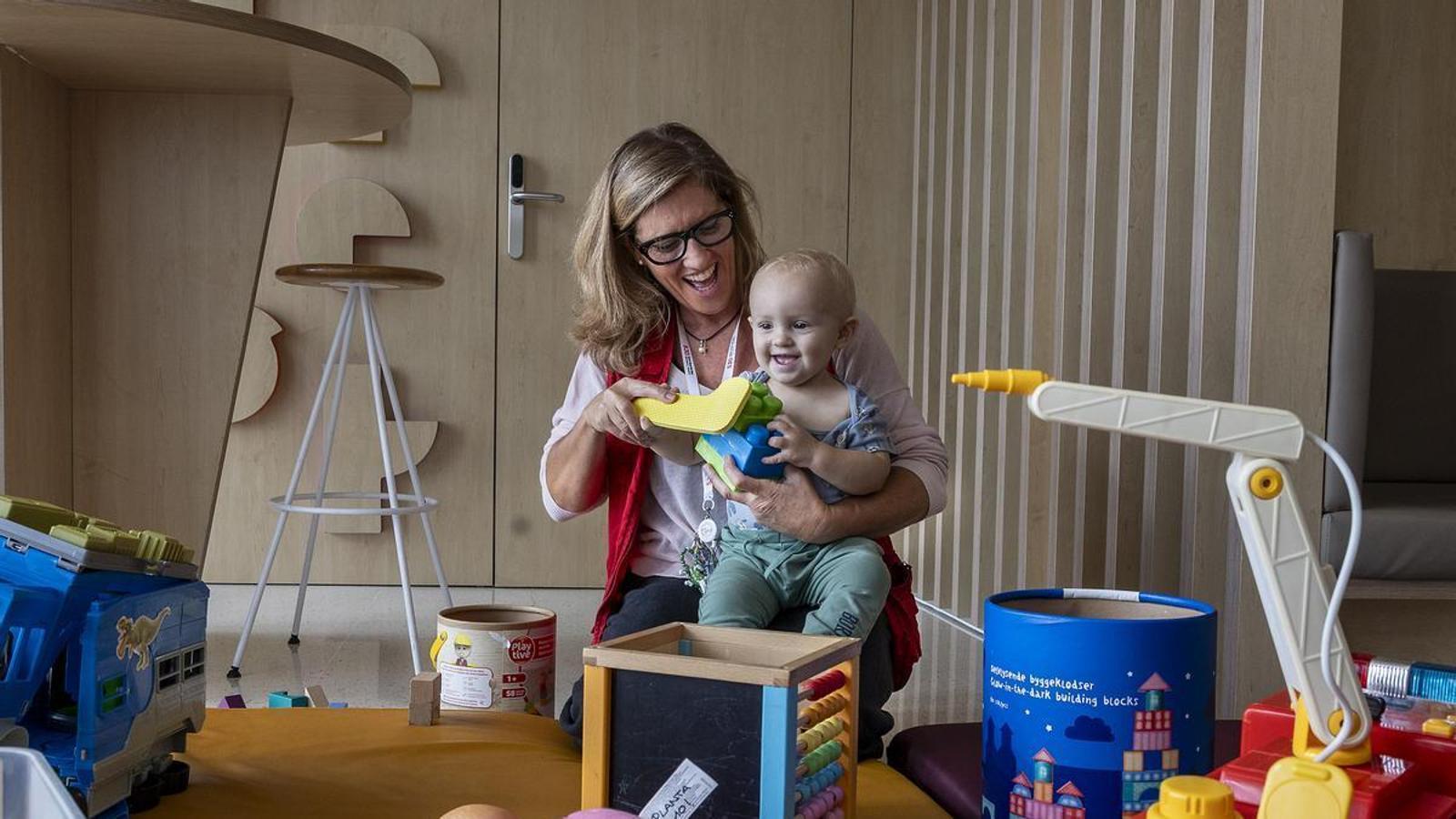
BarcelonaIn the volunteer lounge of the Sant Joan de Déu Hospital, there is a cheerful and relaxed atmosphere. More than three hundred people pass through here, entering and leaving the rooms throughout the week. Some go to the neonatology unit for skin-to-skin contact with the babies; others head to the hospitalization wards, the ICU, or the emergency department. They are not healthcare professionals, but they are part of the children's daily lives at the hospital.
This is the case for 56-year-old lawyer Eva Toscas, who has been dedicating part of her time to volunteering for about fourteen years. She has worked in different areas and programs at the hospital, and currently, one day a week, she is on the hospitalization floors where children with cancer and those awaiting transplants are admitted. Her work consists of offering some playtime, painting, and, above all, company.
Volunteers are, in a way, the only ones who enter the rooms without a white coat and without being linked to any medical procedure. For this reason, their arrival is usually a relief for the families: "They make it easier for parents to go to the supermarket, eat, shower, or take care of whatever errands they need," explains Mireia Espinet, volunteer coordinator at Sant Joan de Déu.
But not everyone can do this work. Before joining the team, interested individuals go through a personal interview to understand their motivations and explain to them what they will encounter. "Often, volunteers come to us who are not aware of what they will find or arrive wanting to have a lot of activity, but this volunteering also entails downtime where they might have to clean or tidy up toys," she explains.
Besides receiving training in the hospital environment and on hygiene standards for each case, the volunteer center also teaches them how to relate to families with discretion and respect. "We never ask the family why they are there; those are very sensitive data. Only if they want to tell us, we will be happy to listen to them, because we practice a lot of active listening," says the coordinator.
There is, furthermore, a question that may seem obvious, but which is fundamental: “A part of the theoretical training is that the children are not our children or our grandchildren, and we cannot be coddling them as if they were”. It is necessary to find the appropriate distance and understand that, even if the relationship is affectionate, the volunteers do not take the place of the families.
A special empathy
Eva knows this well. After so many years of entering rooms, she has learned that doing this job requires more than just a desire to help. "You need a sensitivity to empathize with everything you see," she asserts. There are children who spend many weeks hospitalized, often in the same room. Therefore, volunteering does not just consist of staying with them for a while while their parents go out. It is also important to get to know them, talk to them, and remember small details of their lives, such as the name of their dog or their favorite food.
It is also necessary to have imagination and the ability to adapt. Sometimes, she explains, parents need help to go buy diapers or they stop them in the hallway because they have some need. And, above all, one must know how to work as a team with the hospital. In fact, some of the volunteer services have been launched at the request of the healthcare professionals themselves, who detect needs and ask them for help.
But there are situations that are not easy to manage. “You need special empathy to put yourself in the families' shoes. Some have left everything in their country, they have sold everything they had to come here to give their child one last chance to be cured. And sometimes they are cured, but sometimes they are not,,” she notes. These are relationships that are built over the weeks and that make the work go much further than offering a moment of distraction.
Learning to leave it at the hospital
Marta Navarro, 53, has also found in volunteering a way to help families. Previously she worked in the corporate world, and for six months she has been collaborating at Sant Joan de Déu and La Casa de Sofia, where there are many children in end-of-life situations.
She assures that the experience “is brutal”, but that you have to be prepared for everything you might end up living through. “It’s impossible for it not to affect you,” she asserts. She has three grown children and acknowledges that, if they were small, it might be harder for her to manage some of the situations she experiences. Often, when she arrives home, she writes as a valve to vent and organize her emotions. Even so, she is very clear about it: “What you receive is infinitely more impressive than what you give.”
This does not mean that there aren't experiences that have left a mark on her, such as when she was asked to accompany a seven-year-old girl who had arrived with the Mossos d'Esquadra due to possible mistreatment. The child was alone in the emergency room while the situation was being clarified. Marta tried to distract her, but the situation struck her deeply. It was not an illness or an accident, but a situation caused by an adult. “That, for me, was devastating,” she laments.
The other one is that of a boy who was in a complicated medical situation. She focused especially on his mother, who had left the room for an hour just to be able to take a resuscitation course for her son. When she returned, she would not stop apologizing. “She felt selfish for having left for an hour,” she laments.
When accompaniment is essential
In other centers in Catalonia and the State there are also initiatives such as Mamás en Acción, an association with more than three thousand volunteers that accompanies hospitalized children and adolescents when their social circumstances mean they cannot have a reference person by their side. In Catalonia, they are present in hospitals such as Vall d’Hebron, the Hospital de Sant Pau, or Trias i Pujol in Badalona.
They usually accompany children who arrive at the hospital in situations of helplessness, abandonment at birth, or suspicion of mistreatment and who may spend many hours alone there. Also children who come from vulnerable families who need help balancing the hospitalization with work or the care of other children, as well as children under guardianship who live in foster centers. “We are always activated through the hospital,” explains Amparo Arona, volunteer, coordinator, and director of expansion for the NGO.
Their work, however, is nothing extraordinary. “We do what the dad or mom in the room next door does: give a bottle, read a story, go to the playroom... Whatever comes up,” they explain. An experience they assure is very rewarding: “You always receive more than you give. And afterwards, you leave the hospital with a different perspective on life, giving thanks and not allowing yourself to complain about trivialities,” they confess.
Finally, there is another type of support for hospitalized children that is not voluntary, but rather professional and paid work. This is the case of Montse, who prefers not to make her surname public. She is now retired, but she is a psycho-pedagogue and social educator, and for a time she worked accompanying children under public administration guardianship when they had to be admitted to the hospital.
She mostly worked with babies. Some were admitted with withdrawal syndromes, others had been abandoned or arrived after neighbors alerted of concerning situations. She also accompanied adolescents under guardianship, many of whom were admitted due to self-harm and were carrying complex personal situations.
After having known so many different situations, it is clear to her that not everyone is prepared to do this job. “There are people who do it out of vocation and there are people who do it to make a little extra money,” she reflects. In the same way, there are people who commit themselves completely, even if they do not have all the required training, and others who, despite having it, do not end up working out. “It is purely vocational,” she concludes.
