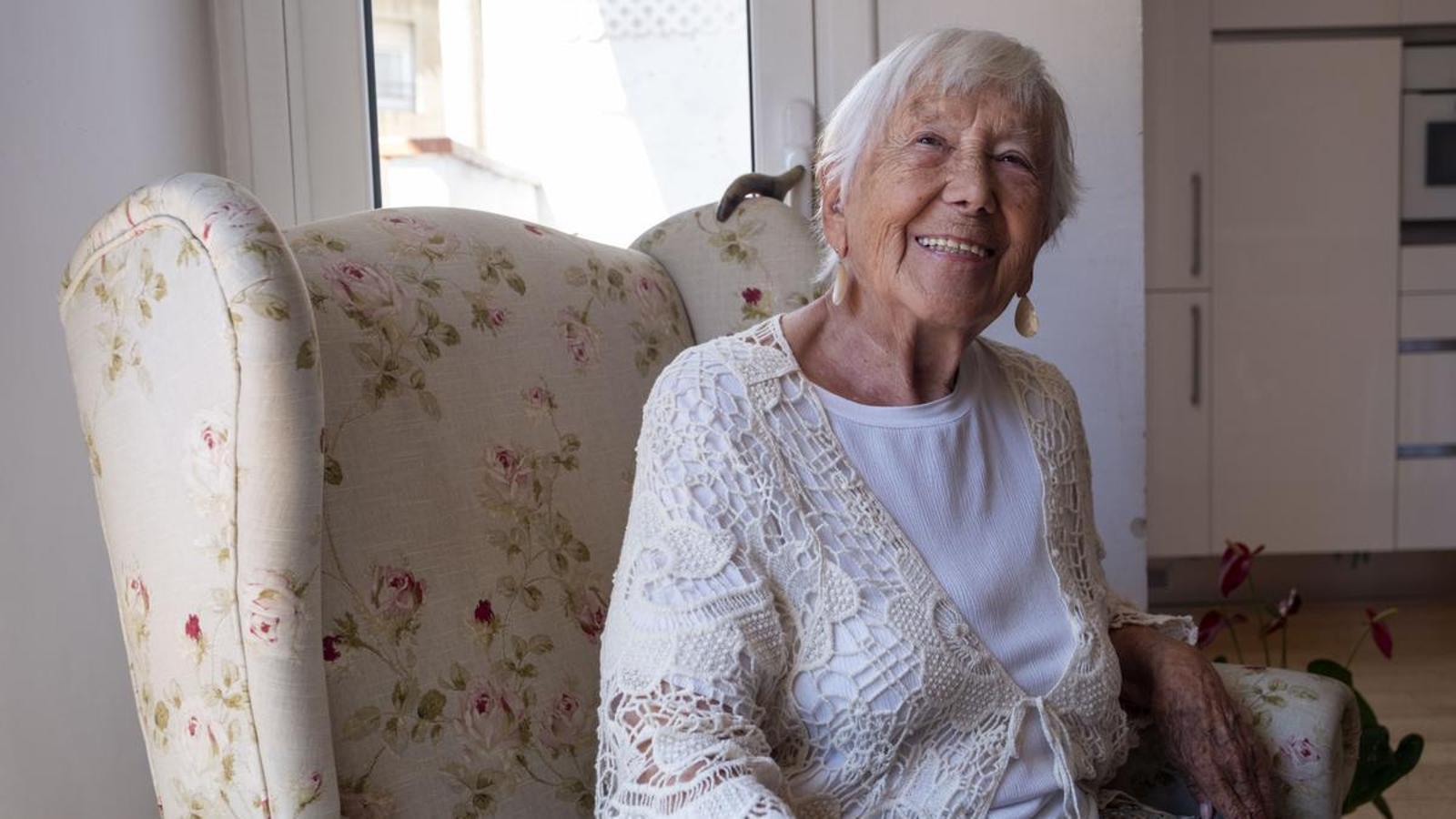
Teresa Cunillé, historic actress of Catalan theatre, dies at 102 years old
Great defender of Sagarra, she is the performer who has acted the most times at the Romea Theatre

-
CAT -
CAST
Barcelona“When I do something, I do it for real and completely. I love what I do and I dedicate myself to it strongly,” said Teresa Cunillé (Sabadell, 1924 - Barcelona, 2026). A fundamental actress in the shaping of the Catalan scene in the second half of the 20th century, Cunillé passed away this Friday at the age of 102, as family sources confirmed to ARA. Throughout her career, she was part of more than a hundred plays and was the performer who acted the most times at the Teatre Romea in Barcelona. She worked with directors such as Hermann Bonnín, Joan Ollé, Esteve Polls, and Sílvia Munt, was one of the great defenders of the works of Josep Maria de Sagarra, and remained active until she turned 80.
Her love for the stage came from home: Teresa Cunillé was the daughter of actor and director Jaume Cunillé, with whom she formed a comic duo and began acting in zarzuelas. Later, she trained at the Institut del Teatre, where she received the extraordinary award for interpretation in 1944. Cunillé took her first professional steps with the Irene López Heredia company, but they did not get along and she soon left it. The actress returned to Sabadell to perform theater with her father and with actor and director Domènec Vilarrasa, whom she married. At that time and in the most unexpected way, Cunillé discovered one of the writers who would mark her life and career: Josep Maria de Sagarra.

She and Vilarrasa were performing Terra baixa when the poet went to see a performance along with the theatrical entrepreneur Joan Serrat. After the show, they went to find them. They wanted to create a company of only young people for the Teatre Romea, and they asked them if they would like to be part of it. “We said yes! That was the highlight,” recalled Cunillé in a conversation with Televisió Espanyola. The couple was part of the production of La filla del Carmesí, which premiered in 1953 at the Teatre Romea with the freshly formed Catalan Titular Company. That was the first time that Cunillé stepped onto the stage of one of the most important venues for her history as an actress.
A great comedy actress
In the 50s, the performer founded the Joan Maragall company with Vilarrasa and they devoted themselves to performing comedies. The group wanted to recover the tradition of Catalan cooperatives during the Franco regime and often had to battle against censorship. "On stage, we would change the text depending on whether there was a gentleman in the front row taking notes," the actress explained. Cunillé brought to life a wide range of Sagarra's works such as L’alcova vermella (1952), L’amor viu a dispesa (1952), and La ferida lluminosa (1954), which she premiered with the Companyia Titular Catalana and became one of the great successes of post-war Catalan theater. "We always did Sagarra's plays, always. It's just that at first we recited the text in a very sung way, but later we began to give a more natural tone to the performances," Cunillé explained in 2024 in an interview with ARA.
The 50s were crucial for her consolidation as an actress, especially thanks to the premiere of La Pepa maca, by Cecília A. Màntua, at the Romea in 1959. That show, a tribute to the fisherwomen of the Costa Brava, brought Cunillé great popularity among Catalan spectators. That same year the actress participated in the comedy Les maletes del senyor Vernet at the Teatre Guimerà and saw Josep Maria Flotats make his debut there. Long after, in 1990, the actor and director would hire her to perform in L’Autèntic Oest at the Teatre Tívoli alongside Francesc Orella, Joan Crosas, and Jaume Comas.

Another of the fundamental names in Teresa Cunillé's career is that of Joan Capri. They met in the 70s and appeared together on stage in shows such as L’amic ministre (1972) and El peu de la lletra (1973). “Capri was a person who made everyone laugh a lot, but he was very sad. He could be crying sitting on the floor, but when he went on stage he would change radically,” said Cunillé. During that time, she participated in various recordings for the Catalan Circuit of TVE of works from the Catalan theatrical repertoire, such as L’hostal de la Glòria (1976) by Sagarra. “I played all the roles in this play: when I did theater in Sabadell as a young girl, I played the role of a child, later the sister, and when I performed it in Barcelona with Rosa Maria Sardà, I was the old woman,” the actress explained. During her time on television, she also participated in the series Mare i fill. Societat limitada by Terenci Moix for RTVE, which premiered in 1980, where she coincided with Mary Santpere.
The return to the stages
Cunillé stepped away from the stage during the 80s, but at the end of that decade she decided to resume her acting career. She did so with the Sagarra show that had seen her debut at the Romea, La filla del Carmesí (1987). In fact, her return was closely linked to Sagarra's characters, which are the epicenter of her acting career. She also received some institutional recognitions such as the Medal for Artistic Merit of the city granted to her by Sabadell, through Josep Maria Flotats, and the Creu de Sant Jordi, which she received in 1996. That same year she appeared in the TV3 series Nissaga de poder, where she played a matriarch of a family of winemakers, enemies of the Montsolís, which gave her even more popularity.
With so many shows under her belt, what was Cunillé looking for in the characters she played? “They had to have truth. If it is real, you get into it immediately,” defended the actress, who understood her profession as luck and a passion: “I have never had the feeling of working while I was acting. I went in to play the role and I was no longer myself. That does not tire you out.” In 1999, Cunillé performed at the Sala Petita of the National Theatre of Catalonia —inaugurated three years earlier— with El maniquí, by Mercè Rodoreda, directed by Pere Planella, and in 2002 she performed at the Lliure Dones com jo. Heroïnes de Sagarra, in which she took a tour through all the Sagarra characters she played throughout her career.
At that time, Cunillé was 82 years old and wanted to retire, but the director of that production, Francesc Nel·lo, made her one last proposal: the role of the grandmother in El jardí abandonat, by Santiago Rusiñol. The show premiered in 2007 at the Espai Brossa with Nausicaa Bonnín and Iván Morales, and it was the last theatrical play performed by Teresa Cunillé. To pay tribute to her, the Teatre Romea created the Teresa Cunillé Award in 2018. It is a biennial award that recognizes the best research work on the history of Catalan theatre. Cunillé also received the Centenary Medal awarded by the Generalitat in 2025, and the same Teatre Romea hosted a tribute in 2024 to celebrate the performer's centenary. “I am so moved that the words almost won't come out, I don't know what to say to you, I am so proud — said the actress during her speech, deeply moved—. I have this feeling inside, and I don't know if I want to cry or laugh. You don't know how good you make me feel!”.
