Kristján Andri Stefánsson: “Russia continues to be the most direct and significant threat to the security of the North Atlantic”
Ambassador of Iceland to Spain
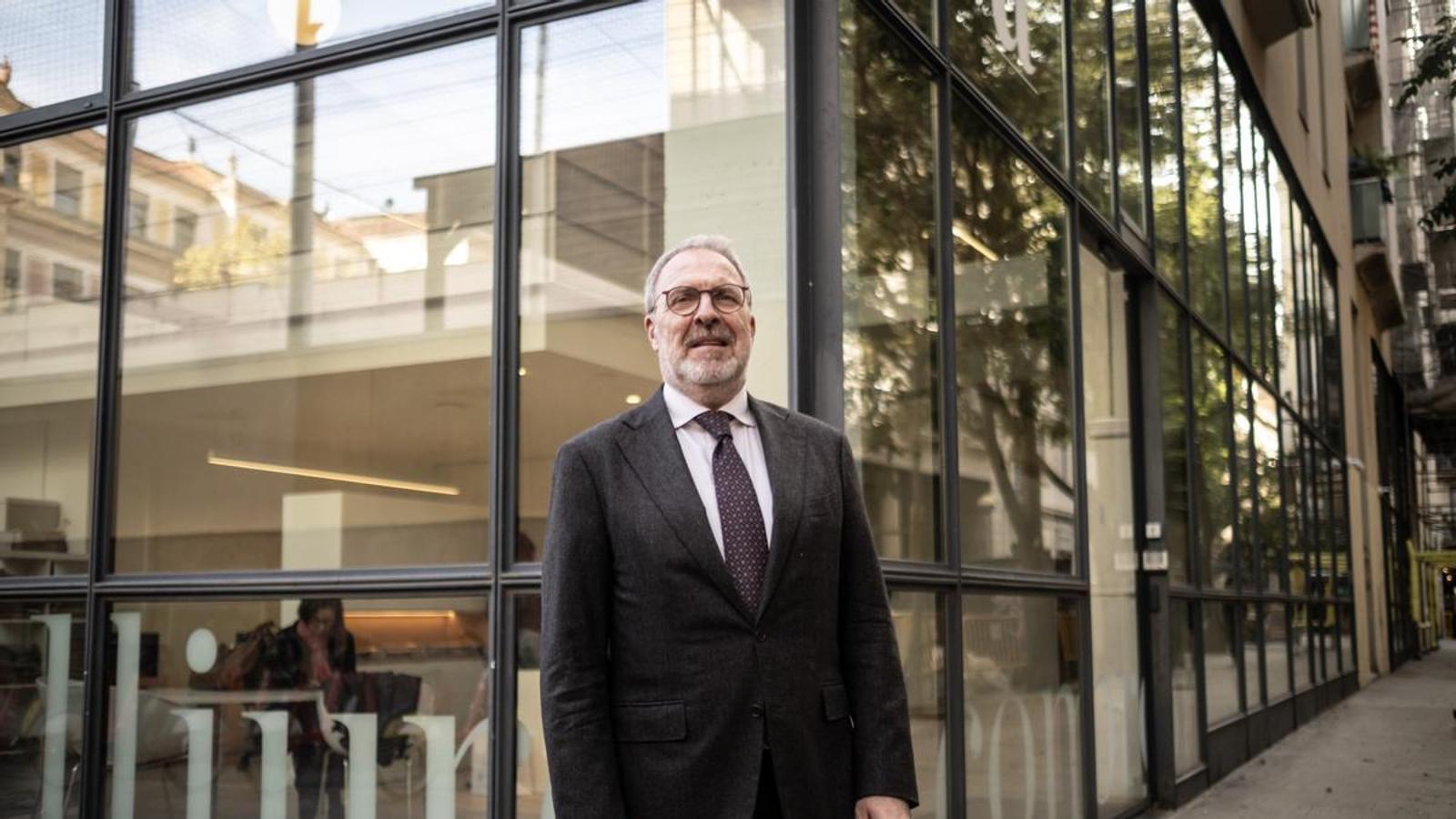

BarcelonaKristján Andri Stefánsson (Reykjavík, 1967) has been the first ambassador of Iceland to Spain for just a year. We take advantage of a visit to Barcelona to analyze the situation of Iceland in an increasingly convulsive context in the Arctic and a few months after the Icelanders rejected in a referendum to initiate the process of accession to the European Union.
The Icelandic government asked this year to restart accession negotiations with the EU, frozen since 2013. What has changed in this time?
— The main reason was the search for greater economic stability. In Iceland, we have recently experienced high inflation, and it must be taken into account that our economy is based almost entirely on natural resources. So it is quite vulnerable to strong fluctuations. And this is due, among other things, to the fact that we have a rather small currency that is not used in international markets. So the euro was also a goal when calling the referendum. Furthermore, security issues and geopolitics have gained importance lately. It is natural for a country of this size and our geographical location that we consider how to strengthen cooperation with like-minded countries to increase our resilience and address common challenges.
In the referendum, the 'no' vote won, especially in rural areas. Does fishing continue to be the main obstacle to a potential accession?
— Traditionally, fishing has been the main obstacle to eventual accession to the European Union, along with the concern about maintaining control over our natural resources, which have formed the basis of our economy for decades. But the referendum result should not be interpreted as a rejection of European cooperation. Through the European Economic Area Agreement, we have been part of the single market for more than 30 years with the free movement of goods, services, capital, and workers. We also belong to Schengen. At the beginning of this year, my government signed an association agreement with the European Union regarding security and defense. Therefore, the majority of Icelanders voted against resuming the accession process in the referendum, but it was not because they opposed the European Union per se, but because they prefer to maintain the current format of cooperation, which has worked well for us over the last few decades.
What role can Iceland play in this convulsive environment in the northern area of Europe?
— It must be taken into account that the Arctic is changing at an unprecedented speed. It is warming four times faster than the rest of the planet. This affects us both in terms of fishing ecosystems and maritime routes, as well as the Arctic communities themselves, especially indigenous ones. For an economy like ours, which depends on the ocean, these changes are not theoretical, they are our day-to-day life. At the same time, the international context has become more tense. The war in Ukraine, the situation in the Middle East, more Russian military presence in the Arctic, and growing cooperation between Russia and China in the region. For this reason, the idea of a low-tension Arctic no longer reflects reality, especially after Russia's aggression in Ukraine. So in this context, in this part of the world, we welcome greater attention to security in the Arctic and we support closer cooperation within NATO among Arctic allies. We must ensure that the region remains stable, predictable, and governed by international law. This is the most important thing for small nations like ours, where maritime security is directly linked to our prosperity and our way of life.
The Arctic has become a kind of game board between three great powers. Which poses the greatest risk to the region: Russia, China, or the USA?
— What concerns us especially is the increase in hybrid activities in Europe, such as the sabotage of critical infrastructure, disinformation campaigns, and cyberattacks. And, as NATO allies have pointed out, Russia continues to be the most direct and significant threat to security. Iceland fully shares this assessment. With the aggression against Ukraine, it has demonstrated its willingness to challenge the international order and use military force to achieve its objectives. So we are closely monitoring the evolution of the environment, including the growing influence of China and the changes in the international policy of the United States. But we consider that Russia represents today the main challenge for European and North Atlantic security, both in the short and medium term.
Trump has questioned the international order and has even threatened forced invasions of Greenland. Is there any concern in Iceland?
— For Iceland, sovereignty, territorial integrity, and respect for the rules-based international order are fundamental principles. And for a country as small as ours, this international order is not an abstract issue, it is an essential guarantee of security and stability. Denmark and Greenland are very close partners and allies, just like the United States, and what is important is that these issues have been resolved through dialogue and with full respect for international law. In fact, we had a visit from the Secretary of State, Marco Rubio, in the fall, and he wanted to convey a very clear message of cooperation with Iceland on the goals we share, that is to say, the defense of the North Atlantic, the strengthening of regional security, and ensuring that the Arctic remains a stable and predictable region in an increasingly uncertain international environment.
Isn't this message contradictory to Trump's way of acting?
— We have had excellent relations with the United States for decades and I believe that Iceland's geographical position remains fundamental. We are a bridge between Europe and North America and we have an important role in surveillance and security in this region. In fact, the United States, although they closed the permanent base in Keflavik in 2006, returned in 2014 to develop anti-submarine maritime surveillance operations from Iceland, and since then allied activity in Iceland has increased and has become increasingly international with the participation of various NATO countries, including Spain. Therefore, yes, it can be said that the strategic importance of Iceland for the security of the Atlantic and the Arctic is more visible today than it was a decade ago.
Has Washington considered increasing its presence in Iceland? For example, as it has done with Greenland, where it will install more military bases.
— As far as I know, no. But we have, just like Greenland, a bilateral defense agreement with the United States since the same year, 1951. And the key to the solution in Greenland was an annex to this agreement.
Iceland is a country without an army, which basically relies on the USA for its security. Do you think this situation of unpredictability from Trump should push the country to diversify its allies?
— Our security policy has evolved with the international context, but it continues to rely on two very clear pillars: NATO and the bilateral defense agreement with the United States. And in recent years, we have taken concrete steps to progressively increase our defense effort, with annual increases of close to 20% over the last decade and greater participation in multilateral initiatives. Our contribution is different, but even though we do not have our own army, we act as a force multiplier, providing infrastructure and support so that allies can operate in the North Atlantic and the Arctic. We are also investing more in surveillance, coastal radars, and maritime domain awareness.
Do you believe that in the current context, the model of a country without its own army and at the mercy of third parties remains viable?
— We are a population of 400,000 inhabitants, and this limits what can be done. As a country without permanent armed forces, Iceland has always understood that its security is built through alliances and international cooperation. This approach remains fully valid. Our membership in NATO, our close collaboration with the Nordic countries, and our transatlantic ties remain essential, and recent events have only reinforced the importance of these partnerships.
Therefore, they maintain full confidence in Washington.
— And with more attention to the Arctic, yes.
In other words, it suits them that the attention shifts its focus towards the Arctic; in part, this benefits Iceland.
— It is important, yes.
