Trump maneuvers so that Bolsonaro's son is the next president of Brazil
Brasilia, due to its position as a regional leader and for being one of the last great bastions of the left on the continent, becomes a priority for Washington

-
CAT -
CAST
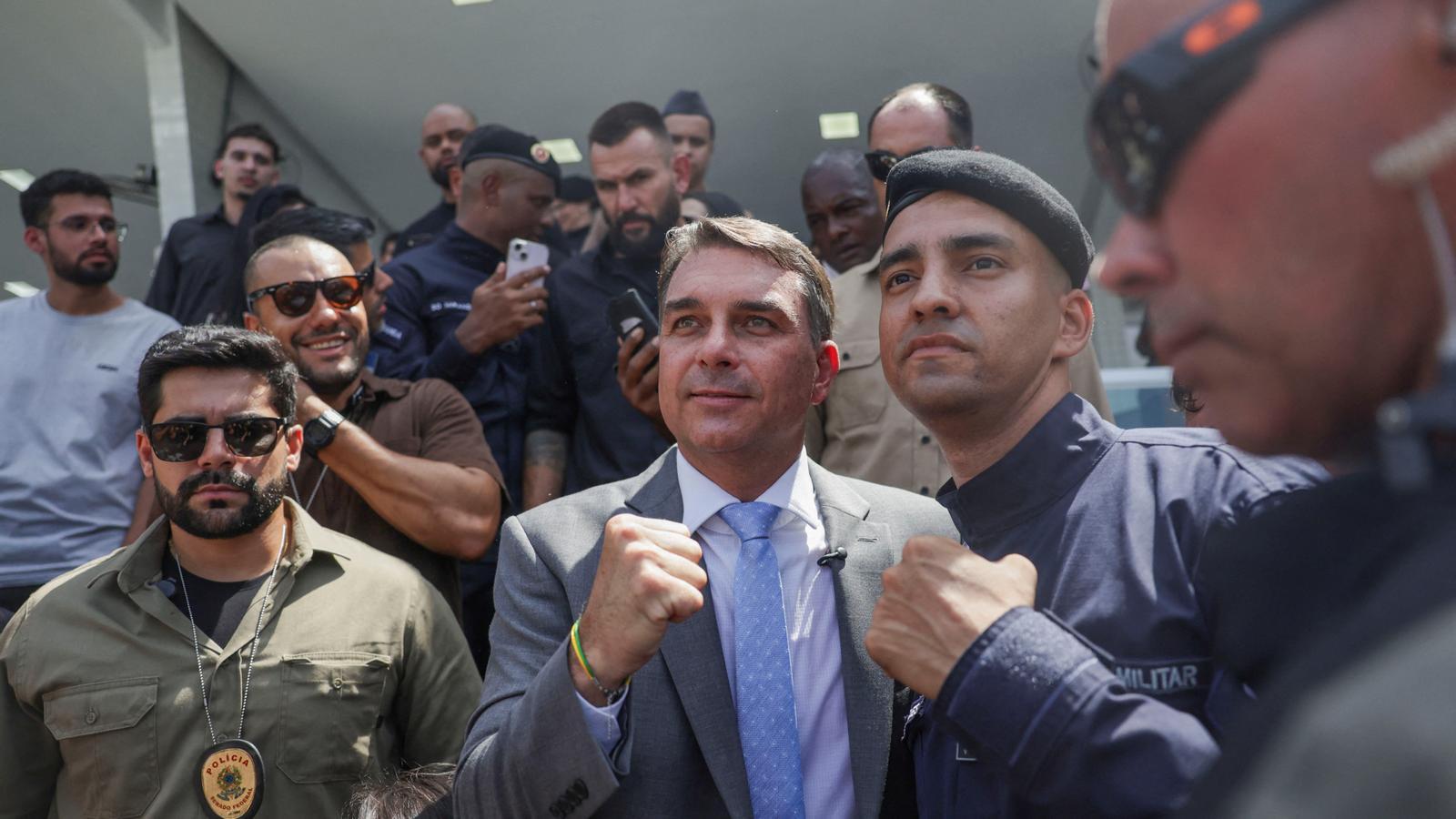
São PauloDonald Trump's government has entered fully into the Brazilian presidential race, which will hold its first round on Sunday, October 4th. The explicit support for the far-right candidate, Flávio Bolsonaro, has transformed into an electoral interference operation that has forced Lula da Silva, who is running for re-election, and his executive branch to take measures to protect themselves.
Brazil, due to its position as a regional leader and for being one of the last great bastions of the left on the continent, has become a priority for the Republican administration in the framework of the reinterpretation of the Monroe Doctrine, which defended “America for the Americans”. Now, Latin America, forgotten during the last decades by Washington, is once again a key zone of influence for the United States, which wants to exert direct and unilateral dominance there and integrate it into the national security and economic exploitation strategy, curbing Chinese commercial expansion.
In the case of the Brazilian elections, there is a coincidence of personal, business, and political interests between Trump and his Secretary of State, Marco Rubio, who, in some conflicts generated by the White House, has acted as a counterbalance to the president's impulsiveness and outbursts. In this case, however, it has not been so.
The two tariff hikes (tariff increases) applied by Trump, in July 2025 and July 2026, on a very significant contingent of Brazilian exports to the United States have made the South American giant one of the countries most affected by Washington's trade restrictions, despite the Yankee surplus in the trade balance between the two countries from 2009 until now. The measure, beyond its economic consequences, has a clear political background and involves interference in internal affairs, as demonstrated by the attempt to stop the “witch hunt” against former President Jair Bolsonaro, imprisoned for an attempted coup d'état.
Official documents from the Trump administration already demanded in October 2025 that the Brazilian presidential elections be “fair and free” and not limit the participation of “political dissidents,” which constituted a clear allusion to Jair Bolsonaro.
Marc Rubio takes the reins
Washington's alignment with the candidacy of Flávio Bolsonaro, who visited Trump at the White House in May, has occurred in parallel to an unprecedented diplomatic war between the two countries driven by the State Department. In August, Washington revoked the visa of the Brazilian ambassador to the United States, Maria Luiza Ribeiro Viotti, a career official, who has not been expelled but has been left in a precarious legal situation. If she leaves the country for any reason, she will not be able to re-enter.
Days earlier, the Brazilian executive had denied visas to two State Department officials after The Washington Post reported that they were traveling with the goal of questioning the integrity of the Brazilian electoral system, which is based on electronic ballot boxes, a hobbyhorse of Bolsonarism. For the Brazilian government, the visit had a political objective (they intended to meet with Flávio Bolsonaro, a leader of evangelical churches) and not a diplomatic one, and it sought to prepare the ground to not recognize a possible electoral victory for Lula, as Joe Biden did, quickly, in 2022, when the drums of a possible coup attempt were already sounding.
Marco Rubio is tightening the rope, poisoning all diplomatic channels between the two countries. During his visit to South America this September, in which he went through Ecuador, Colombia, and Peru, the Secretary of State intentionally excluded Brazil from the agenda, which he has described as a "non-friendly country".
Narcoterrorism and the example of Maduro
There is a full alignment between the Bolsonaro family's agenda and that of the Trump administration. Often, it is the Brazilian far-right that leads the way in pressuring Lula da Silva from Washington. This occurred during the tarifaço of 2026, in which former deputy Eduardo Bolsonaro, a refugee in Texas, played a prominent role, and in the designation by the U.S. government of the two main Brazilian criminal factions dedicated to drug trafficking, PCC (Primeiro Comando da Capital) and Comando Vermelho, as “terrorist organizations.” A measure criticized under their breath by the Brazilian executive to avoid giving electoral arguments to the far-right and being accused of alleged weakness in the face of violence and drug trafficking.

This legal instrument allows the United States to take coercive measures against the collaborators of both organizations, including financial and asset restrictions, which could extend to the Brazilian financial market, one of the targets of large North American tech companies due to the role played there by PIX, the automatic and free payment system established by the Central Bank.
In practice, the left fears that the designation could serve as an alibi for potential illegal United States military operations in Brazilian territory. The precedent invoked is that of Nicolás Maduro and his extraction to the United States, after Washington accused him of leading the Cartel of the Suns, although later the Trump administration dropped the charges when the former Venezuelan president was already detained in a federal prison in Brooklyn.
