The rescuers of Zaporizhzhia: searching for the bodies of the victims under the threat of dying from a Russian drone
A Russian attack against an aid center in this Ukrainian province caused more than 50 deaths almost two weeks ago
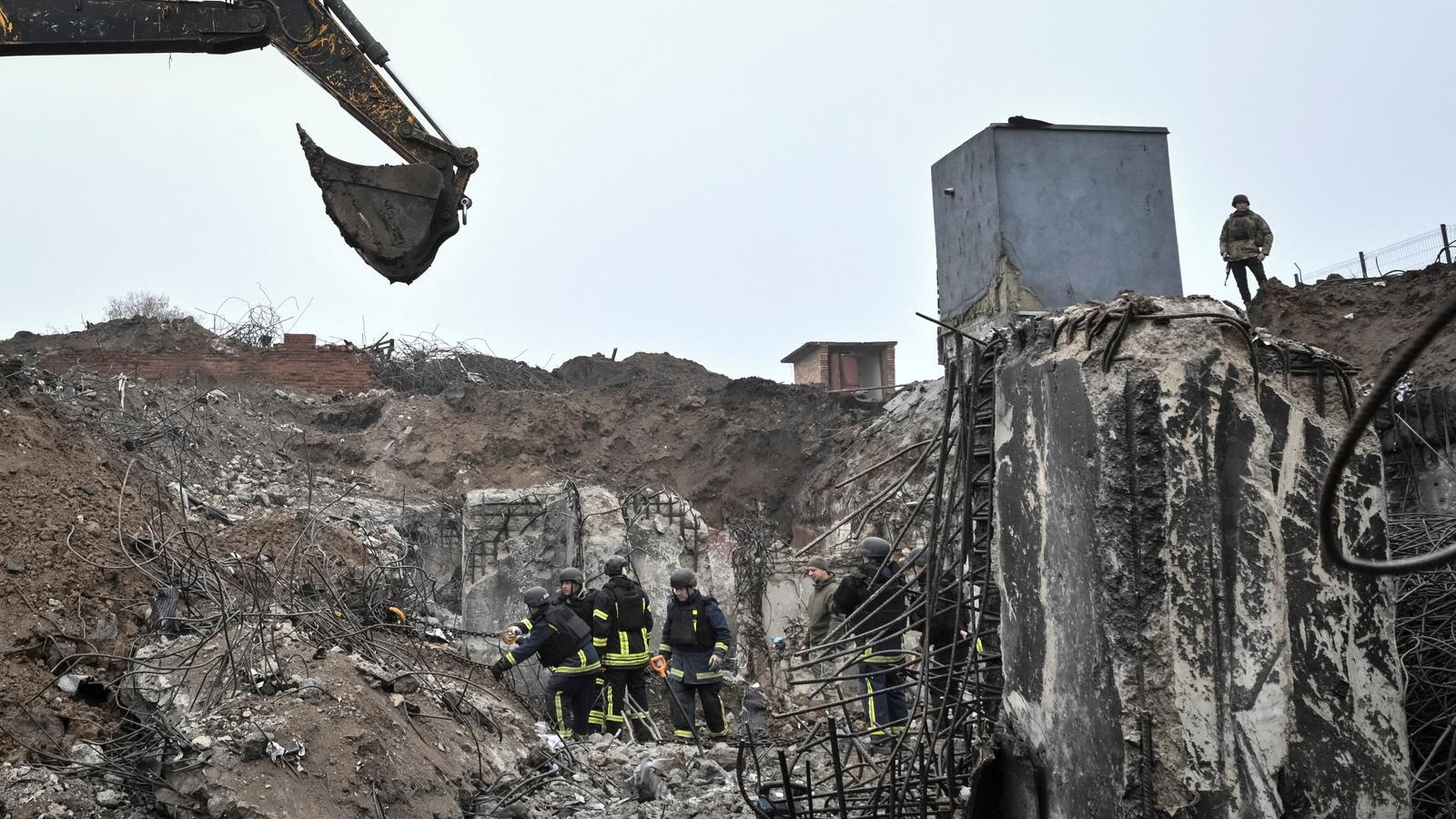
Zaporizhzhia (Ukraine)“We only have two minutes to hide when we receive the warning that a glide bomb is coming,” says Dragon, a Ukrainian operator who drives an excavator and works twelve-hour shifts in a row to recover bodies from a destroyed underground shelter in the village of Komyshuvakha, in northwestern Ukraine, where on November 2nd Russia launched a series of airstrikes that left 55 dead and 19 missing. Emergency services have been working tirelessly for thirteen days in a large crater of concrete and iron just twelve kilometers from the front, and they must constantly stop due to the presence of Russian unmanned aerial vehicles that harass them during rescue efforts. “If it weren't for that, we would have finished in just three days, but sometimes we have to run to a shelter that we have two hundred meters away,” declares Dragon, who in a single day has extracted four corpses.
Komyshuvakha, a small town in the Zaporizhzhia region, located in the so-called killer zone (killer zone) due to the range of drones, is now synonymous with one of the worst atrocities committed in the war in Ukraine. “Every Monday, at ten in the morning, everyone in the village usually went to pick up food or to be seen by doctors. There are only about one hundred and fifty residents left here, mostly elderly people,” explains Vlad Makovsky, a volunteer experienced in evacuations. According to witnesses, first fell guided bombs known as KABs, of about 250 kilograms, and when the residents sought refuge in an underground school that served as a humanitarian point, they launched a three-thousand-kilogram one that buried dozens of people under concrete blocks and killed paramedics and police officers who had come to aid the victims of the first explosions.
“I had never seen such destruction, everything was burning and there were victims there whom I knew personally: agents with whom we had carried out evacuations and social workers who helped people with disabilities. That same day I transported eleven lifeless bodies to the morgue, and an elderly woman who survived and whom we kept waking up throughout the journey so she would not fall asleep,” relates Makovski, who combines volunteering with his trade as a locksmith and an evangelical pastor. Just a month ago, an FPV drone hit his vehicle during an operation in Novotavriske. “It is not an isolated case that they attack evacuation teams or rescuers; they want to intimidate the civilian population by attacking us and destroying basic infrastructure. In fact, we can only endure the silence of the pain by continuing with our work,” he laments.
Schools underground
Inaugurated in 2025 with international funds and the state budget, the underground school in Komyshuvakha had not had students since January and was being used as a humanitarian center and dormitory for the few inhabitants of the town, who spent the night there due to the risk of night-time bombings. “In the city of Zaporizhzhia – where half a million residents live on the banks of the Dnieper River – we have about nineteen schools of this kind and, in the region as a whole, about twenty-five. Following this offensive, families suffer from the anxiety of not knowing whether they should take their children to these centers,” points out Serhiy Sidorov, from the Zaporizhzhia Research Center. Sidorov details that the educational facility was built at a depth of about three meters with protection from cement slabs eighty centimeters thick. “These structures can withstand 250 or 500-kilogram bombs, but not one of three thousand launched from a distance of one hundred kilometers, as was done from Tokmak, Ukrainian territory occupied by Russia”.
With a relatively stable front in the area, these types of actions seek to generate a psychological effect, to provoke shock, in the researcher's opinion. The same thing happened when, to the south of the city of Zaporizhzhia, anti-drone nets began to be installed due to the proximity of the grey zone – territory in dispute –, which is now located about seventeen kilometers away. During the last few weeks, Russian FPV drones have rammed urban buses in the center of the town and caused injuries. It is now common to see public transport drivers, such as marshrutkas, equipped with drone detectors. Despite all this, Sidorov remarks that the fact of having enabled underground spaces has contributed to the resumption of numerous activities and cultural events. The figure, however, is not comparable to those that existed in peacetime.
War crime
Dmitro Hladki is a lawyer investigating war crimes in Ukraine for the International Bar Association (IBA), created in 1947 in the United Kingdom. On the way to Komyshuvakha, on a journey along a road covered with nets and devoid of cars, he records with his phone the withered and blackened sunflower fields, just like the vehicles and large harvesting machines that lie on the roadside, scorched by projectile impacts. “Before the war, I dedicated myself to representing farmers,” he comments. Now, Hladki has documented Russian offensives against civilians with five thousand photographs and videos. He uses an encrypted application that verifies the geolocation, time, and date of the image, as well as certifying that it has not been generated by artificial intelligence.
“In Komyshuvakha, Russian reconnaissance drones arrive. They saw in real time that there were civilians, so it was a very precise bombardment and it must be classified as a war crime. The most devastating thing this region has experienced,” asserts Hladki. “Attacking medical personnel and rescue workers constitutes another distinct war crime, and we have many episodes of this kind in the country,” he adds. According to reports from entities working in transnational justice such as the IBA, and which take as a reference their investigators on the ground and the Office of the Prosecutor General of Ukraine, the war crimes registered in the country grew by 113% between May 2024 and October 2026, going from 129,000 to 275,000 files, with a peak of nearly 270 daily cases in the last six months.
“In the offensive against the humanitarian point, between eight and ten guided bombs of various dimensions were used. The victims went to take shelter, but it was a trap.” Dmitro asks and answers at the same time: “What are the Russians trying to demonstrate with this action? What do they want to say to their population, to the Ukrainians, and to the whole world? They knew perfectly well that the aid distribution took place from ten to eleven in the morning. What is the message? I have seen their propaganda channels and they only claim that it was a military target. Probably, they just want us to understand that they can kill civilians and go unpunished,” he laments.
