Will Netanyahu fall? Guide to not getting lost in the negotiations to form a government in Israel
All scenarios open, after former general Eisenkot has received the difficult task of assembling a viable executive
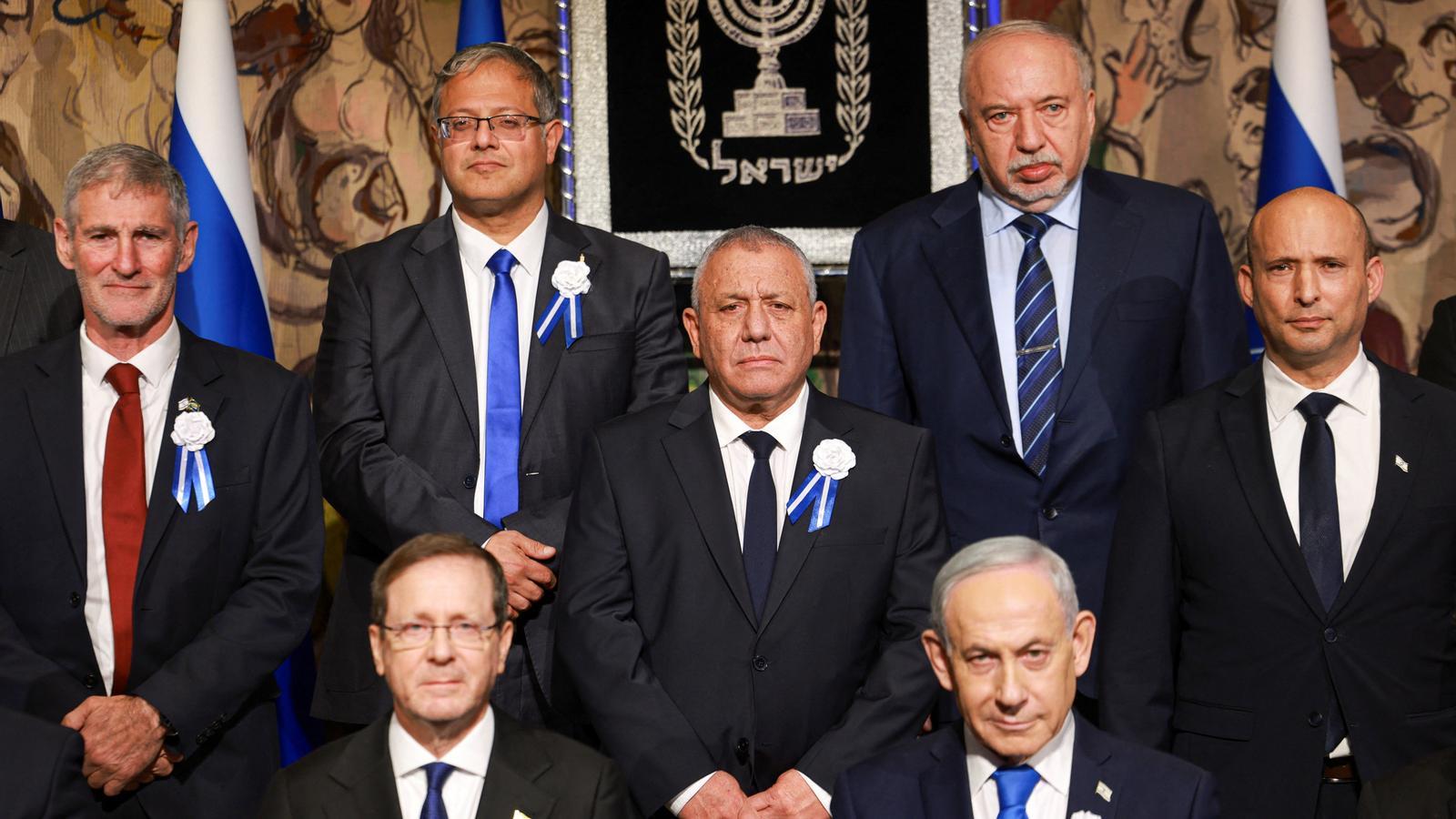

BarcelonaThe former general Gadi Eisenkot has been tasked with forming a government in Israel, after Prime Minister Benjamin Netanyahu lost his parliamentary majority in last month's elections. On the table is the opportunity for a change in the political cycle –the Likud has been in power almost uninterruptedly for the last quarter-century–, but the path is by no means easy. Eisenkot is trying to assemble an alternative governing coalition that can have the endorsement of the majority of the members of the new Israeli Parliament, the Knesset, which was constituted on Tuesday. The game of alliances is underway and the obstacles to ending the Netanyahu era are not few: Eisenkot must achieve consensus among a series of parties with very different policies, interests, and priorities to reach this figure.

“The situation is confusing because the parties in the opposition bloc are not necessarily working together; they have different interests and different priorities. Everyone wants their piece of the pie,” explains Mairav Zonszein, Israel researcher for the International Crisis Group, to ARA. “But it is becoming increasingly clear that if they do not reach an agreement, the only alternative is to return power to Netanyahu, and it seems they are determined not to do so,” she adds.
What was the result of the elections?
In the October 27th elections, neither the governing bloc nor the opposition bloc achieved the 61 seats out of the 120 that make up Parliament to guarantee the investiture. Netanyahu's bloc –the conservative Likud, with its far-right and ultra-Orthodox allies– obtained 53 deputies. And the opposition bloc, led by Eisenkot –which ranges from the left-wing Democrats to the right-wing secular pro-settler parties–, was left with 48. The two lists representing Palestinians with Israeli citizenship, who are those living in the territory of Israel –those in Gaza and the West Bank, which are territories under military occupation, cannot vote– obtained 19, thanks to a record turnout of this minority, traditionally abstentionist.
What are the possible scenarios?
To form a government, parties must negotiate alliances that ensure they win the Knesset's vote of confidence. On paper, Netanyahu has lost his parliamentary majority, but in Israel nothing is simple. The opposition does not have a majority on its own either and must lean towards alliances. And the result forces it to renounce one of its three electoral promises: removing Netanyahu from the government, not making deals with Arab parties, and eliminating the exemptions for ultra-Orthodox in mandatory military service.
Can a government be invested without Netanyahu?
A government can be invested with an absolute majority of 61 seats or more, but also with a simple majority and the abstention of some groups. The Arab parties have no intention of voting for a Netanyahu government, but Eisenkot’s coalition does not want to appear as the winner thanks to their support. Therefore, the option that now seems most viable is the formation of a minority government with the external support of these parties.
“Eisenkot has enough just by presenting a government coalition with the opposition bloc to Parliament: at the time of the vote, he would have a very comfortable majority of 67 votes, without the Arab parties being part of the government,” explains Israeli political scientist Yaniv Roznai to ARA. It would be the first scenario: the formation of a minority government that would depend on the support of the Arab parties in Parliament. “This government could last, because even if the Arab parties disagreed with the government’s decisions on Gaza or Iran... what could they do, vote with Netanyahu? There would be no alternative majority either,” he argues.
In fact, Eisenkot would have enough with the 8 deputies of the United Arab List (Ra’am), the conservative Arab party, which already participated in the government coalition that ousted Netanyahu for eighteen months in 2021, in the midst of the pandemic. The number two of the United Arab List is Yoav Segalovitz, a former Jewish deputy who had been Deputy Minister of National Security.
Eisenkot could also form a minority government by incorporating the ultra-Orthodox United Torah Judaism party, which has seven deputies and had supported Netanyahu, but is now negotiating with Avigdor Lieberman, the most right-wing representative of the opposition coalition. This is another thorny point because one of the great banners of the opposition has been to criticize the government for allowing students of religious Jewish schools to be exempt from military service. “It is unlikely that in the remaining weeks Eisenkot will be able to solve the problem of recruiting the ultra-Orthodox –opines Zonszein–. It is important that they have broken the Netanyahu bloc, but the prospect of reaching some kind of agreement with the Palestinian parties is much more important.”
What other options are there?
The second scenario is that Netanyahu manages to scrape together parties or deputies from the opposition coalition to switch to his side. To remain in power, he can seek the support of Naftali Bennett or Avigdor Lieberman, who are now part of the opposition coalition, but had previously worked with him. He only needs to convince them that it is better for them to join his bloc than to collaborate with the Palestinian parties, something both of them reject.
It is also possible that a unity government with Eisenkot will be formed, supported by a situation of national emergency. After knowing the electoral result, the acting prime minister tried to discredit it, accusing the Arab parties of manipulating the vote in the service of foreign interference. But once this strategy failed –the investigation came to nothing and all Israeli legal authorities have endorsed the result–, he has now become the champion of unity.
Displaying his racism, Netanyahu speaks only of the results among the Jewish population –neglecting the Arab vote–, whom he treats almost like a fifth column. And now that he has no alternative after having governed without consulting anything with the opposition all these years, Netanyahu advocates for national unity. “In a unity government, one could agree on a two-year rotation with Eisenkot as prime minister and two years with Netanyahu,” points out Roznai. The precedent is the agreement of fellow former general Benny Gantz, who had presented himself as a rival to Netanyahu and ended up reaching a coalition agreement with him in 2020, after Israel held three elections between April 2019 and March 2020. In the October elections, Gantz ended up withdrawing. “All the candidates who defended the unity government either withdrew or did not pass the 3% threshold to enter Parliament,” recalls the political scientist.
Can the elections be repeated?
The fourth option is an electoral repetition with Netanyahu in power. Now Eisenkot has until December 6th –he can request an automatic 14-day extension– to present his government and, if he does not succeed, the Israeli president, Isaac Herzog, will entrust the task to Netanyahu. If he is unable to form a government that has the support of the majority of the Parliament, Israel would be forced into new elections. It already happened in 2019-2020 and Netanyahu managed to pull it off.
“It would be a very good option for Netanyahu,” notes the political scientist. It is unlikely that the high turnout rate will be repeated, both among the Palestinian population with Israeli citizenship and among the Israelis who have left the country –about 70,000 returned to Israel to vote, because the external vote is limited to diplomats and mobilized soldiers–. An electoral repetition would further demobilize Palestinian voters, after seeing that their vote does not serve to change things, and probably also the opposition voters, disappointed by the inability of their leaders.
What can the opposition do with the parliamentary majority?
Before the formation of the government is resolved, the new parliamentary majority can already be set in motion. This Tuesday the speaker of Parliament will be voted on, and the opposition has already conspired to remove from office Amir Ohana, a man loyal to Netanyahu, willing to twist parliamentary rules in defense of the government. If they succeed, it will be a sign of cohesion for what is to come.
And with control of the chamber's agenda they will be able to form committees, undo the laws approved under Netanyahu's government that have divided the country –such as those that have diminished the independence of the judiciary– and, above all, launch the state commission of inquiry into the Palestinian attacks of October 7, 2023, which the Likud government has blocked. If this commission is opened and Netanyahu is officially investigated, it would be possible that he could not run in new elections.

