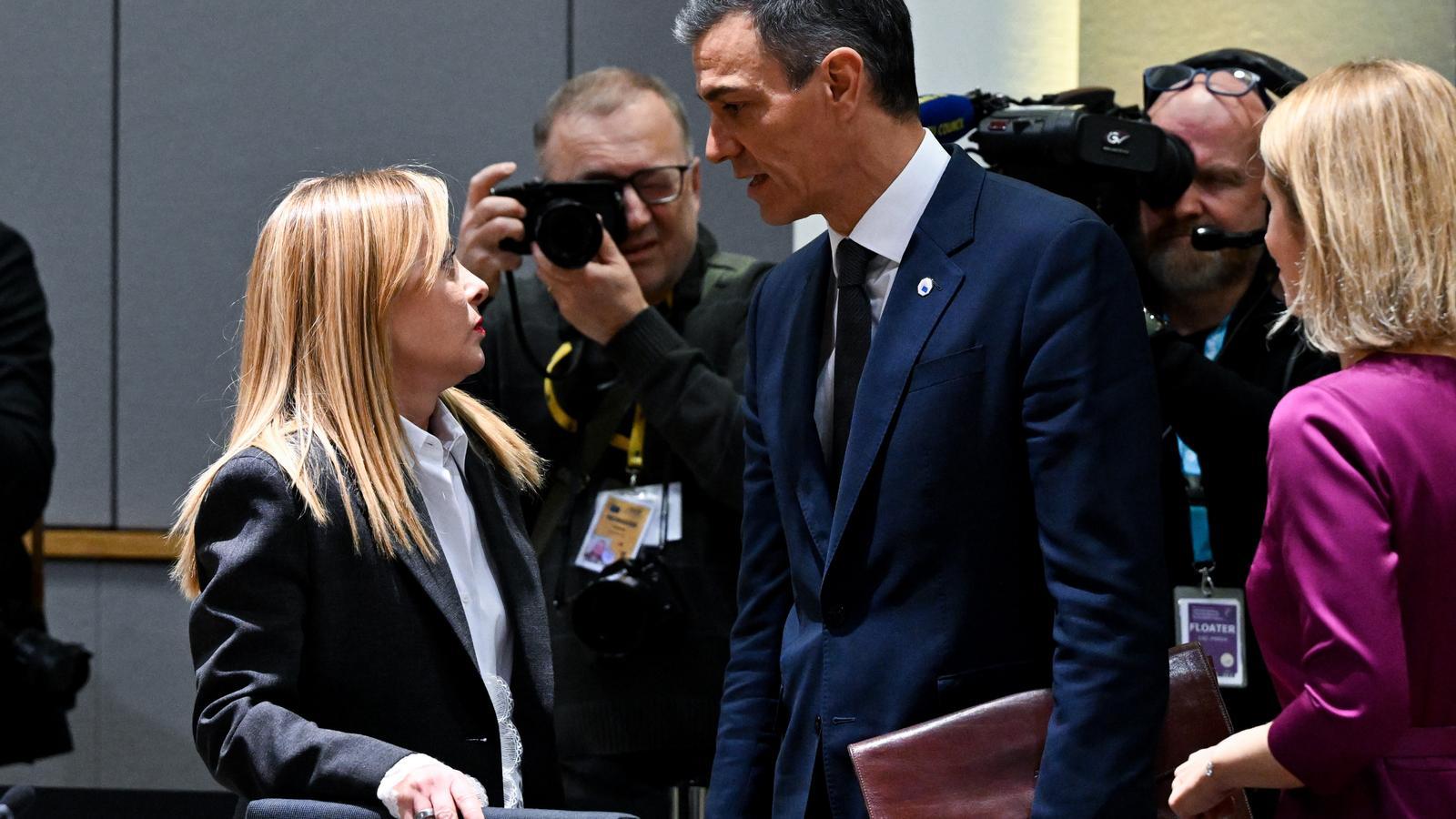
Sánchez, "prepared" for the duel with Meloni in the migratory debate
The leaders will try to unblock the debate on the EU budget at the leaders' summit

-
CAT -
CAST
BrusselsPedro Sánchez "arrives prepared" in Brussels to face the migration rebukes from his partners, including those from Italian Prime Minister Giorgia Meloni, according to diplomatic sources. This week's leaders' summit will be the first time the Spanish Prime Minister meets with the Italian Prime Minister since this summer's Ceuta crisis. At that time, the leader's response to the mass influx of immigrants opened the floodgates for a confrontation over migration. Italy suspended free movement with Spanish travelers –a measure replicated by the Spanish government– and initiated a spiral of confrontation that has served to assert its model of external border control.
Since then, the spiral has escalated. Spain has become the preferred target of states that wanted to draw a hard line on immigration. The executive's management of the crisis has earned Sánchez reproaches from twenty-three of the twenty-seven partners, who in a letter in August reproached him, among other things, that the mass regularization he had promoted had generated a "pull effect". But Sánchez plans to defend himself against the darts thrown at him by citing Spain's positive data, such as a 74% drop in arrivals on the Atlantic route, which Madrid attributes to cooperation with Mauritania and Senegal.
How to reinforce European borders in crisis situations like the one in Ceuta will be precisely one of the hottest points of debate. The President of the European Commission, Ursula von der Leyen, sent a letter to the leaders on Tuesday in which she cited the Ceuta crisis as an example of how "sudden and massive arrivals can put pressure on the EU's external borders" and proposed the creation of a Rapid Reaction Force to be deployed in crisis situations, among other proposals to reinforce the Frontex corps.
On the migration front, a group of countries led by Greece, Germany, or Austria is betting on a mechanism to suspend the right to asylum in emergency contexts, a proposal not very different from the one made by the European Commission, which is preparing a legislative framework to provide legal coverage for emergency returns.
Budget blockade
But if there is one issue that will mark the summit, it will be the next European Union budget from 2028 to 2034, which affects all areas of community policy. And it also has a component of urgency due to the electoral cycle approaching in Spain, France, Italy, or Poland. Leaders are negotiating against the clock to reach an agreement before the end of the year to prevent the ones who decide the course of community funding from eventually being Marine Le Pen or Santiago Abascal.
This week, Ireland, which holds the rotating presidency of the EU, presented a budget proposal that reduced the community budget by more than 7%. And its accounts have not convinced anyone. Both the Commission and the Parliament and the states have rejected them. The "frugals" demand even more austerity and the southern and eastern countries find the figure insufficient. Nor are there any agreements on which new revenue tools the EU should implement.
On the international stage, the debate will be marked by the increasingly frequent interference from Russia and Donald Trump's decision to lift the ban on Russian diesel. This turn by Washington caught European leaders by surprise and has exposed the shortcomings of their sanctions architecture. With Volodymyr Zelensky as the star guest, the EU will have to perform a balancing act to appease Kyiv and condemn Trump's action without further damaging the relationship with the United States.
On the other hand, on Thursday morning, the leaders will get down to business to remedy the increase in energy prices, triggered by the conflict in the Middle East. With inflation becoming increasingly strong, the leaders feel the pressure to provide relief to households and industries, especially as the cold approaches and the heating season begins. While Greece and Italy are asking for fiscal flexibility to cushion the energy crisis, states like Spain and Germany want to tax energy company profits.
The trade confrontation with China will also have a certain prominence. Despite Beijing's concessions on hybrid cars –which allow keeping a line of dialogue open–, the EU does not close the door to more forceful measures. Germany and France, for example, proposed an emergency instrument to cut off China's access to the EU market if the deficit continues to be unsustainable.
The main powers arrive at the meeting at a low point and, therefore, with a greater need to bring home a victory. The German Chancellor, Friedrich Merz, arrives weakened by the recent electoral victories of Alternative for Germany and with an open crisis in his party, and the French President, Emmanuel Macron, devastated by the student protests in France, while Sánchez arrives there after the calling of elections. A scenario of weakness that could further complicate decision-making in Brussels.
