The Ceuta crisis triggers an offensive in the EU to suspend the right of asylum in emergency contexts
The Spanish government remains alone voting against the regulation that allows the creation of migrant centers in third countries

-
CAT -
CAST
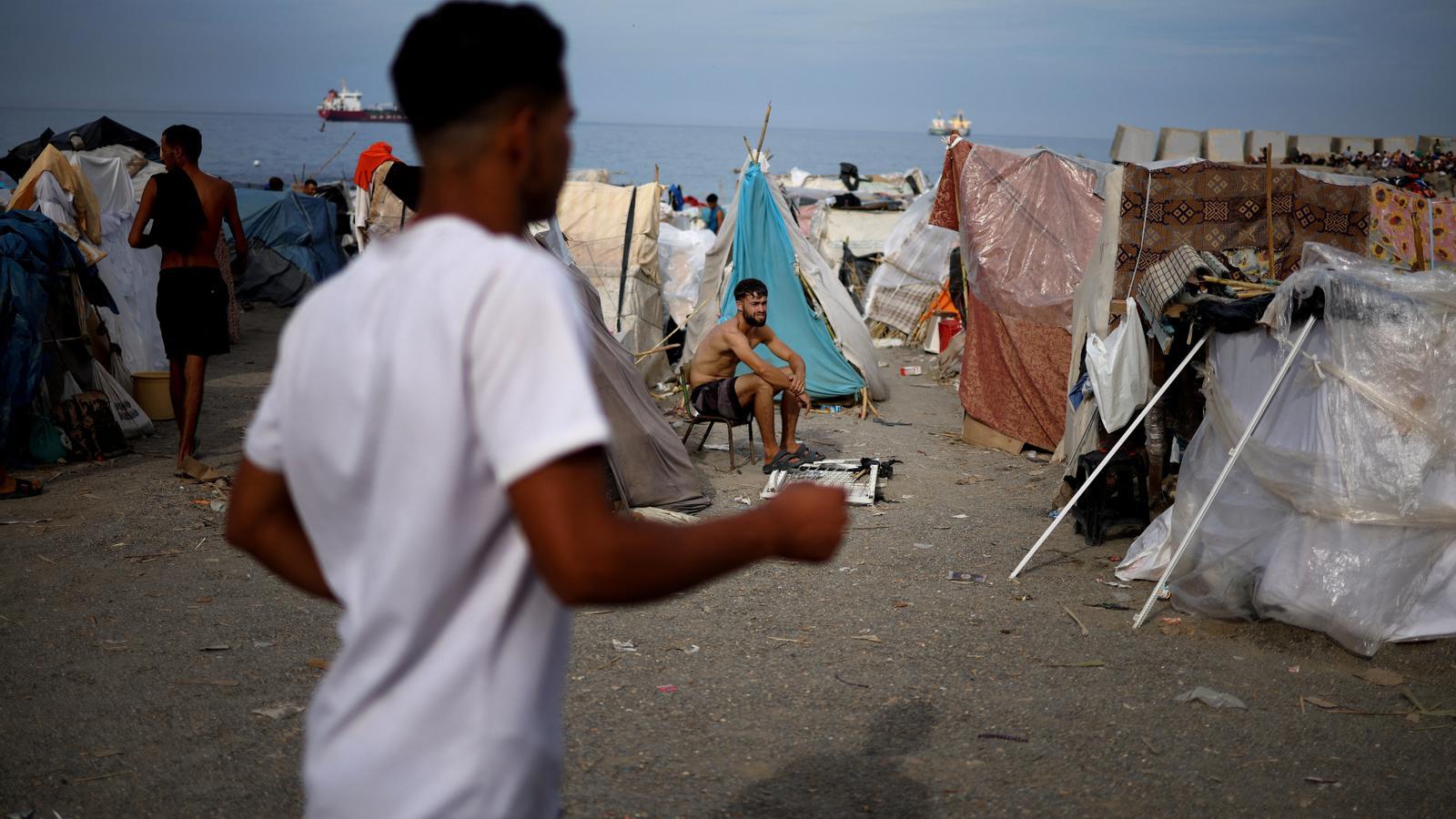
BrusselsNew offensive to restrict the right of asylum in the European Union. Several member states are pushing to suspend asylum applications in emergency situations. The mass entry of migrants into Ceuta this summer has served as a pretext for the most conservative sector of the bloc to put immigration in the spotlight and try to further tighten European migration law. Countries like Germany, Greece, and Austria have redoubled pressure on the EU Council in Luxembourg, where the EU interior ministers met this Thursday, so that "ordinary asylum procedures" can be suspended in exceptional situations such as the one they consider occurred in the autonomous city at the end of July.
"We must strengthen border surveillance and suspend the right of asylum," asserted the Greek Minister of the Interior, Thodoris Livanios, who cited as an example circumstances like those experienced by Greece in 2015 or Spain this summer with the Ceuta crisis. The proposal that the ministers will discuss aims to stop the evaluation of asylum applications on an individual basis in such contexts, which "have nothing to do with the classic asylum case," noted the Austrian minister of the sector, Gerhard Karner.
The request has the support of the European People's Party, the most represented in the European Parliament, which this week asked to suspend asylum procedures in cases of "hybrid attacks" in which migrants are instrumentalized, as—they point out—happened during the mass entry into Ceuta from Morocco. The approach aligns with the announcement made by the President of the European Commission, Ursula von der Leyen, of a plan to allow more flexibility in migration and asylum management procedures in these situations.
As detailed by the Commissioner for Home Affairs, Magnus Brunner, one of the pillars of the plan is to strengthen the mandate of Frontex, the European agency in charge of border control, and to increase the body's capacity to deploy in emergency situations. It also intends to improve early warning systems and the monitoring of migration routes and disinformation campaigns; as well as to intensify return operations and cooperation with third countries. Brunner assured this Thursday that the debate on restricting the right of asylum has been "initial" and has called on EU leaders to address the issue at the European Council summit on October 15.
Spain seeks to endorse hot returns
Spain arrives at the meeting eager to leave behind the recriminations over the migratory management of the Ceuta episode. La Moncloa does not support the proposal to restrict the right of asylum, but it does seek the endorsement of European partners for the "rejection at the border" mechanism, known as hot returns, according to Spanish diplomatic sources.
The European Court of Human Rights in Strasbourg endorsed the controversial policy of hot returns at the Melilla border in 2022. Conversely, judicial rulings by the Constitutional Court and the Supreme Court argued that for entries by sea or outside the border fences, the ordinary or emergency procedure must be applied, and they rejected these returns in cases where the person is deprived of the possibility of claiming vulnerability.
Regulation approved to deport to third countries
On the other hand, during the ministers' meeting, the new regulation that allows the deportation of migrants to third countries and accelerates the expulsion of people in an irregular situation. The Spanish government, represented in Luxembourg by Minister Fernando Grande-Marlaska, was the only one to vote against it. The vote on the regulation, which was approved without Madrid's support and with the abstentions of Ireland, Denmark, and Belgium, once again highlights the isolation of Pedro Sánchez's executive on migration issues within the community bloc.
During his speech, Marlaska defended the "effectiveness of Spain's migration management" and argued that entries through Ceuta represent only "0.7% of the total" irregular arrivals, while the Atlantic and Western Mediterranean routes account for 17%. "The lack of solidarity weakens and fragments the EU," lamented the Spanish Interior Minister in a clear reproach to his counterparts.
The isolation became especially evident at the beginning of August when a group of 22 countries (led by Italy, Denmark, Germany, and the Netherlands) sent a letter addressed to the leadership of the European institutions to demand a common EU response to the border situation in Ceuta. They argued that the mass regularization process promoted by Spain was a "pull factor" for the migration crisis in Ceuta.
